The narrator–Watchman interrogation relationship
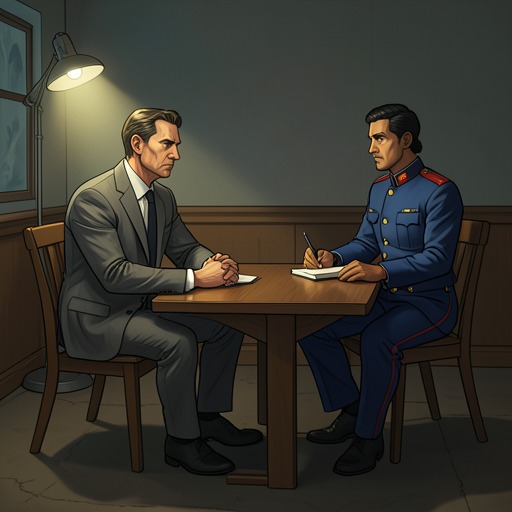
The SympathizerThe narrator–Watchman interrogation relationship is a contest in which professional roles repeatedly give way to personal recognition and antagonism. Assigned by Claude to break The Watchman as the graduation test for his interrogation course, the narrator encounters a prisoner who understands the coercion behind his treatment and turns the interrogator’s own assumptions back on him. Their exchanges culminate not in a recorded confession or a demonstrated surrender, but in the narrator’s calculated attempt to make The Watchman’s family and revolutionary commitments into instruments of pressure.
Assignment and conditions
Claude assigns the narrator the task of breaking The Watchman, making the interrogation both a test of the prisoner and the narrator’s final examination in the course. The Watchman is kept alone for a week before the narrator enters his room. Constant light and a loop of Hank Williams’s Hey, Good Lookin’ define the confinement; food arrives through a door slot only three times a day, in specified portions of rice, greens, meat, and water. The narrator watches him on a video feed as he eats, washes from a bucket, exercises, paces, and lies on his bed. When The Watchman plugs his ears, the narrator turns up the music, with Claude beside him. The arrangement makes the narrator’s authority concrete: even the volume of the song depends on his decision, while Claude monitors both prisoner and interrogator.
The song is not an arbitrary soundtrack. The narrator has chosen country music for its association, in his view, with white American culture and racial exclusion. He intends the loop as psychological pressure, but The Watchman refuses the response the treatment is designed to elicit. When he finally meets the narrator, he greets him by echoing the song’s title and says in English that he loves it. The narrator recognizes the claim as a taunt, not evidence that the week’s isolation has worked. Their first exchange therefore establishes the central imbalance: the narrator controls the room, but The Watchman can still control the meaning of what happens inside it.
Recognition beneath the roles
The Watchman is a small, shivering man with coarse black hair, and he meets the narrator with amusement rather than visible fear. He is a philosophy graduate of the University of Saigon and the eldest son of a respectable Catholic family that has disowned him because of his revolutionary activities. Before becoming a revolutionary, he supported himself through legitimate watchmaking. These details give the narrator a person to address beneath the official category of prisoner, even as the two remain acutely aware of their assigned positions. The narrator knows Claude is watching on the video monitor and is grateful for the air-conditioning because, without it, he would be sweating as he tried to be both enemy and friend.
When the narrator lays out charges of subversion, conspiracy, and murder, he invokes the American presumption of innocence. The Watchman laughs at that claim and argues that war and American conduct show the opposite: people, especially Vietnamese people treated as suspects, are regarded as guilty first. He identifies a contradiction between religious belief in humanity’s sinfulness and secular professions of legal innocence, then argues that Americans preserve their sense of innocence even after losing it. In his account, people who insist they are innocent can regard anything they do as just, while those who acknowledge guilt know the darkness they may commit.
The narrator is impressed by this reading of American culture but conceals that response behind another question. The Watchman sees through the maneuver and says that the narrator’s superiors already regard him as guilty; he then attacks the narrator as a bastard and a defective hybrid. The narrator later judges that The Watchman was not necessarily trying to wound him, but that explanation does not undo the effect. In the white room, the insult makes him see red. What began as a controlled interrogation becomes a struggle in which the narrator wants to prove not merely that he can extract information, but that he is smarter than The Watchman. He reduces their positions to a contest in which one must be master and the other slave.
The invented confession
After his anger cools, the narrator identifies the vulnerability he thinks lies inside The Watchman’s strength. The prisoner has left his family for the revolution, sacrificing a bond that, in the narrator’s understanding, carries particular weight for both Vietnamese and Catholic identity. The narrator decides to attack that sacrifice by writing a confession for him rather than continuing to ask questions that lead nowhere. His tactic converts knowledge of The Watchman’s loyalties into a means of coercion: the confession claims that he joined the revolution because of love for a man and betrayed it to save that lover, who has supposedly been captured.
The Watchman reads the document in disbelief, then reads it again before confronting the narrator. He rejects its central claim and objects that the narrator is fabricating a homosexual identity and a motive that would stain his philosophical commitments and revolutionary activity. The distinction matters: the confession is the narrator’s scenario, not an admission by The Watchman, and the evidence does not establish that its allegations are true. The narrator has created a weapon out of a lie he expects to be socially damaging.
He then makes the threat explicit. If the confession is published alongside the supposed lover’s confession and intimate photographs, he warns, The Watchman will be condemned not only by revolutionary comrades but also by his family. The narrator invokes the possibility of hypnosis and drugs to answer The Watchman’s insistence that no such photograph can be obtained, and presents cooperation as the only way to keep the confession unpublished and his reputation intact until the war ends. The tactic presses on both the revolutionary identity that brought The Watchman into conflict with his family and the family connection that his departure has already put at risk. The scene ends with The Watchman staring at the confession and saying nothing; it does not show whether he accepts the narrator’s terms.
Coercion and the limits of mastery
The relationship turns on the narrator’s ability to understand The Watchman and his choice to use that understanding against him. He recognizes the prisoner’s intelligence, knows the music has not subdued him, and sees how family estrangement gives revolutionary sacrifice its force. Yet this insight does not lead to solidarity. In the moment of wounded pride, the narrator wants mastery; in the written confession, he turns psychological insight into a threat against The Watchman’s standing with both comrades and family. His capacity to imagine the prisoner’s vulnerabilities is inseparable from his capacity to exploit them.
The narrator’s later recollection of the interrogation of The Communist Agent offers a wider, distinct context for his role in this system of questioning. In that episode, he watches police sexually assault a prisoner while Claude and the crapulent major are present; he objects that the abuse is wrong and asks for time alone with her, but remains in the room as the assault proceeds. This is not an episode involving The Watchman, and it does not establish what happened after the narrator’s invented confession. It does, however, place his attempt to break The Watchman within a broader record of interrogation in which stated limits, personal qualms, and participation coexist. The relationship’s unresolved ending preserves that contradiction: the narrator has made himself The Watchman’s adversary, but his account also shows how closely that adversary depends on the ability to recognize the person he is trying to break.