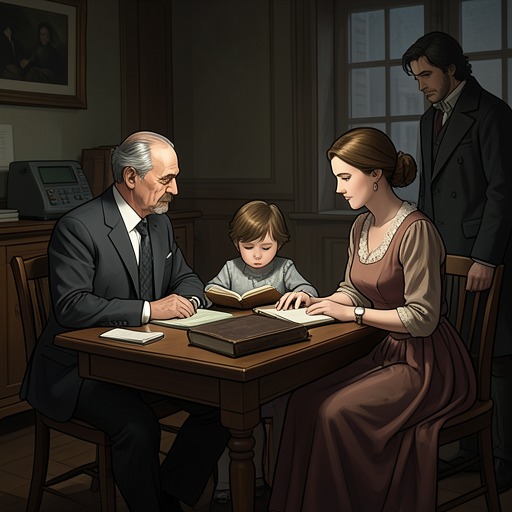
The narrator’s father-son relationship with his biological father, a priest
The SympathizerThe narrator’s father-son relationship with his biological father, a priest, begins as a hidden contradiction: the man who teaches the narrator Catholic doctrine is also the father whose identity the child longs to know. The revelation does not bring them together. Instead, it alters the meaning of the narrator’s religious education and leaves him with a father who is present as teacher but absent as parent—a separation that continues to govern his fantasies of recognition, anger, and uncertain forgiveness.
Identity and an Unknowing Education
The Father is a priest who teaches classes for the children of the diocese. The unnamed narrator attends because his mother makes him go, learning the Bible, the history of his divine Father, the story of his Gallic forefathers, and the catechism of the Catholic Church. He is still a child, counting his years on the fingers of two hands, and does not understand that the priest at the front of the schoolroom is his own father. The man’s black cassock and religious authority belong, in the boy’s understanding, to the public world of church and doctrine; his paternity remains concealed within the family’s private life.
That division makes the eventual knowledge more than a disclosure of biological identity. The Father has already helped form the narrator’s religious vocabulary before the narrator knows their personal connection. The catechism’s lesson on Original Sin acquires a particular force: the idea of an inherited sin becomes entangled with the question of what the narrator himself has inherited from a father who has not acknowledged him. Religious instruction, once apparently impersonal, is retrospectively bound to the secret that the teacher’s son cannot name.
Revelation and the Mother’s Account
The narrator learns the truth at eleven, after a classmate uses an animal comparison to mark him as an unnatural mixture. The insult makes his difference visible to the other children and leaves him seeing himself through their eyes as neither one thing nor another. He responds by beating the boy, then returns home in distress and confesses what happened to his mother. Her reassurance leads to a more consequential disclosure: she asks whether he is ready to know who his father is, presenting the knowledge as the end of childhood and the beginning of manhood.
The unnamed narrator’s mother identifies The Father and describes how she came to know him. She had been very young when she worked as his maid. He treated her kindly, taught her to read and count in his language when her parents could not afford to send her to school, and spent evenings telling her about France and his childhood. She remembers him as lonely, the only person of his kind in their village, while she felt herself the only one of hers. Her account presents their closeness through shared isolation as well as through the practical education he gave her. She then indicates that one night their relationship changed, but the narrator cannot bear to hear the story: he breaks away, covers his ears, and closes his eyes while his mother continues speaking.
His mother interprets his birth through faith. She tells him that God would not have permitted what happened between her and The Father without giving him a role in a larger plan, and urges him to understand himself as destined rather than unnatural. Her appeal to Christian teachings about the meek offers a counter-story to the classmate’s insult, but it does not erase the pain of learning that his father has been present in his life without being known as his father.
Recognition, Anger, and Distance
The unnamed narrator later imagines the acknowledgment he never received. He pictures The Father standing before his congregation and publicly identifying him as a son worthy of recognition and love. The fantasy exposes the distance between religious authority and private responsibility: the priest can teach a community’s children, yet the narrator wishes for something as modest as a visit, a meal together, and a secret use of the word son. The narrator describes none of these ordinary signs of kinship as having occurred. The relationship is therefore shaped not by remembered intimacy with his father, but by the contrast between the father’s formative presence in the classroom and his absence from the narrator’s family life.
That deprivation also gives his anger its imagined forms. The narrator recalls fantasies in which a lightning bolt, a mad elephant, a fatal disease, or an angel with a trumpet would remove The Father from the world. He distinguishes these scenarios from the more direct wish he eventually admits: he had also imagined killing his father with a gun. The sequence does not establish an attempt or an action; it reveals how the desire for acknowledgment has curdled into fantasies of punishment and disappearance. His resentment is inseparable from the longing beneath it, since the imagined death answers, in distorted form, the father’s failure to appear as a son’s father.
Forgiveness and the Unresolved Bond
As an adult, the narrator tells Lana about his father while discussing fantasies of killing. When she asks whether he has forgiven him, the narrator cannot give a settled answer. At times he thinks he has; at others, especially when he thinks of his mother, he believes he has not truly forgiven him. His response links the father-son injury to the mother’s experience, rather than treating forgiveness as a private decision between two men. The Father’s absence has consequences in the life he failed to share with his son and in the narrator’s continuing sense of what that absence meant for his mother.
The relationship thus remains unresolved even when its central facts are known. The narrator has the father’s name and the mother’s account of their history, but the evidence offers no reconciliation, acknowledgment, or later meeting. What persists is an uneasy inheritance: the priest who taught him the language of sin also becomes the focus of questions about guilt, legitimacy, and belonging. The narrator can imagine both forgiveness and violence, but neither image closes the distance between the father who instructed him and the father who never publicly claimed him.