The narrator’s sleep-deprivation interrogation state
The SympathizerThe narrator’s sleep-deprivation interrogation state is a prolonged ordeal in which restraint, sensory deprivation, hunger, and timed electrical stimulation make sleep itself the object of torture. The ordeal also becomes an enforced return to memories the narrator had lost or could not face, especially his presence at the sexual assault of a Communist agent. Its method exposes a central contradiction in the captors’ procedure: they describe their experiment as a way to make him know himself, while keeping him awake and powerless under conditions designed to break down his ability to understand or speak.
Confinement and Sensory Assault
The guards take the narrator from his cell, gag and blindfold him, and bring him to a room less than a hundred paces away. There they strip him and tie him spread-eagled to a mattress—a startling change after a year sleeping on planks. Foam covers his hands and feet; earplugs and heavy muffs shut out sound; a soft hood covers his head. The contrast between the mattress and the planks offers no comfort for long: once alone in the dark, he sweats beneath the hood, panics against his restraints, and cannot tell whether anyone is watching him. His gag and the guards’ control of his senses leave him unable even to call out or establish how much time has passed.
The Mechanics of Wakefulness
As hunger and isolation deepen, the narrator’s attention fixes on the foot that repeatedly nudges him whenever he is close to sleep. It presses against his thigh, hip, shoulder, and forehead, turning an ordinary bodily touch into the sole reliable measure of passing time. Hands occasionally lift his hood, loosen his gag, and give him water, but he can manage only a word or two before being silenced again. He comes to imagine the foot as judge, guard, and executioner: his desperate appeal to it expands into a meditation on how feet carry humanity across the world while remaining neglected. The comic extravagance of that address does not soften the ordeal; it shows how sleep deprivation redirects thought toward whatever small sensation remains available.
Hunger brings back an earlier scene with his mother, who used to give him three-quarters of a meal and keep only a quarter for herself. Each insists on not being hungry, until her love prevails and he eats her portion, taking in love and anger with the food. The memory leads him back to a lesson from Man’s study group: sympathy cannot by itself make the rich share or the powerful surrender power, and revolution seeks change at the level of classes and collectivities rather than guaranteeing freedom to individuals. In the examination room, that distinction becomes painfully immediate. The narrator has pursued history and its laws, yet now fears that imprisonment will be his own fate; the enforced wakefulness that is meant to make him confront himself also threatens to destroy him.
When the hood and gag are finally removed, the narrator is met not with relief but with an array of lightbulbs in a white examination room roughly three meters by five. A doctor explains the experiment as a means of helping the patient observe his own mind by seeing himself as someone else. Its apparatus joins a Soviet-provided serum, intended to compel truth, to an American military field telephone modified so that its crank will not deliver painful shocks. Instead, a wire runs from the telephone satchel to the narrator’s toe, and a wristwatch triggers a brief spark whenever its second hand crosses twelve. The doctor insists that the procedure is not torture and that the electrical stimulus is only enough to keep the patient awake. The watch gives the deprivation a mechanical rhythm, converting time from an abstraction into a recurring shock and making the captors’ professed experiment in self-knowledge inseparable from coercive control.
The Lost Memory and Its Return
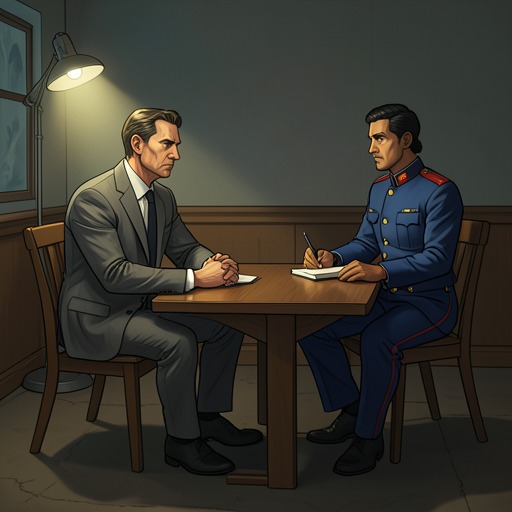
The enforced wakefulness eventually opens onto the memory the narrator had buried: an interrogation in a room the police called a movie theater when foreigners visited, though it was used for interrogations otherwise. The narrator had been there with Claude and the crapulent major when The Communist Agent was brought in, naked and restrained, after being caught with a list of police names she had tried to swallow. The narrator recognized that his own name was on the list and knew that she was Man’s courier, while she did not know his identity. In the present examination, questions about the room and the people in it make the scene return piece by piece, converting the earlier blank in his memory into evidence of what he witnessed.
The narrator recalls protesting that the treatment was wrong and asking the crapulent major for time alone with The Communist Agent. The major, responsible to the General for learning how she obtained the names, did not intervene; Claude likewise remained present as an adviser. The three policemen raped her while the narrator watched. As they took turns, the narrator’s view was repeatedly obstructed, until the oldest policeman left her face visible and she stared toward him, though her pain seemed to make him invisible to her. His soda grew warm in his hand; he neither drank it nor stopped the assault. His remembered objection and his inaction therefore remain side by side, without turning his presence into rescue.
Afterward, the policemen poured soda into a bottle and inserted it into The Communist Agent’s body, treating the act as a joke. They then splashed water over her and the table, mopped the floor, and left her silent and motionless. Claude distanced himself from the bottle’s use, saying he had not taught the policemen that method, even as his earlier presence and advisory role remained part of the scene. The narrator’s recovered memory includes the bottle, the cleanup, the warm soda, and the men’s casual conduct: details that make the violence difficult to reduce to an abstract report of interrogation. Under the later questioning, the memory returns not as a coherent confession at first but as an accumulation of objects, questions, and answers that exposes both the policemen’s brutality and the narrator’s compromised witness.
Recorded Screams and the Collapse of Time
The examination continues through a recording of a baby screaming. At first the narrator experiences the sound as immediate suffering in the room; when it stops, he recognizes that it is a tape, but the recognition brings no relief. The next click makes his body brace for the scream again, while the timed electrical snap at his toe and the unceasing light keep his senses under assault. Clock time gives way to a loop: time seems to repeat like a cassette, and the recording makes the captors’ claim to control wakefulness feel like a claim to control history itself. The narrator’s plea for silence marks a change in what he wants most: sleep is no longer the only respite he seeks.
The repeated scream also draws the narrator into a memory of his own beginning. He wonders whether he screamed as an infant and asks forgiveness of The narrator’s mother, then imagines his conception as an invasion of her body by The narrator’s father. The sequence links the helplessness of the recorded baby to the narrator’s own origin and divided inheritance, without making the recording a literal memory of infancy. Under enforced wakefulness, recollection and speculation converge: the examination produces neither a calm, detached self-observer nor a simple, orderly confession, but a consciousness pulled between present sensation, buried experience, and the unanswered question of who he is.