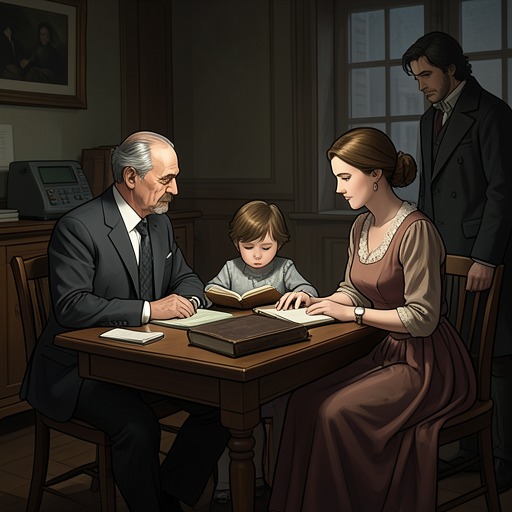
The narrator's father is assassinated
The SympathizerThe narrator's father is assassinated by a bullet to the head, and the later disclosure that the killing was arranged by The Communist Agent turns a remembered family loss into a reckoning over responsibility. The narrator had once written to Man, “I wish he were dead”; during his interrogation, that sentence is treated not as an empty expression of anger but as a request addressed to a trusted revolutionary.
Death and Its Belated Revelation
The death first returns through the narrator’s memory of carrying the severed leg of a dead lieutenant. Its weight summons the image of his father’s coffin and the punishment of holding a Bible out at arm’s length in a classroom. The memory shifts to the call from his father’s deacon at police headquarters: the narrator initially says he has no time to attend the funeral, but the deacon reminds him that father and son mattered to one another. The funeral Mass lasted two hours, a measure that later shadows the narrator’s forced march before the lieutenant is buried. Only during his interrogation does the narrator learn that his father died from a bullet to the head, listening to the assassin’s confession, and that The Communist Agent arranged the killing.
The Words Behind the Killing
During the final interrogation, the narrator is confronted with the sentence he had written to Man: “I wish he were dead.” He insists that he did not mean for Man to act on it, but recognizes the force of the person to whom he wrote: a revolutionary on a powerful committee, a political cadre, a friend who would do what he asked, and a brother who understood his wishes. The revelation makes the sentence more than an expression of anger. The narrator had entrusted it to someone with the power to turn words into action, and The Communist Agent arranged his father’s death.
The interrogation does not settle the narrator’s responsibility so much as sharpen its contradictions. The Commandant regards the father as a colonial priest who served a religion that had justified the sacrifice of millions, and considers his death a just sentence. The narrator, meanwhile, distinguishes wanting his father dead from intending that he be killed, even as he must confront the possibility that his written wish helped set the killing in motion. The assassination thus binds private resentment to revolutionary action: the narrator’s words acquire consequences through Man, while the later questioning makes him answer for a desire whose meaning he had not fully faced.
The Agent and the Interrogation
The later disclosure about the killing emerges within the narrator’s recovered memory of the “movie theater,” a room used for interrogations when foreign visitors were absent. The Communist Agent had been caught with a list of policemen’s names concealed in her mouth; the narrator’s own name was on it, and he knew that she was Man’s courier, though he believed she did not know his true identity. He had passed the list to Man. During the interrogation, The Commandant’s men subjected the agent to sexual violence while the narrator watched beside Claude, protesting that it was wrong but failing to stop it. Only much later, under questioning, does the narrator learn that this same agent arranged his father’s death. The revelation places the assassination inside a larger chain of clandestine exchange, coercion, and inaction: the agent carried a list that implicated the narrator, while he had already entrusted his father’s fate to a sentence sent to Man.
The Killing Beside the Official Record
The recollection of the narrator’s father’s death is set beside a classified investigation on the narrator’s desk at police headquarters, concerning an American platoon’s 1968 attack on a mostly abandoned village near Quang Ngai. The report’s language called the operation pacification, while the testimony described soldiers killing animals, raping four girls, and shooting fifteen elders, women, and children. The platoon leader nevertheless certified that his men had killed nineteen Viet Cong, despite recovering no weapons beyond farm tools, a crossbow, and a musket. The juxtaposition does not connect the father’s assassination to that massacre; it places private loss beside another record in which official language disguises what happened. In the larger confession, the father’s death likewise becomes inseparable from competing claims about action, responsibility, and the stories people use to explain violence.