The narrator's isolation and confession in the reeducation camp
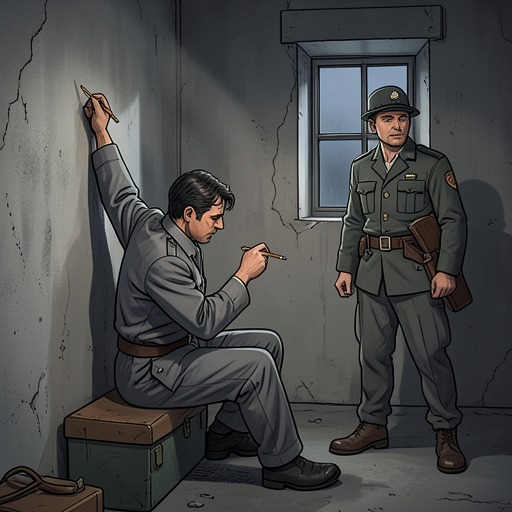
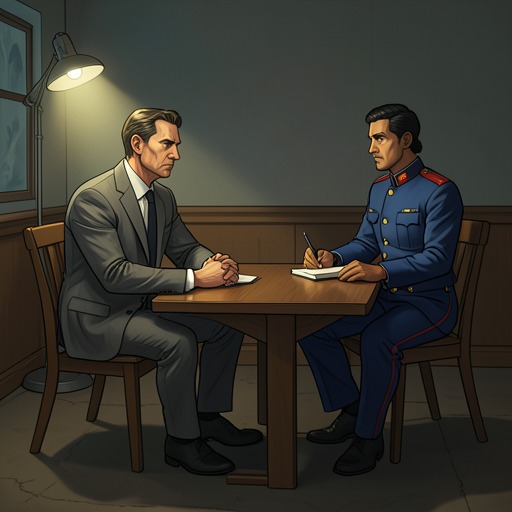
The SympathizerThe unnamed narrator's isolation and confession in the reeducation camp make self-examination a battleground over memory, political language, and responsibility. For a year after the ambush, he is held in a windowless cell, allowed out for only an hour of exercise each day, and required to rewrite his confession. The Commandant calls him a guest, then a patient; the narrator understands the practical reality as imprisonment. Their weekly meetings turn the manuscript into an editorial contest in which the state judges not only what he admits, but how he tells it.
Confinement and the Status of a Guest
The immediate dispute begins with the last words of the narrator's account of the ambush: he had saved Bon, but only from death. The Commandant objects to the implication that life in the camp could be worse than death, calling it melodramatic. The narrator answers from a sharply unequal position: he is a prisoner, while The Commandant controls the room and the terms of their conversation. He has not spoken to anyone for a week, and says that sympathy between them may be difficult precisely because one is confined and the other is in charge.
The Commandant rejects the word prisoner. Pointing toward barracks holding a thousand inmates, including survivors of the ambush and former soldiers and officials, he distinguishes the narrator as a special case and describes him as a guest of himself and the commissar. The narrator tests the claim by observing that guests can leave. The Commandant instead revises the label to patient: the narrator, he argues, has encountered dangerous foreign ideas and must be quarantined until cured. The medical language makes confinement sound like protection of the population, even as the narrator describes a year in isolation and the daily disorientation of emerging from darkness pale and blinking.
The camp's geography gives this euphemism a physical frame. A barbed-wire fence divides the guards' inner compound from the outer camp of inmates; beyond the latter lie barren plains, denuded trees, and watchtowers. Family visits take place in a pavilion by the dividing fence, where wives and children may see imprisoned relatives only a couple of times a year after arduous journeys by train, bus, and motorbike. The narrator's special cell is among the guards' facilities, but its isolation does not make him free. Before entering The Commandant's quarters, he pauses on the patio to look over a landscape denied to him from his cell. The view becomes a brief measure of the difference between seeing the world and being permitted to inhabit it.
The Manuscript and Its Editors
The confession has accumulated to 295 pages, but its length has not secured approval. The Commandant keeps the blue pencil associated, in his account, with Stalin and treats the manuscript as a text to be edited: errors and digressions are marked for deletion, rewording, or addition. He says the narrator took a year to produce an account that is still not satisfactory. Other inmates, he claims, have readily described themselves as puppets, imperialist lackeys, or brainwashed stooges. Their formulas may tell the authorities what they want to hear; the narrator's refusal to do so leaves his own confession unacceptable.
The disagreement is explicitly about form as well as content. The Commandant says that a confession must have a particular style, citing the Red Guards as an example. The narrator has admitted to many things, but the Commandant regards admission alone as insufficient. He explains that the commissar will permit an oral examination only once the written examination is satisfactory, and that his reports from the narrator's self-criticism sessions will help determine when that threshold has been met. Confession thus operates as a staged procedure: writing, review, self-criticism, and a possible next examination. The prospect of release is made contingent on an authority's judgment of the narrative.
The narrator answers with a double-edged performance. He thanks The Commandant for the opportunity to examine his life, invoking the examined life while also noting that writing and reflection are privileges he has been given. He presents himself as capable of taking editorial suggestions seriously but unable to understand why the text fails the standard. The response is neither simple defiance nor full submission: he acknowledges the process while exposing its contradiction, since the official invitation to reflect is inseparable from prolonged confinement and compulsory revision.
Political Style and Cultural Contamination
The Commandant's criticism makes the narrator's cultural references evidence in the case against him. In the latest draft, he has quoted Uncle Ho only once, while discussing Pham Duy's yellow music and the Beatles. The Commandant contrasts these references with the revolutionary poet To Huu and asks why the narrator prefers foreign intellectuals and culture to native traditions. The dispute is not just over which works belong in a confession. It frames cultural taste as proof of political contamination and asks the narrator to represent himself in an approved ideological vocabulary.
The Commandant presents his own position as reasonable and protective: exposure to foreign ideas, he says, could harm people unprepared for them. Yet the narrator's access to even basic political instruction is also controlled. He has not met the commissar, who appears to inmates at weekly lectures, and has been exempted from those lessons on the grounds that they are elementary. Instead, his supposed privilege is to write and reflect in isolation. The arrangement turns intellectual scrutiny into both a claimed benefit and a means of surveillance; his manuscript is judged for the very foreign attachments that the camp says it must cure.
Recovered Memory and the Limits of Confession
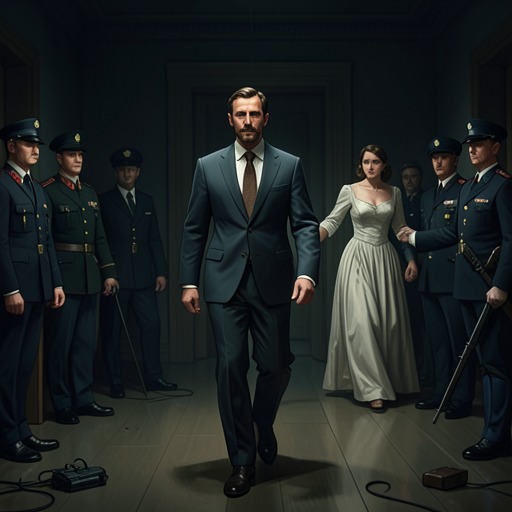
The confession's stakes reach beyond the manuscript's stated admissions. In a later interrogation, the narrator's memory returns to a room called a movie theater when foreigners visit and used for interrogations at other times. There he had watched the Communist Agent, a courier for Man, restrained naked on a table while three policemen assaulted her. She had been caught trying to swallow a list of policemen's names, and the narrator's own name was on it. He had passed the list to Man, while believing that the agent did not know his true identity. The memory therefore connects his clandestine role to a scene in which another participant bears the consequences of the secret he helped preserve.
The narrator recalls protesting to Claude that the treatment was wrong and unnecessary, then asking the policemen to leave him alone with her. The crapulent major, responsible for the interrogation, had yielded the work to the policemen; Claude stood by the projector as an adviser. The narrator's account does not turn his objection into intervention that stops the assault. He remains a witness, and the distance between recognizing wrongdoing and preventing it becomes part of what the recovered memory records.
The scene returns through fragments: the fluorescent-lit room, the closed blackout curtains, the projector, and a bottle of warm soda in the narrator's hand. After the assault, the policemen clean the floor and table; the agent is left silent, and the bottle is used in a further act of degradation. The narrator describes memory as sticky, an image joined to the soda that remains in his hand and to the residue of an event that cannot be made clean by washing the room. The remembered details complicate any neat account of confession as a completed inventory: what has been omitted can return with the force of a scene, while the narrator's presence within it resists a simple division between innocent observer and knowing participant.
Narrative Role and Significance
The isolation and the confession are bound together by a conflict over narration. The Commandant edits the narrator's sentences and classifies his ideas as illness; the narrator's account, in turn, records the circumstances under which that editorial authority operates. Even the terms used for his condition remain contested: guest, patient, prisoner. Each renaming tries to make coercion legible as hospitality or treatment, while the daily hour outside the cell and the year spent rewriting the testimony insist on its material cost.
The confession also becomes a structure through which buried experience reappears. Its revisions do not guarantee that every memory has been acknowledged, and the recovered interrogation-room scene exposes the distance between political self-description and witnessed violence. The narrator's testimony thus carries two forms of evidence at once: what he can set down under supervision, and what returns through memory with its silences, sensory fragments, and unresolved responsibility. The Commandant wants a confession that can be corrected into the right style; the narrative shows why no authorized wording can simply close the past.