The racialized foreigner status of Vietnamese people in America
The SympathizerThe racialized foreigner status of Vietnamese people in America persists even when they speak flawless English, hold American documents, work, and build communities. The unnamed narrator encounters foreignness not as a simple measure of citizenship or cultural knowledge but as a judgment repeatedly imposed by others: racial categories mark him as an outsider, refugee policy scatters people across the country, and popular images make Vietnamese people legible through stereotypes rather than through their own accounts.
Names and imposed categories
The unnamed narrator’s mixed heritage has attracted a succession of labels. French colonists called him Eurasian or métis; Americans could mistake him for Amerasian, a category associated with the children of American servicemen. The narrator distinguishes these classifications from his own circumstances: the latter term does not accurately describe him, but it shows how readily a society can turn a person’s ancestry into a category. Other names range from the legal description of an illegitimate son to his mother’s affectionate term, love child. His father’s refusal to call him anything at all is the most absolute form of exclusion in this sequence. Each designation offers a different account of belonging, but none resolves who has the authority to define him.
The labels also change meaning across settings. In Saigon, French expatriates who continued to inhabit the former colonial world treated the narrator with the suspicion of border guards, despite their own status as lingering outsiders. In America, the narrator’s Eurasian appearance might seem to promise a romantic exception, yet it does not protect him from racial classification. The episode establishes a recurring contradiction: mixed ancestry can be presented as a bridge between cultures while also making the person who bears it vulnerable to being claimed, misread, or rejected by both.
Refugee settlement and economic precarity
The conditions of arrival reinforce that unstable belonging. Refugees leaving camp depended on sponsors to guarantee that they would not become dependent on public assistance. The unnamed narrator’s former professor, Avery Wright Hammer, found him a clerical job in a university department and collected money that helped pay for travel to Los Angeles, a motel stay, an apartment deposit near Chinatown, and a used car. The narrator then sought sponsorship for Bon through churches. These details show how settlement depended on personal networks and charitable institutions as much as on the refugees’ own efforts.
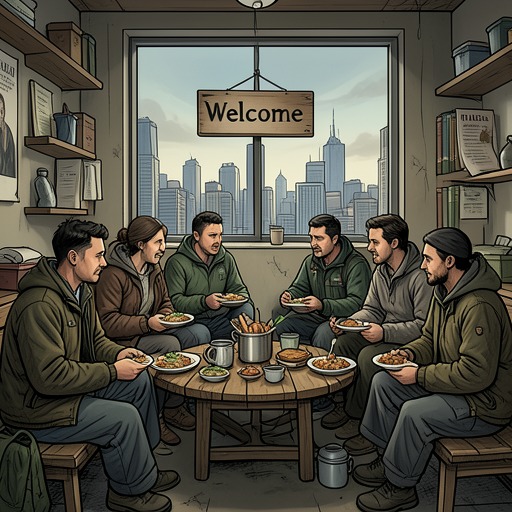
The dispersal of refugees made that dependence collective as well as individual. Families and friends were sent to different states, and people exchanged new addresses and telephone numbers in the hope of learning where jobs, welfare support, and less hostile conditions might be found. The narrator imagines that the refugees might have formed a substantial, self-sufficient community if they had been allowed to remain together. Instead, bureaucratic distribution separated them across the country. They nevertheless gathered in basements, churches, backyards, and beaches, rebuilding social ties wherever they landed. Their food offered a particularly intimate measure of displacement: Chinese markets supplied ingredients, but the resulting dishes lacked the fish sauce and complexity remembered from home. The meals recalled the past while making clear that it could not be recovered intact.
Economic adaptation did not erase the racialized limits of the new life. Bon, a skilled veteran, could find work only as a part-time church janitor, paid in cash, while receiving welfare. The crapulent major worked as a gas station attendant in Monterey Park, also paid in cash so he could qualify for benefits; his wife sewed in a sweatshop. Their circumstances reveal a gap between military experience and civilian opportunity. The major’s account of naming his American-born twins Spinach and Broccoli registers both his hope that they will be strong enough for their new country and the precariousness of the family’s position within it.
Speech, visibility, and everyday racial judgment
At a refugee wedding, a politician welcomed the émigrés as fellow Americans, but the welcome stood against a broader public response of ambivalence or hostility. The narrator describes an imagined national order organized around a white-and-black racial binary, leaving Vietnamese refugees outside its terms. Popular suspicions about Asian immigrants, including the grotesque rumor that they ate household dogs, reduce people to a racial caricature. The narrator’s elaboration of the food stereotype is deliberately ironic: it exposes the absurdity and exoticizing force of the accusation rather than treating it as a reliable description of Vietnamese life.
The exchange between Sofia Mori, Sonny, and the unnamed narrator makes the unequal rules of speech explicit. Mori observes that a white man can learn a few words of an Asian language and be admired, while Asian speakers are expected to produce nearly perfect English or risk mockery for their accents. The narrator adds the other side of that pressure: fluent English can win trust by making an Asian speaker seem more like an insider. Yet the apparent possibility of acceptance remains conditional. Speech may soften suspicion without ending the presumption that Asian people are foreign, a distinction that the conversation makes plain without treating fluency as a cure for racial exclusion.
The Hollywood gaze and continuing foreignness
The narrator’s meeting with a film director brings that presumption into a professional setting. Before the meeting, Violet’s curt manner leads him to suspect that his race explains her treatment of him. He recognizes that this interpretation may be affected by his own recent distress, but the surroundings sharpen his suspicion: she steers around a dark-skinned maid while moving through the house. The narrator has American identification documents and a command of English, yet he feels that Violet sees a racial type rather than the person before her. He connects that misrecognition to Hollywood’s stock Asian figures, including Fu Manchu, Charlie Chan, Number One Son, and Hop Sing, as well as Mickey Rooney’s mocking performance of an Asian character in Breakfast at Tiffany’s.
The screenplay itself compounds the injury. It tells a story set in the narrator’s country without giving any of his countrymen an intelligible word to say. His frustration is therefore not only about how Asians are depicted but also about who is allowed to speak within a representation of their own world. The earlier encounters with French colonial nostalgia, American stereotypes, and unequal language expectations converge here: Vietnamese identity is repeatedly interpreted from outside, while the people represented are denied meaningful control over the image.
Significance
Across these episodes, foreignness is produced through ordinary interactions and larger structures alike. Family naming, refugee sponsorship and dispersal, low-wage employment, judgments about accents, and Hollywood’s familiar Asian types each assign a place to Vietnamese people while limiting their authority to define that place themselves. The unnamed narrator’s experience is especially unsettled because his mixed ancestry and American fluency can suggest access to more than one world, yet neither guarantees recognition as belonging. The narrative’s irony makes the stereotypes visible as constructions, while its concrete accounts of sponsorship, work, food, and community show what those constructions obscure: refugees creating lives and relationships under conditions that repeatedly cast them as outsiders.