The revolutionary vanguard
The SympathizerThe revolutionary vanguard is the clandestine core of the General’s proposed campaign to reclaim South Vietnam: a network of committed officers and political supporters that would organize covertly, recruit through public-facing groups, and help prepare forces abroad. Its significance lies in the irony of its design. The General and the unnamed narrator, opponents of the communists, propose learning from the organizational methods of the movement that defeated them, while the plan’s charitable and patriotic appearance obscures a separate military purpose.
From defeat to a clandestine organization
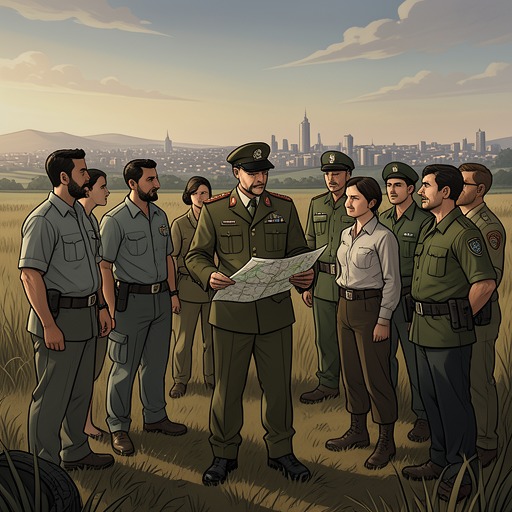
The plan takes shape in exile, where the General says that former officers have little to do and see the recovery of their country as a way to regain honor and a sense of manhood. He has spoken to prospective participants in person and has a list of officers for their first meeting. Public support for another war is difficult to obtain from Americans, so the General expects the effort to assemble gradually, while the unnamed narrator proposes building a network across different locations.
The narrator calls for more than a small group of leaders. When Madame objects that the language of a vanguard sounds communist, he argues that the communists won through more than luck and that their strategies should be studied. In his account, a vanguard can lead people toward a destination they do not yet recognize as their own. The General agrees. The proposed borrowing is tactical rather than an endorsement of communist aims: clandestine organization is treated as a method that can be adopted by the General’s anti-communist movement.
Cells, fronts, and controlled visibility
The vanguard’s basic structure combines secrecy with a public face. The unnamed narrator explains that it can work clandestinely while presenting the public with other kinds of organizations. Voluntary associations would appear to act openly, while serving as fronts for the hidden political core. The General proposes turning Sonny’s newspaper into one such organization and creating groups for young people, women, and intellectuals. These fronts would give the movement different points of contact with the exile community while concealing the central organization’s purpose.
Compartmentalization is equally important. The unnamed narrator proposes cells separated from one another so that the loss of one part will not expose the rest. He identifies the General’s gathering as one cell and says that Claude and the Congressman are involved in others, whose activities are not known to him. The structure therefore depends on limits to knowledge as well as deliberate concealment. Even a participant helping to design the system cannot see the whole network; secrecy is built into its organization, not merely added as a precaution.
The plan also uses a public charitable identity. The General and the unnamed narrator help establish the Benevolent Fraternity of Former Soldiers of the Army of the Republic of Vietnam as a nonprofit able to receive tax-deductible donations. In one function, it serves veterans without an army, country, or secure identity. In another, it provides a channel for money intended to support the Movement. The same organization can thus present assistance to former soldiers as its purpose while supplying resources to a clandestine political project.
Funding, intermediaries, and plausible deniability
The Fraternity’s financing relies on a chain of donors and intermediaries rather than a single openly acknowledged sponsor. The General has contacts among Americans who visited South Vietnam or served there, and Claude introduces him to charitable organizations. The Fraternity receives modest donations from refugee supporters, revenue from Madame’s restaurant, and contributions from respectable organizations. The narrator reports that the principal donors are not the Vietnamese refugees who belong to the Fraternity, but well-connected individuals and foundations interested in supporting America’s former allies.
The unnamed narrator recognizes that this arrangement resembles the Central Intelligence Agency’s use of front organizations. Claude has told him that the agency funds activities through organizations controlled by its agents and sympathizers rather than in its own name. He also points out that recipients of such funds may themselves be fronts. In the General’s scheme, the Fraternity is a front for the Movement, while organizations connected to the Congressman or his associates can channel funds through respectable foundations. When the Congressman warns that the Fraternity should not engage in illegal activity, the narrator understands the warning as a way to preserve distance from any illicit actions, not as a clear rejection of them. Responsibility and knowledge are distributed among the participants, leaving parts of the arrangement deliberately unseen.
The public rationale of aid to veterans also has a practical financial effect. At a fundraising dinner, the General redirects a tense discussion about happiness toward freedom and the refugees’ former military service, a shift that helps keep the guests receptive. Donations to the Fraternity are moderate enough not to attract the attention of auditors or journalists. Once money reaches Thailand, the exchange rate gives each dollar far greater purchasing power: donations ostensibly made for refugees can provide food and uniforms to the fighting force. Weapons and ammunition, by contrast, come from Thai security forces whose funding from the United States government is described as open and congressionally approved. The arrangement joins public aid, private giving, foreign support, and secret military preparation without making them one visible transaction.
The narrator as organizer and informer
The unnamed narrator is both a participant in the General’s project and an informant who records its workings. While serving as the General’s aide-de-camp, he has access to files and performs unpaid administrative work for the General, the Fraternity, and the Movement. He photographs the order of battle, communications with officers in Thai refugee camps, and bank statements showing where movement funds are held. His documentation extends from public parades to private maneuvers, making the supposedly respectable and the covert parts of the project visible together.
He sends information to Man through Man’s aunt in Paris, concealing Minox film in hollowed-out batteries included with a Hollywood souvenir. His reports include the names of officers in the vanguard and details of the General’s organization. The structure he helps describe is therefore also the subject of his surveillance: the narrator works inside its administrative machinery while transmitting evidence of its composition and funding to a revolutionary contact.
That divided role complicates the movement’s claims to unity. The narrator’s provocation of Sonny contributes, unintentionally, to the newspaper headline “Move On, War Over,” which appears beneath photographs of a Fraternity rally. He recognizes that the article may weaken support for continuing the war and divide exile factions. He photographs it alongside the General’s files. The public press, intended to serve as a front for the vanguard, can also circulate a message at odds with the General’s campaign. The plan depends on managing representation, but its various channels do not guarantee control of what those channels communicate.
Significance and limits of the model
The vanguard is presented as a response to political defeat and the dispersed condition of exile: it promises coordination, renewed military purpose, and a route toward reclaiming the lost country. Yet its operation relies on distinctions between public and private purpose, aid and military financing, and knowledge and ignorance. The Fraternity can genuinely assist veterans while also serving the Movement; the Congressman can help arrange funds while maintaining distance from their use; and the unnamed narrator can help organize the network while secretly documenting it.
The structure thus echoes the revolutionary tactics it seeks to appropriate while exposing the compromises involved in turning a cause into an organization. The General’s network needs public legitimacy, but depends on secrecy; it speaks in the name of refugees and former soldiers, but its most consequential planning is restricted to cells and intermediaries. Rather than presenting the vanguard as a transparent expression of collective will, the narrative shows it being assembled through fronts, money, limited knowledge, and competing loyalties.