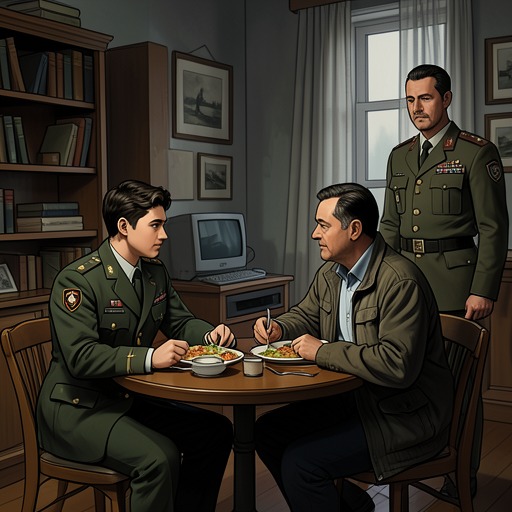
U.S. Embassy in Saigon
The SympathizerThe U.S. Embassy in Saigon is presented as a place where American authority, intelligence work, and evacuation policy converge—and where the promise of protection collides with the limits of rescue. First a base for Claude’s long-standing presence in the country, it becomes, in the final crisis, an overwhelmed refuge whose gates divide those admitted from thousands left waiting outside.
Intelligence Work and the General’s Appeal
Claude’s desk is at the embassy, where his public assignment is ostensibly to promote tourism in a country at war. The narrator identifies the cover as part of a deeper history: Claude is a Central Intelligence Agency operative whose time in Vietnam reaches back to the French colonial period. His fluency in English and long acquaintance with the country make him an intermediary between American officials and the General, even as the narrator recognizes that Claude can never be invisible in the place where he works.
When the General loses hope, the narrator calls Claude from an office near the General’s study. The call turns the city’s impending defeat into something real for the narrator. Claude promises to see what he can arrange, and a few days later meets the General. The General asks what will happen to his staff; Claude answers that the General has one plane and should consider himself fortunate. The embassy thus appears not as a source of rescue for everyone who has worked with the Americans, but as a channel through which a very limited evacuation opportunity is negotiated.
Denial and the Evacuation Dilemma
Claude says there is officially no evacuation because the Americans are not leaving soon. The General confronts this claim with what he sees around him: planes departing from the airport, people seeking exit visas, and the evacuation of American women, babies, and orphans. He asks why the Americans themselves seem unaware that their country is pulling out. Claude looks embarrassed and explains that publicly declaring an evacuation could provoke riots and endanger Americans still in the city. He invokes the earlier flight from Da Nang and Nha Trang, where Americans escaped and residents turned on one another.
The account exposes a contradiction between public reassurance and the visible preparations for departure. Many Vietnamese who had worked for the Americans feared imprisonment or death if the Communists won, while refusing to believe that victory was imminent. The narrator notes that the Central Intelligence Agency was also spreading rumors about what would happen to those left behind. In this atmosphere, silence is not neutral: it is presented as a tactic meant to manage danger, but it leaves people trying to infer their fate from departures they can already see.
The Embassy as a Choked Refuge
Claude’s later account makes the embassy a scene of mass desperation. By the time the crowd reaches it, thousands are pressing toward the compound, waving marriage certificates, employment contracts, letters, and even U.S. passports to establish a claim to evacuation. Marines guard the wall and beat back people attempting to get in. Claude says some applicants had to reach a marine and offer a thousand dollars to be hauled over; he and his colleagues also tried to identify former employees in the crowd so the marines might pull them inside or open the gate for them.
Those efforts could not overcome the crowd’s size or its own desperate competition. People near the front did not let other Vietnamese push ahead, even when Claude and his colleagues waved to acquaintances caught farther back. The embassy’s perimeter therefore becomes more than a physical barrier: it sorts people by access, position, and recognition at the very moment when documents and past service are being presented as claims to safety. Claude says the staff eventually looked away and went back inside, unable to hear the people screaming amid the noise.
Abandonment and the Unfinished Rescue
Inside, the radio carried increasingly specific pleas from people waiting at compounds around the city. Translators, employees, and groups of hundreds were told to wait at designated addresses; later, American staff called those locations to say no one was coming and that people should make their own way to the embassy. Agents outside the city also called for help as Communist forces advanced, but Claude says they had no chance of being evacuated. The failure was not confined to the crowd at the gates: the system’s instructions had led people to expect rescue at places where none would arrive.
Thousands were evacuated, but Claude remembers that when the last helicopter took off, four hundred people were still in the embassy courtyard, neatly arranged and waiting for helicopters they had been told were coming. None got out. His recollection gives the institution’s final image its force: the courtyard is full of people who have followed instructions and maintained order, yet the promised rescue does not follow. The embassy remains a center of American operations, but at the moment of departure its capacity to shelter those who depended on it proves sharply bounded.