Vietnamese boat people crisis
The SympathizerThe Vietnamese boat people crisis in the novel is not a single crossing but a chain of forced departures, scattered resettlement, and unresolved longing for home. Refugees flee a country where, as one woman puts it, victimization and humiliation have passed from foreigners to their own people; in the United States, they encounter bureaucratic dispersal, poverty, and a public identity that reduces them to a supposedly primitive category. The narrator’s path from recruiting refugees as film extras to preparing to escape Vietnam by boat makes the crisis both a political reality and a test of who gets to describe it.
Flight and the name
The narrator encounters the crisis while working on The Hamlet. After visiting the Bataan refugee camp, where thousands of people have fled their homeland, he returns dispirited and recruits a hundred Vietnamese extras. The people are hungry enough to accept the mandated wage of one dollar a day without bargaining. Their lack of leverage turns an ordinary employment transaction into evidence of the conditions that have driven them from home.
A lawyer among the refugees gives the narrator a bleak account of life in Vietnam after the communist victory: before, foreigners victimized and humiliated the population; now, she says, their own people do so. Her dry suggestion that this might count as improvement unsettles him. The refugees are not merely fleeing a distant war or a past regime; their testimony presents danger and humiliation as continuing conditions under the new order.
The label boat people troubles the narrator because it makes displaced Vietnamese sound like an exotic, vanished tribe rather than people with histories and political claims. He later recognizes that the name carries anthropological condescension. Yet the refugees’ flight is also described as a form of judgment: some appear to be voting against the revolution by leaving. The narrator cannot initially tell whether reports of postwar persecution are accurate or propaganda. Headlines supplied by The General describe drowning, pillage, rape, and possible cannibalism, and claim that only one in two boats survives the crossing toward Hong Kong, Indonesia, Malaysia, and the Philippines. In a coded message to Man, the narrator asks whether the accounts are true. His uncertainty does not cancel the refugees’ testimony; it exposes the distance between reports, political claims, and the people risking their lives at sea.
Dispersal and settlement in the United States
The crisis continues after the refugees reach the United States. In the narrator’s account of the first year after Saigon’s fall, no one leaves the camp without a sponsor to guarantee that the newcomer will not depend on the welfare system. Those without benefactors write to former employers, military advisers, lovers, churches, and even casual acquaintances. Families are sometimes divided, and people are sent to states whose names are difficult for them to pronounce. They exchange addresses before departure and rely on a refugee telegraph system to learn where jobs, benefits, and relative freedom from racism might be found.
The narrator imagines that, if refugees had been allowed to remain together, they could have formed a self-sufficient community with the full range of professions, faiths, political positions, and social types found in their former society. Instead, bureaucratic dispersal prevents the formation of that collective settlement. People rebuild smaller networks in basements, churches, backyards, and at beaches, gathering for food and news about scattered countrymen. Their efforts to recreate familiar meals are compromised by dependence on Chinese markets; the missing fish sauce becomes a particularly vivid sign that the remembered home cannot simply be reproduced in exile.
Sponsorship gives the narrator and Bon different but precarious footholds. Professor Hammer, the narrator’s former teacher, sponsors him, finds him a clerical position in the Department of Oriental Studies, and raises money that pays for his bus journey to Los Angeles, a motel stay, an apartment deposit near Chinatown, and a used Ford. The narrator then canvasses churches for a sponsor for Bon. The Everlasting Church of Prophets agrees, and the two are reunited in their apartment by September, living in genteel poverty.
Their new lives reveal how little refugee labor is valued. Bon works nights as a church janitor for cash and receives welfare, having concluded that it is a better reward for his military service than a medal. His ability to parachute, march long distances under a heavy load, shoot accurately, and endure punishment gives him no advantage in a labor market that has no use for those skills. The crapulent major, formerly an analyst in the Special Branch, becomes a gas station attendant in Monterey Park, also paid in cash so that he can qualify for welfare; his wife works in a sweatshop. Their experiences show resettlement as more than a change of address: military rank and expertise give way to low-paid work, dependence on benefits, and the need to make do.
Community, memory, and public representation
Scattered refugees try to counter dispersal by finding one another. Their informal networks circulate practical information about jobs, taxes, welfare, racism, and places where more people share their food and customs. They also carry stories of hardship, often heard at second or third hand. The narrator recounts reports of a group turned into slave labor by a farmer in Modesto, a young woman sold to a brothel after traveling to Spokane to marry her American serviceman sweetheart, a widower who froze to death in a Minnesota winter, and an ex-Ranger who killed his wife and children before killing himself. These stories give the dispersed community a shared, if painful, knowledge of what can happen to its members.
The refugees are also made into images for other people’s purposes. The narrator recruits them as extras for a film, while newspaper headlines supplied by The General frame their suffering as evidence in an argument about communist rule. His letter to his aunt contains both visible accounts and coded questions, reflecting the division between what can be said openly and what remains uncertain. The crisis therefore involves not only physical displacement but a struggle over representation: refugees appear as subjects in their own testimony, as figures in political propaganda, and as anonymous bodies in a film production.
A hardwood clock shaped like Vietnam condenses the exiles’ sense of time. Its dial places Saigon at the center, with the hands pivoting in the south. The narrator observes that displacement is measured not only by distance from the lost country but by the unknown number of years before return. The recurring question for the displaced is when they can go home. The clock makes that question tangible: the homeland survives as an object of memory, but return remains suspended in time.
Becoming boat people
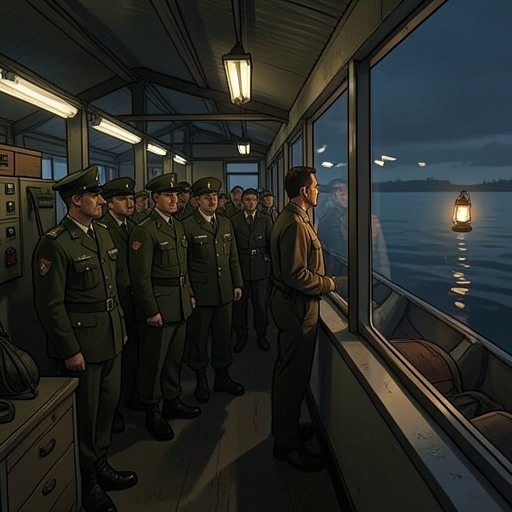
At the novel’s end, the narrator and Bon prepare to join the sea exodus themselves. On the eve of departure, their fare has been paid with gold hidden in the narrator’s rucksack, alongside a cipher and the manuscript they have been writing. The planned route begins with a bus journey to a village south of Saigon, then a ferryman’s skiff to a hamlet where the navigator’s family will join them. From there, a fishing trawler meant for 150 people will carry the group toward an uncertain crossing. Most will be packed into a hold designed for far fewer, with no vents to relieve the heat and pressure. The narrator recognizes that survival is far from assured.
The final reversal is in the narrator’s position. He first encounters the refugees as a film worker recruiting desperate people for a day’s pay; now he and Bon are preparing to be counted among them. The manuscript and cipher are carried as a means of preserving testimony and representing themselves against those who would speak for them. Their departure does not resolve the political questions that have accompanied the crisis: the narrator continues to wonder what happens when a revolution seizes power, and why a movement for independence can deprive others of freedom. Yet neither persecution nor disillusionment has extinguished his revolutionary hope. As the departure approaches, the narrator and his companions hold to the prospect of living, and the book ends with their declaration, "We will live!"