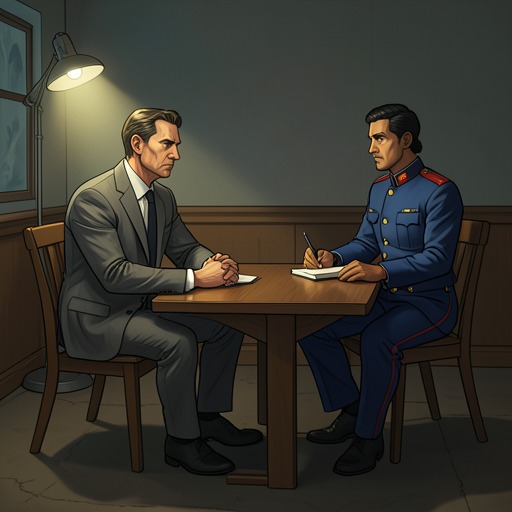
Watchman's confession
The SympathizerThe Watchman's confession is a written statement at the center of an interrogation in which the narrator uses threats of exposure and abandonment to pressure its author. The narrator later revisits the encounter as an act of coercion in which he took pleasure, while the Watchman’s death gives the document a stark afterlife: it remains the focus of the last scene in which the narrator sees him alive, and a sign of how completely others controlled his representation.
The Confession Under Interrogation
The encounter follows the Watchman’s claim that the Central Intelligence Agency has remarkable abilities with hypnosis and drugs. The narrator answers not by disputing that claim, but by describing the consequences of public exposure: the Watchman’s revolutionary comrades might condemn him, and his family might never accept him because he is homosexual. The narrator warns that he could lose both his reputation and his place in their memories.
The narrator offers one limited assurance: if the Watchman speaks to him, the confession will not be published, and his reputation will remain intact until the war ends. The offer is inseparable from the threat that precedes it. The document is thus not presented as an unpressured account; it is obtained through a calculated appeal to the Watchman’s fear of being rejected by both comrades and family.
The Narrator’s Retrospective Account
In the reeducation camp’s white room, the narrator asks himself why he acted as he did and recalls the interrogation as an event he had previously suppressed. He says the Watchman’s pseudoscientific judgment enraged him, but also acknowledges that the Watchman could not have provoked him in this way if he had simply performed his role as a mole. The narrator admits taking pleasure in both sides of his assignment: interrogating the Watchman, as Claude had requested, and acting beyond what the role required.
Claude later replays the surveillance-room footage. Watching himself watch the Watchman stare at the confession, the narrator understands the scene through a film analogy: Claude had produced it, and he had directed it. The analogy makes the document more than a record of what the Watchman said. It becomes evidence of the narrator’s participation in staging the interrogation and of the power to determine how another person appears to an audience.
The Document’s Afterlife
When the narrator and Claude return to the National Interrogation Center, the Watchman is dead. The account states that, after a week of good behavior, he had been given the breakfast he wanted: hard-boiled eggs. He ate two after peeling them and then swallowed a third whole, causing his death. The confession is not described as having been published; the narrator’s promise that it would remain private is therefore distinct from the question of whether the statement was truthful or freely given.
The narrator’s final reflection connects the Watchman’s confession to the broader act of representation: the Watchman could not represent himself, so the narrator represented him. That admission carries both political and personal weight. The narrator recognizes that he did not merely obtain a statement; he controlled the circumstances in which it was produced and later watched himself exercising that control. The confession endures as a document of the Watchman’s compelled speech and of the narrator’s acknowledged complicity.