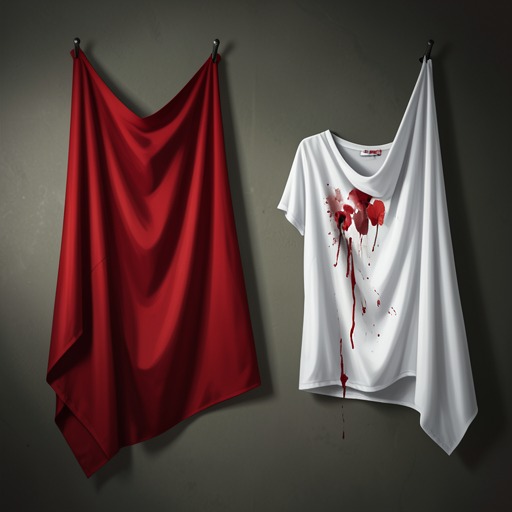
White: purity, mourning, and torture
The SympathizerWhite: purity, mourning, and torture is a recurring visual motif whose meanings turn against one another. It evokes the idealized innocence the narrator feels excluded from, becomes an image of mourning and death in his fantasies, and is engineered as an instrument of psychological coercion in an interrogation room. When white returns in the hospital after an explosion, apparent cleanliness and recovery instead frame his isolation and the return of buried memories.
Desire, innocence, and mourning
The motif first gathers force around Lana. After her commanding performance, the narrator approaches her in a restaurant foyer, where an imposing photograph of the newlyweds stands on an easel. Lana studies him with the unsentimental eye of an art appraiser and asks whether he likes what he sees. He answers by distinguishing the woman she has become from the girl he knew, and tells her she looks like the woman he had imagined she would become. Their exchange is cut short when Madame appears, seizes Lana by the elbow, and pulls her toward the ladies’ room. The interruption leaves the conversation suspended rather than resolved.
In the weeks that follow, Lana returns in the narrator’s fantasies, invariably wearing a white ao dai. The dress calls up the innocent schoolgirls in white whom some men prefer, and a pastoral vision of Vietnamese culture from which the narrator believes himself excluded. He describes himself instead as impure, someone for whom impurity is both desire and desert. The contrast makes white less a neutral sign of traditional beauty than an image of idealized belonging that he cannot claim. Lana’s remembered and imagined presence unsettles the boundary between that ideal and his own self-conception: in the nameless dream city where he encounters her, his shadow self wavers.
The fantasy does not settle white’s meaning. Even within it, the narrator recognizes the color not only as purity and innocence but also as mourning and death. That doubleness gives the image a foreboding edge: Lana’s white dress can suggest a cherished ideal while also carrying the possibility of loss. The motif makes desire inseparable from the narrator’s sense of exclusion and from an awareness that the image of innocence is shadowed by mortality.
The hospital’s white enclosure
After the explosion, the narrator wakes in a Manila hospital unable to speak. A white curtain shields his bed; a white sheet covers him; he wears a flimsy gown. The doctor records first-degree burns, smoke inhalation, bruises, and concussion, but tells him that his physical condition is remarkably good considering the danger. The clinical setting appears to promise care, yet the narrator’s attention fixes on its whiteness and on what the room withholds.
When the doctor leaves, the narrator inventories the white ceiling, sheets, and gown, then insists inwardly that he is not fine. The room offers no television, book, magazine, or fellow patient to distract him. As the hours pass, solitude gives way to claustrophobic unease: the blank walls seem about to release the past. White here is not simply a sign of medical cleanliness or safety. It is the empty surface against which memory threatens to emerge, and the physical enclosure that leaves him alone with it.
That afternoon, four extras who had played Viet Cong torturers arrive freshly shaven and dressed in jeans and T-shirts. Looking more like befuddled refugees than villains, they bring a fruit basket wrapped in cellophane and a bottle of Johnnie Walker. Their visit briefly interrupts the hospital’s isolation, and the narrator is moved by their recognition of him as a fellow Vietnamese. But after they leave and the bottle is empty, darkness returns him to another white room from his past. The shift shows how the hospital’s blankness becomes a route into recollection, not a barrier against it.
The interrogation room
The remembered room at the National Interrogation Center in Saigon was white by design. The narrator had been present when workmen built and painted it under Claude’s direction. Every inch was white, including the bed frame, desk, chair, and bucket; the food trays, plates, water cup, and soap were white as well. The prisoner wore only a white T-shirt and white boxer shorts. Apart from the door, the room’s sole opening was a small dark hole for sewage. White did not make this space open or pure: its uniformity emphasized confinement, while the dark aperture marked the bodily function the controlled room could not erase.
Claude’s experiment joined that visual sameness to cold and unbroken exposure. Air conditioners held the room at eighteen degrees Celsius, a temperature described as cool by Western standards but freezing for the prisoner. Fluorescent lights remained on overhead, imposing a continual day without ordinary markers of time. White-painted speakers completed the arrangement, ready to broadcast music at any hour. Whiteness thus operated alongside temperature, light, and sound: the room’s controlled environment was meant to soften the prisoner, while removing the ordinary variation that might orient him.
The prisoner spent a week inside before the narrator saw him in person. The only interruption came three times a day, when a slot opened and meals were pushed through: rice, one hundred grams of boiled greens, fifty grams of boiled meat, and twelve ounces of water. Through a video feed, the narrator watched him eat, wash from his bucket, pace, exercise, lie with a forearm over his eyes, and plug his ears. When the prisoner covered his ears, the narrator turned up the volume. These details make the room’s whiteness part of a practical system of observation and control, not merely a visual metaphor.
Sound, race, and complicity
Claude asks the narrator to choose music the prisoner cannot stand. The narrator selects country music, then obtains Hank Williams’s “Hey, Good Lookin’” from a jukebox in a Saigon bar popular with white soldiers. He associates the music’s sound with an American whiteness and with a racially segregated culture, drawing a connection between its place in those bars and the violence directed at Black people in the United States. The song therefore extends the room’s color scheme into sound: the prisoner is subjected not only to white walls and lights but to a soundtrack the narrator presents as culturally alienating.
Claude makes the narrator chief interrogator and treats breaking the prisoner as his graduation exam from the interrogation course. The narrator chooses the music, watches the prisoner through the cameras, and increases the volume when he sees him trying to block it out. His position is not that of an uninvolved observer: he participates in the experiment even as he recognizes that the prisoner has little hope of escape from it. White’s connection to torture consequently implicates the narrator in the production of the coercive space, rather than leaving him outside it as a commentator.
A motif of divided meanings
Across these scenes, white changes with its setting but never remains securely attached to innocence. On Lana’s dress it carries the narrator’s longing for an idealized cultural belonging, while his dream also marks it as mourning and death. In the hospital it accompanies bodily survival but sharpens solitude and anticipates the return of the past. In Claude’s room it is deliberately made oppressive through cold, continuous light, surveillance, and music. The movement from imagined dress to clinical bed to engineered prison cell binds personal desire to institutional violence without making those experiences interchangeable.
The motif’s force lies in that instability. The same color can promise purity, expose exclusion, suggest bereavement, or help construct an environment of torture. Its recurrence also shapes how the narrator encounters memory: the hospital’s white walls recall the earlier room where he helped carry out an interrogation. Whiteness thus links an intimate fantasy to wartime practice and turns a seemingly blank surface into a record of conflicting claims about innocence, victimhood, and responsibility.