Yellow Music
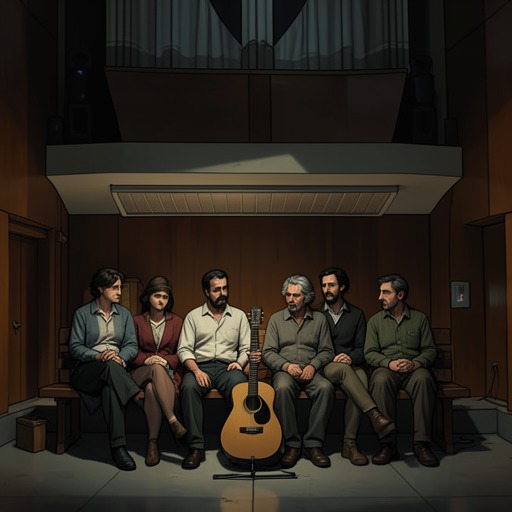
The SympathizerYellow Music is the novel’s politically charged name for music condemned as decadent or insufficiently revolutionary, but its meanings exceed that official judgment. Songs carry memories of home across exile, voice desires the revolution seeks to discipline, and become instruments of interrogation. The contrast between yellow and red music turns listening itself into a struggle over culture, political loyalty, and who has the power to decide what the people may hear.
Meaning and Political Use
The distinction between yellow and red music is presented as a political division rather than a neutral description of sound. During the exile army’s preparations for a reconnaissance mission through Laos, Radio Free Vietnam broadcasts speeches, translated newspaper items, and popular songs with reactionary sentiments. The General defends the love songs by arguing that communists reject romance and entertainment, whereas the people love love songs and the station serves the people. In this account, musical pleasure is evidence of a life that cannot be reduced to revolutionary duty.
The broadcasts also make music a form of political communication. Songs cross the border over the airwaves, reaching listeners in Laos and, the characters hope, their homeland. The unnamed narrator carries a transistor radio and an earpiece, valuing them more than his weapon or the laminated picture of the Virgin Mary worn for protection. This choice makes the radio more than a source of diversion: it connects a mobile, armed group to a shared cultural world beyond its immediate route and mission.
Songs in Exile
In the United States, music gives the exiles a way to stage a version of communal life in circumstances that have scattered them. At a performance called Fantasia in the Roosevelt Hotel, a singer performs Pham Duy’s “City of Sadness.” The audience consists of Vietnamese men and women who have found work and can now spend some of their earnings on wine and song. The narrator understands the song’s city as portable: the exiles carry it with them, and sadness has become a familiar element of their lyrical repertoire.
The performance is both an occasion of pleasure and an encounter with loss. The singers croon, wail, sigh, belt, moan, and roar; the crowd responds with adoration. The range of voices matters in a setting where the refugees can briefly gather as an audience and recognize one another through shared songs. Music does not restore the lost city, but it gives the dispersed community a way to evoke it together. The song’s title and its reception make exile audible without turning the gathering into a simple celebration: conviviality and grief occupy the same room.
Contested Cultural Inheritance
Yellow Music also becomes evidence in an ideological examination of the narrator’s writing. During reeducation, the Commandant criticizes him for quoting revolutionary figures too rarely and for citing Pham Duy and the Beatles instead. The Commandant presents this preference as a symptom of the narrator’s attachment to foreign intellectual life and culture. He contrasts the songs with the revolutionary poet To Huu, whose work sustained him during infantry training in China and whose writing, in his view, expresses the revolution’s promise.
The charge is complicated by the Commandant’s knowledge of the music he rejects. He says that the commissar keeps a collection of Yellow Music for research, while disavowing any wish to listen himself because he regards it as decadent contamination. The contradiction reveals how tightly the label is bound to authority: the songs are not simply unknown or inaccessible, but are familiar enough to be collected, discussed, and used as a test of political allegiance. What matters in the examination is not only what the narrator has heard, but what his choices of reference are taken to say about him.
Music as an Instrument of Coercion
An earlier interrogation scene gives music a different political function. Under Claude’s supervision in Saigon, the narrator helps design the conditions of confinement for a prisoner held in an all-white room. Asked to choose music the prisoner cannot stand, he proposes country music, which he says drives the average Vietnamese somewhat crazy. He obtains Hank Williams’s “Hey, Good Lookin’” from a jukebox in a bar popular with white soldiers. The song is then played on a continuous loop while the prisoner is held for a week before the narrator sees him in person.
This episode does not identify country music with Yellow Music; instead, it places the two forms within a wider conflict over who controls sound and what music can signify. The narrator describes country music as conspicuously white and racially segregated, connecting its presence in Saigon’s bars to the exclusion of Black soldiers and to the violence of American racism. Yet he knowingly selects that sound as a means of breaking a prisoner. Claude’s experiment turns listening into forced exposure, and the narrator’s role as chief interrogator makes musical judgment part of his own complicity in the interrogation. The scene’s irony is sharpened by the narrator’s subsequent defense of songs that revolutionary authorities call corrupting: music can express cultural belonging, but it can also be deployed as a weapon against someone who cannot choose whether to hear it.
Prohibition and Aftermath
After returning to Saigon, the narrator and Bon notice the absence of romantic songs and popular music in the streets. The Navigator confirms the reason: Yellow Music has been banned, and only red, revolutionary music is allowed. The restriction turns the earlier ideological distinction into an everyday condition of public life. What had traveled by radio across borders and gathered exiles in a hotel lounge can no longer be heard openly in the city.
The ban arrives amid renewed war and the narrator’s preparations to leave the country by boat. He and Bon continue writing their manuscript and composing confessions required by local cadres, even though they have little to report about their lives since returning. Against this enforced language of self-criticism and the prohibition of Yellow Music, their manuscript becomes an attempt to represent themselves rather than accept representation by others. The novel therefore links musical censorship to a broader contest over expression: control of the permitted soundtrack accompanies control over the stories people may tell, while the songs remain a measure of the emotional and cultural life that official revolutionary categories cannot contain.