the Philippines
The SympathizerThe Philippines serves as a substitute for Vietnam in the film production, but its importance extends beyond scenery: it exposes how political violence, refugee displacement, and cinematic representation converge in the unnamed narrator’s work for Film director (Auteur). Arriving as both a semi-Westerner and a Vietnamese exile, he recognizes familiar authoritarian conditions, recruits Vietnamese refugees as extras, and witnesses a production that turns Asian people and places into material for a story controlled by others. An explosion leaves him injured and out of the film’s final stages; his departure sharpens the question of who has the power to represent whose life.
A destination viewed through competing gazes
Three months after helping secure a revenue source for the Movement, the unnamed narrator travels to the Philippines with a guidebook that presents Asia to Western readers as vast, complex, mysterious, and alluring. He finds the description both accurate and meaningless: it makes the East seem uniquely strange while overlooking the West’s own unfamiliarity. He also objects to the guidebook’s flattering description of Cambodia beside its bleak account of his homeland, observing that residents may be less able than tourists to notice a place’s charms and faults. The contrast puts him in an unsettled position: he is from the region, yet expects to become a tourist in a neighboring country and to look at it through a visitor’s eyes.
That mixed position shifts as soon as he steps from the airplane into the humid jetway. Armed constabulary in the terminal makes the country feel familiar, as does a newspaper report about the unsolved murders of political dissidents whose bullet-riddled bodies have been abandoned in the streets. He reads the murders as evidence of a dictatorship and sees the United States supporting President Marcos’s effort to suppress both communist and Muslim insurgencies. American-made aircraft, tanks, helicopters, artillery, armored personnel carriers, weapons, and equipment give the political parallel a material form. The Philippines is not Vietnam, but its militarization and landscape make it a convincing stand-in for the war-torn country the production intends to depict.
A landscape turned into a film set
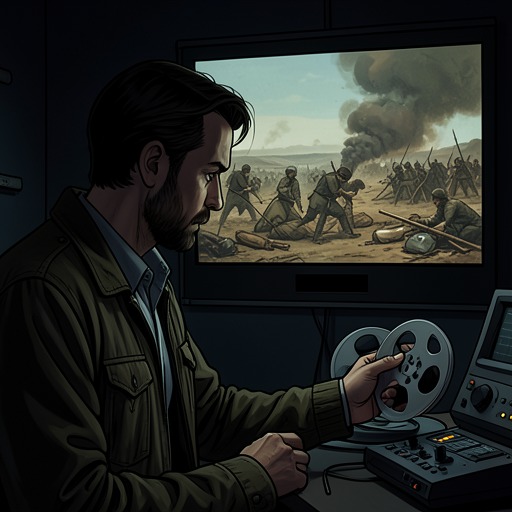
Film director (Auteur) chooses the Philippines for its capacity to resemble Vietnam. The production’s base camp is in a provincial city in the northern Luzon Cordillera, where the mountains play the role of the Annamese Cordillera separating Vietnam and Laos. The unnamed narrator’s hotel offers a weak stream of water, a toilet that sighs when flushed, a wheezing air conditioner, and damp sheets; even these discomforts recall home. The landscape’s usefulness to the film is thus linked to conditions the narrator recognizes from his own country, not to an exotic difference detached from lived experience.
The unnamed narrator admires the cemetery set, returning to it after a trip to the Bataan refugee camp. Harry loves the temple, though he expects the special-effects team to destroy it. These sites already carry opposing values: they are places of beauty and attachment for the people encountering them, yet also expendable scenery within a production. The film’s power to preserve an image depends on its power to alter or destroy the place it depicts.
When Film director (Auteur) arrives, the welcome party makes that imbalance unmistakable. The prop department builds a fake cauldron from plywood and papier-mâché, fills it with dry ice, and places two blond strippers inside to portray white women supposedly boiled alive by natives. Young local men wear loincloths and carry prop spears as the natives; Filipino laborers and cooks work among more than a hundred actors and crew members. The local guests join in slicing carrots into the staged soup. The unnamed narrator foresees that stories about the Hollywood crew will grow in the retelling, while the Vietnamese extras—the boat people—will be forgotten. He belongs to the production, but sympathy draws him toward the refugees and alienation pushes him away from the movie people. His feeling of being at home in unfamiliarity is therefore not simply a matter of climate or landscape: it reflects his divided membership in the film’s world.
Refugees recruited as extras
At the Bataan refugee camp, the unnamed narrator recruits one hundred Vietnamese extras. He encounters thousands of people who fled their homeland, a different kind of displacement from the earlier wartime homelessness of millions of southerners within their own country. The refugees’ new name, boat people, seems to him to turn a population driven from home into a supposedly novel species. Their condition can be understood either as flight from home or as abandonment by their country; either way, they arrive at the film set carrying circumstances the production can use but is unlikely to remember.
The extras are visibly impoverished and desperate for work. The unnamed narrator is required to offer a dollar a day, and not one person haggles for more. For him, the absence of bargaining measures how little power they have in the transaction: supply and demand are set against people with few alternatives. One recruit, a lawyer of aristocratic appearance, describes a change in who inflicts humiliation rather than an end to it. Under the previous regime, foreigners victimized and terrorized the population; after the communist victory, she says, their own people do so. Her bitter assessment refuses the simple political consolation that a change of rulers has ended suffering.
The trip leaves the unnamed narrator dispirited, and the contrast between the refugees and the party intensifies his sense of separation. The people whose displacement supplies the production with extras are at risk of disappearing from its eventual public story, even as the Hollywood visitors’ comic anecdotes are likely to endure. The Philippines is consequently not only a location where Vietnamese refugees are hired; it is where the unequal distribution of visibility becomes part of the narrator’s experience of exile.
Injury, payment, and departure
After the explosion that injures him, the unnamed narrator wakes in a hospital and learns that Film director (Auteur) has not visited because President Marcos is on the set. Violet and a studio representative tell him that the studio will pay his medical bills. He is shown an accident report, which the representative presents as proof that what happened was an accident, and a check for five thousand dollars. The medical report lists smoke inhalation, scrapes and bruises, mild burns, a bump on the head, and a concussion; a receipt and a release document would settle the studio’s obligations. The narrator reads the swift paperwork as evidence of influence and payment behind the official process, and the offer does not dispel his suspicion that something remains unexplained about his injury and memory.
By the time he leaves the hospital, his services are no longer required. He is excluded from the production’s final cleanup and sent out of the Philippines on an already reserved airplane ticket. His abrupt removal gives practical force to the question he carries into his confession: if a person does not control the means of representation, can others erase that person’s death from public memory? The film may be completed without him, just as its refugees risk being forgotten after serving as extras. Back in California, he cashes the check and gives half to the widow of the man he killed, a personal act that connects the money received for his injury to guilt and attempted forgiveness. The Philippines thus remains central to the narrator not as a lasting home, but as the place where the film’s power over images, the vulnerability of refugees, and the consequences of his own participation become impossible to separate.