Angeline Wright
The Tale of the Vampire BrideAngeline Wright is Andrew Wright’s loving wife and one of the principal human witnesses to the Wright family’s collapse. Her role is domestic but not merely ornamental: she brings news, interprets silence, comforts Andrew, and records the family’s grief while pregnant with their child. Her scenes place ordinary marital tenderness beside an expanding supernatural horror, making her an emotional anchor for a household whose absent members have been drawn into Vlad Dracula’s world.
Identity and Domestic Position
Angeline Wright appears within the family’s English domestic sphere as Andrew Wright’s affectionate and attentive wife. Her entrance is marked by movement toward him: she rushes to him in a flurry of pink, her brown curls bouncing, her face flushed, and her skirt gathered above her ankles. The physical warmth of that arrival establishes her as a figure of intimacy and reassurance rather than distance. She carries a letter from Andrew’s father and urges him to open it quickly, sharing his initial relief at receiving news from his wandering family.
Her marriage to Andrew Wright is presented through small acts of care. She draws close to read over his father’s handwriting, prepares him a hot drink when grief overwhelms him, takes his hand, kisses it, and rocks him in her embrace after the finality of the family’s losses becomes undeniable. These gestures are not separate from the plot’s larger violence: they are the fragile human practices through which Angeline attempts to keep Andrew connected to life, family, and the future.
Foreboding and the Family’s Disappearance
Angeline is not simply a passive recipient of Andrew’s anxiety. When she suggests that Glynis Wright will probably not be married off and may instead do something troublesome before returning home, she demonstrates that she understands Glynis’s forceful independence and expects her to resist conventional arrangements. Her judgment is affectionate rather than condemnatory. She tries to brighten Andrew’s fears by insisting that the family is likely safe and may already be on its way home.
That confidence is tested by the atmosphere surrounding Andrew’s premonition. He tells Angeline that he has been suffering terrible dreams that vanish from memory upon waking, leaving behind an intense and persistent sense of dread. His rational mind rejects the fear as unreasonable, yet he believes that the family has come to harm. Angeline answers with reassurance, promising that the family will return and that all will be well, but the coming rain, gathering storm clouds, rumbling thunder, and sudden cold undercut her words. The weather functions as an external pressure on the domestic scene, turning private unease into a warning that neither spouse can fully name.
Journal of Grief
Angeline’s journal entry dated 27 November 1819 records the aftermath of the news that three members of the family have died. She describes the report as devastating and confesses that she can barely endure her despair. Pregnant and physically burdened, she is also concerned that the child within her seems distressed. Her grief therefore operates on two levels: she mourns the dead while trying to remain physically and emotionally available to the living child and to Andrew Wright.
She finds Andrew Wright in the parlor, collapsed into mourning with one hand covering his face and the other clutching the fatal letter from his only surviving sister. Angeline approaches barefoot, supporting her heavy stomach, and addresses him tenderly. The scene makes her care bodily and deliberate: she moves silently toward his grief, carries her pregnancy into the room, and attempts to meet his devastation without denying her own tears.
When Andrew says that he knew something was dreadfully wrong, Angeline acknowledges his intuition rather than dismissing it. She urges him to be grateful that Glynis Wright survived, calling that survival a miracle, even though the letter from Glynis is strangely formal and fails to explain the supposed accident or her condition. Andrew suspects that the survivor might instead be May Wright, confused by shock; Angeline counters that Glynis is likely in shock and that this accounts for the absence of her usual cleverness. Her explanation shows both her desire to protect Andrew and her willingness to construct a humane interpretation of disturbing evidence.
Angeline’s consolations become increasingly difficult to sustain. She tells Andrew that she is there for him, that the baby will soon arrive, and that Glynis will return so the family can be together again. Yet she privately wonders whether her words sound as empty to him as they do to her. This inward qualification gives her character unusual emotional depth: she performs hope for Andrew while recognizing that the former family cannot simply be restored. Her formulation that life will not be as it was, but may still become good, is a modest vision of survival rather than a denial of loss.
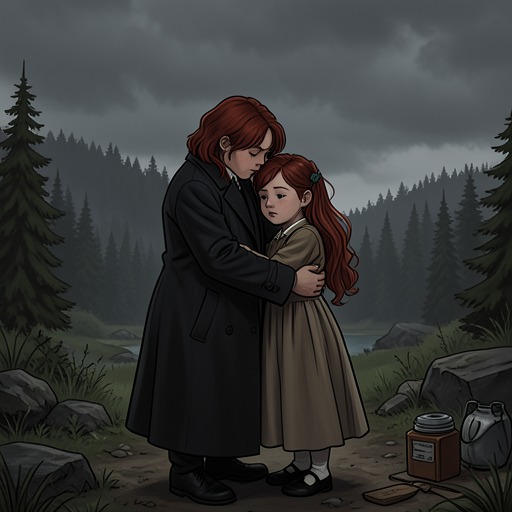
The material objects sent with Count Dracula’s unopened letter complete the movement from uncertainty to confirmation. Angeline unwraps Andrew’s pocket watch and May Wright’s small gold locket from the parcel. When Andrew sees them, he understands that his family is truly gone and collapses into her embrace. Angeline rocks him as she would rock her newborn child, extending maternal care toward her husband at the exact moment when the family’s dead become materially present. Her question about whether he has read the letter from Count Dracula also places her at the threshold of the next stage of the mystery: grief has not ended the story, but has opened the channel through which Dracula’s influence can reach the survivors.
Relationship with Andrew Wright
Angeline and Andrew Wright share a close, mutually protective marriage. Their intimacy is expressed through endearments, physical contact, and the easy exchange of confidence. Andrew tells her about Glynis Wright’s earlier escapade involving Lord Byron: Glynis had pursued an invitation to a London household, appeared dressed in one of the older sisters’ clothes, and was found seated beside Lord Byron listening to his scandalous poetry. Andrew had taken her by the hand and marched her away, keeping the episode secret from their parents. Angeline responds by predicting that Glynis will frustrate any attempt to marry her off, showing that the couple can discuss Glynis’s character with both concern and fond amusement.
Their marriage also reveals the limits of reassurance. Angeline repeatedly tells Andrew that his family is safe, yet she cannot dispel the dread that has entered the household. Later, when the deaths are confirmed, she becomes the physical support on which he collapses. Her pregnancy and the expected birth of their child give her encouragement a concrete future orientation, but they also intensify the stakes: she is trying to preserve a family structure already broken by the disappearance of Andrew’s parents and May Wright.
Narrative Function and Significance
Angeline Wright’s importance lies in the contrast between her ordinary forms of care and the extraordinary forces destroying the Wright family. Letters, parcels, tea, pregnancy, marriage, and the parlor belong to a recognizable domestic order; behind them stand unexplained dreams, ominous weather, a falsified account of an accident, and Count Dracula’s intervention. Angeline’s scenes make the supernatural threat legible through its effects on an intimate household rather than through spectacle alone.
Her presence also sharpens the tragedy of Glynis Wright’s transformation. Angeline belongs to the world Glynis has resisted when she longs to live as freely as a man and escape the constraints imposed on women. Yet Angeline is not reduced to the voice of those constraints. She treats Glynis with affection, understands her rebellious tendencies, and offers Andrew a form of care that is emotionally active and perceptive. The contrast is therefore not simply between confinement and freedom, but between different ways of inhabiting domestic life: Glynis seeks self-determination beyond prescribed roles, while Angeline turns relational devotion into a source of endurance.
As a journal writer and intimate observer, Angeline preserves the human meaning of events that the supernatural plot threatens to make unreal. She cannot rescue the dead, expose Dracula, or retrieve Glynis from the hidden world, but she records the moment when hope becomes mourning and when mourning must become survival. Her final image is inseparable from that function: holding Andrew as he breaks beneath the proof of his family’s death, she becomes the living vessel of the family’s remaining tenderness.