Ariana
The Tale of the Vampire BrideAriana is one of Vlad Dracula’s Brides, a youthful-looking vampire who claims Glynis Wright as her sister through Vlad’s blood. Her role is defined by contrasts: a sweet, playful manner sits beside the predatory life of the Brides, while gestures of sisterly care persist even as hunger, imprisonment, and conflict with Vlad shape their existence.
Identity and Appearance
Ariana is introduced among the dark Brides, alongside Elina. Glynis’s account describes Ariana as the more delicate-looking of the two, with fine, sweet features, dark curly hair, and a small white hand. Glynis later estimates that Ariana may have been no more than sixteen when she entered the vampire world. That estimate belongs to the narrator’s retrospective understanding, not to a stated account of Ariana’s mortal life; the evidence gives no further details of her origins.
The contrast between apparent youth and supernatural maturity is made explicit. Glynis says that the dark gift endowed Ariana with the sensuality and cunning of someone much older. Ariana’s appearance therefore presents no simple measure of her experience or threat: her gentle features and light touch accompany her place among predators, and her polished, beguiling manner can turn quickly into action.
First Encounters with Glynis
Ariana’s first interactions with Glynis mix observation, touch, and an invitation into the Brides’ world. When Glynis begs to leave, Ariana wonders whether she is becoming mad like Erzsébet Dolingen. She then sweeps Glynis’s hair from her face to look into her frightened eyes. The question shows that Ariana recognizes distress, though it does not make her an ally in Glynis’s attempt to escape. The Brides lift Glynis in their cold hands and surround her with promises of jewels, beauty, youth, and immortality; Ariana belongs to this collective embrace, in which apparent comfort is also a means of drawing Glynis toward their existence.
Ariana later appears hovering above Glynis and reaches for her hand. At another moment Glynis hears her sweet voice and finds her lounging on a couch in the shadows, her eyes reflecting the fire. These scenes give Ariana a recurring presence at the border between invitation and menace: she approaches gently, but the intimacy takes place within the castle and among the captors who hold Glynis there. When Ariana tells Glynis that something will come soon, her brief assurance offers anticipation without explaining what awaits.
Her most explicit claim on Glynis is familial. Emerging in a fine gown with jewels in her hair, Ariana laughs, catches Glynis in her arms, and dances her around. Glynis pulls free and regards her suspiciously. Ariana asks whether Glynis wants to dance and play, then explains that she is Glynis’s sister through Vlad Dracula’s blood. She kisses Glynis’s cheek and spins away, insisting that they are sisters forever. The claim does not describe an ordinary biological kinship; it makes shared blood and Vlad the basis of a supernatural bond. Ariana’s playfulness makes that bond appealing even as its source places Glynis within the system that has transformed and confined her.
Sisterhood and Acts of Care
Ariana’s sisterly behavior is not limited to her early attempts to charm Glynis. She appears from the shadows to touch Glynis’s tears, an intimate response that acknowledges her distress without requiring words. Later, when Glynis arrives with Ariana at Erzsébet Dolingen’s side, Ariana speaks tenderly and answers concern about the source of their food by saying that they have fed that night on fresh, life-rich blood. The statement is both reassurance and evidence of the Brides’ dependence on human blood.
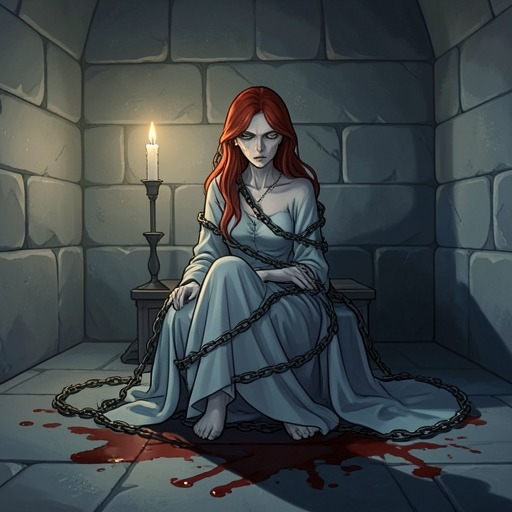
Ariana’s care becomes most concrete when she feeds Erzsébet. She rests her blood-red lips against Erzsébet’s pale, trembling ones, and the kiss turns into an exchange: blood passes from Ariana’s mouth to her sister’s. Glynis recognizes that Ariana is disgorging blood to sustain Erzsébet. The action gives the Brides’ sisterhood a bodily form. Their intimacy can be affectionate, but it is also bound to the same blood that sustains their undead lives and links them to Vlad.
Ariana’s tone can be exuberant as well as tender. After a gruesome ending, she smiles and declares, “We always win!” The confidence sounds collective, spoken on behalf of the Brides, and contrasts with Glynis’s fear and uncertainty. Later, Ariana pursues Elina through the woods, laughing and calling for Glynis to join them. When she brings Glynis to Erzsébet, she identifies herself with tenderness as Glynis’s vampire sister. These episodes present a lively companionship among the women, though it exists within a predatory household and does not erase the danger surrounding Glynis.
Hunger, Captivity, and Decline
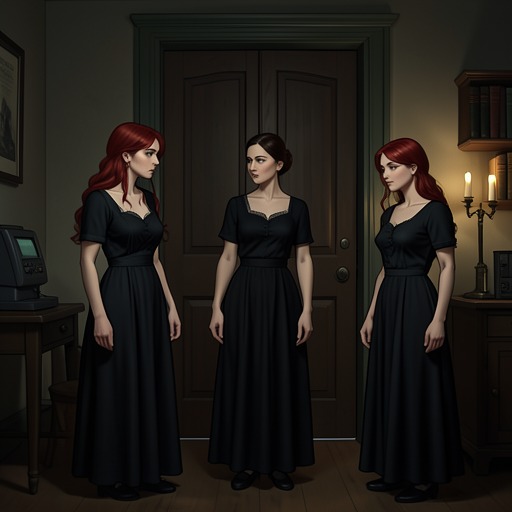
Ariana’s fate is tied to the Brides’ material dependence on blood. In the later crisis at the castle, Glynis sees her three sisters gathered in a doorway, hiding from the flames and gripping the frame. Ariana leans against it, skeletal, frail, gray, and old, staring toward blood-filled Gypsies beyond her reach. The image reverses the earlier picture of the jewel-adorned, dancing Bride: the figure who once offered Glynis beauty, youth, and immortality is now visibly wasted by deprivation.
The contrast makes the Brides’ vitality conditional rather than secure. Their youthful sensuality and power depend upon access to blood; without it, Ariana’s body becomes a sign of starvation and confinement. The scene also recalls her earlier act of sustaining Erzsébet by giving her blood. The same resource that enabled Ariana to care for another Bride is now inaccessible to her, and Glynis sees the consequences in the sisters’ collective physical collapse.
Resistance and the Ending
Ariana’s final actions place her beside Elina in open combat against Vlad Dracula. When the sisters drop onto his back, their blows drive him to his knees and force him to release Cneajna. Ariana lands on him and stabs him with a dagger. Vlad grabs her by the hair and throws her against the wall; she scrambles up into the rafters. Her attack is direct and physical, a sharp departure from the earlier scenes of dancing, coaxing, and gentle touch. The sisters’ resistance has immediate consequences in the struggle, although Ariana is unable to overpower Vlad alone.
After Glynis stakes Vlad and inherits his power, Ariana and Elina look at her with awe and terror. Ariana steps toward Glynis uncertainly and says that she will love her as she loved him. The words retain the language of attachment while marking a changed object and a changed order: the blood-linked sister who had once declared Glynis part of Vlad’s family now addresses Glynis after Vlad’s defeat. Ariana’s ending is not a complete account of what her life will become, but her closing promise makes clear that the bond she asserted through Vlad’s blood can persist beyond his rule.
Narrative Role
Ariana is presented through Glynis’s recollections and observations, so her inner life remains less directly available than her gestures, speech, and actions. That limitation matters: the text shows her asking whether Glynis will go mad, touching her tears, feeding Erzsébet, and attacking Vlad, but does not provide an independent account of Ariana’s motives or mortal past. Her character is instead built through changes in proximity and action—from circling Glynis with the Brides, to claiming sisterhood, to sharing blood, to fighting the master who bound their lives to his.
The arc complicates the idea of the Bride as merely Vlad’s possession. Ariana participates in the seduction and violence of the vampire household, and her boast of the Brides’ victory reveals confidence in their collective power. Yet her exchanges with Glynis and Erzsébet also establish bonds among the women that cannot be reduced to obedience to Vlad. By the final scene, Ariana’s loyalty is expressed toward Glynis, not as a claim of freedom already secured, but as a promise made in the unsettled aftermath of Vlad’s fall.