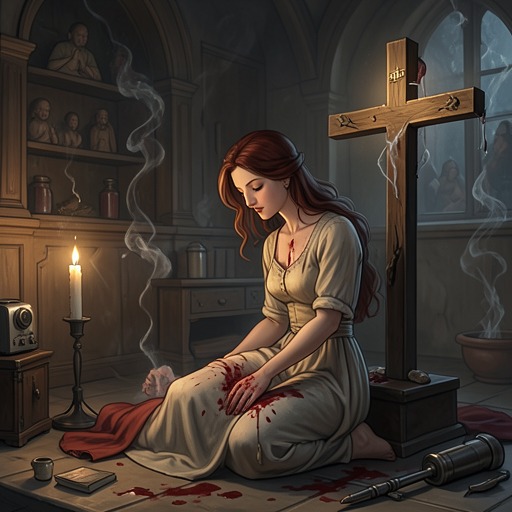
Blood as Sacrament
The Tale of the Vampire BrideBlood as Sacrament names the novel’s reversal of nourishment, religious devotion, and vampiric violence. Blood is the substance through which Glynis Wright is made and sustained as a vampire, yet its meaning changes according to who gives it, who takes it, and under what pressure. Antoinetta Wright’s final gift transforms an act Vlad Dracula intends as degradation into a source of love and resistance; later, forced feeding reveals how readily the same substance can bind Glynis to the identity and power she fears.
A Counter-Ritual of Life and Faith
The idea takes shape within a supernatural order that imitates religious rites while stripping them of consent. The Brides explain that the time has come for Glynis’s making by the Master, and Vlad later orders Elina to prepare her for the vampire baptism once more. The language of baptism gives the transformation a ceremonial frame: Glynis is being admitted into a new community, but the rite is commanded by the one who holds her captive. Blood, in this system, is not simply food. It is part of a process that remakes identity and determines belonging.
Against that imposed ritual, Antoinetta’s faith supplies a different interpretation of bodily sacrifice. Before giving Glynis her blood, she hides her rosary in the dirt of the cell and prays; she promises to pray before the Father, the Son, and the Holy Spirit, and asks the Blessed Virgin to watch over her daughter. The gesture places the Christian objects and prayers of Antoinetta’s former life beside the blood rite that follows. Rather than treating these traditions as interchangeable, the scene makes their difference matter: Vlad controls the setting and has engineered the ordeal, while Antoinetta gives the act its loving intention.
Antoinetta Wright’s Gift
The central scene begins with a mother’s instruction that Glynis must escape and be free. Antoinetta understands that her daughter’s hunger makes her own heartbeat an invitation to feed, and Glynis promises to survive and find a way out. Then Antoinetta tells her that, as she gave her life before, she gives it once more. The words recast the coming exchange as a second birth: Antoinetta’s body had brought Glynis into life, and her blood will now sustain her in a life altered by vampirism.
Antoinetta knowingly prepares Glynis to drink. She asks her daughter to rest, promises prayer for her soul, and reminds her of the promise to escape. Glynis lowers her head to Antoinetta’s throat, her fangs descend, and she drinks even as she weeps. The feeding is intimate and terrible: Glynis takes her mother’s life, but Antoinetta has chosen to give what she can so that her daughter may live. Her repeated forgiveness does not erase the pain or make the act harmless. It distinguishes the gift from Vlad’s violence by making love, rather than command, its defining force.
After Antoinetta’s death, Glynis interprets the event as the source of a new strength. She understands that Vlad meant for her to defile her mother by feasting on her, but that Antoinetta’s flesh and blood have instead become a holy sacrament. The reversal is consequential rather than merely symbolic: Glynis takes her mother’s command as an edict, resolves to escape, and refuses to let Vlad’s intended meaning govern what the blood has given her. The mother’s death remains a loss, but its legacy becomes a form of resistance carried within Glynis herself.
Hunger, Renewal, and Coercion
The later blood-feeding scene exposes the limits of that hopeful meaning. After Glynis has been wounded and weakened, Vlad presents blood from one of his victims and declares that she is his bride and must drink. Cneajna also urges her to feed. Glynis initially pleads for help and resists, but the hunger overwhelms her; she drinks from the blood offered by Cneajna and Ariana, then takes the goblet from Vlad. Her eventual submission is bodily and emotional: she embraces her fate in the moment, while the surrounding vampires support her and Vlad repeatedly fills the goblet.
Blood restores her body. As Glynis lies in it, the wounds inflicted by Vlad fade, her vision and hearing sharpen, and her heart begins to beat. The hunger recedes, but so does the temporary ecstasy of feeding; conscience returns with the knowledge that she has feasted on innocents in the arms of her captor. This renewal is therefore not a simple triumph over death. The blood gives Glynis strength while drawing her into the violence she had vowed to reject. Antoinetta’s willing sacrifice and the victims’ coerced deaths produce sharply different moral meanings, even though both become nourishment for Glynis.
Sacred Signs and Competing Meanings
The novel repeatedly places Christian signs beside vampiric appetite without suggesting that the conflict has been settled. During the attack on the castle, a priest chants while a guard wrestles the crucifix from his grasp; nearby, the violence and the smell of blood fill the scene. The juxtaposition makes visible a struggle between religious protection and the physical power of the vampire household, but it does not turn bloodshed into a sacrament. Instead, the priest’s threatened crucifix and the blood that draws Glynis’s attention mark competing claims over what can save or sustain a person.
Ignatius’s account supplies another perspective on the spiritual cost of vampirism. He recalls that after his transformation he could no longer touch his crucifix or enter his church, and no longer felt God’s presence. He describes serving the woman who made him and her husband, and undertaking penance in the hope of returning to God’s service. His testimony does not redefine Antoinetta’s gift, but it prevents the language of sacred blood from becoming an easy assurance of redemption. The novel holds together a mother’s prayerful act, a vampire’s bodily renewal, and a convert’s sense of spiritual separation.
Meaning and Consequence
Blood as Sacrament is therefore neither a fixed doctrine nor a clean distinction between holy and profane. The same hunger that makes Glynis a threat to those around her also makes her vulnerable to control; the same blood that restores her can be given in love or extracted through domination. Antoinetta’s choice does not undo Glynis’s transformation, but it gives her a moral inheritance that Vlad cannot entirely dictate. The contrast between motherly offering and coerced feeding turns the question of blood into a question of agency: who chooses the exchange, whose life is being taken, and what meaning the survivor carries forward.