Buda
The Tale of the Vampire BrideBuda is the most important urban counterspace to Dracula’s castle in the narrative. It is presented first as a promised home and a possible future, then as the center of a hidden supernatural society in which Glynis Wright moves between domestic captivity, public ceremony, secret affection, investigation, and rebellion. Its apparent civility—homes near the Danube, churches, estates, shops, opera, and carriages—does not dispel danger; it gives danger a social form. By the end, Buda has become both the world Glynis has grown to love and the home destroyed by vampire hunters, making her departure a second exile rather than a simple escape.
Definition and First Appearance
Buda enters the story through Vlad Dracula’s account of his future plans. He tells the Wright family that he does not intend to remain at the castle much longer, that he plans to move to England, invest in an estate near London, marry, and live there with his family. He describes the castle as a kind of vacation home and claims that he already has a lovely home in Buda, where he had been staying before an unexpected summons brought him back. The statement gives Buda an immediate double identity: it is supposedly evidence of Vlad’s settled wealth and domestic respectability, but it is also part of the explanation by which he makes his larger life appear ordinary.
That explanation does not withstand scrutiny. Glynis Wright’s mother doubts that the Buda house exists at all, suspecting that Vlad has invented it to make his marriage proposal more acceptable. Vlad insists that the house is real and repeats that he intends to move to London because his time in the region is coming to an end. His insistence makes Buda a rhetorical instrument before it becomes a fully inhabited setting. It represents the respectable future he offers, while the uncertainty surrounding it exposes how easily property, marriage, and prestige can be used to conceal supernatural power.
The Wright family’s questions also place Buda within a recognizable social geography. Glynis Wright’s mother asks which church Vlad attends there and which estate is his, recalling the grand properties the family saw during its travels. Vlad answers only that his home is near the Danube, then redirects his attention toward Glynis Wright and the shops. Buda therefore appears as a place where identity can be tested through ordinary markers—religious attendance, property, local knowledge, and public taste—even while Vlad evades the inspection that would establish him as a genuine member of that world.
Arrival and Urban Geography
When Vlad Dracula’s household finally reaches Buda, the city is introduced through water, moonlight, and transit. The carriage arrives in Hungary as the moon shines on the Danube, and the travelers cross the pontoon bridge joining Buda to Pesth. This approach makes the city a threshold: the bridge carries Glynis Wright out of the isolated castle’s world and into an urban environment where movement, commerce, and social contact become possible. Yet the crossing does not free her. She enters Buda still bound to Vlad, carrying the invisible consequences of the castle into a setting that seems more open.
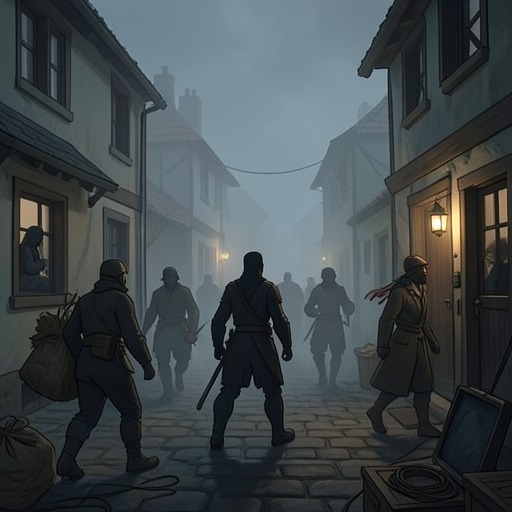
Buda’s spatial structure repeatedly accommodates both visibility and concealment. The city contains grand residences and ceremonial spaces, but it also offers back streets, doorways, shadows, narrow doors, and hidden alcoves. Glynis Wright instinctively slips backward into a doorway and disappears into darkness when danger approaches. In another episode, a battered ancient door opens only after a summons, and the statement that the Master awaits within turns an apparently ordinary entrance into a controlled threshold. A separate narrow door, worn and battered, leads into darkness when opened by a figure whose eyes carry a glimmer. These entrances make Buda legible as a city of layered access: public streets conceal private rooms, and private rooms conceal supernatural authority.
The same logic governs Astir’s haven. Glynis Wright and her companions turn into a familiar back street and reach an alcove in a wall, where a small door opens to reveal darkness that is suddenly welcome. The haven interrupts the city’s danger without removing it. Buda’s protective spaces are not bright sanctuaries but concealed interiors, and safety depends on knowing where they are and who may enter. The city thus becomes a network of routes between exposure and shelter, rather than a simple refuge from the castle.
Social Life and Supernatural Politics
Buda gives Vlad an environment in which supernatural relations can be staged through human forms. The city’s homes and estates support the appearance of marriage, wealth, and family life, while its churches and public entertainments provide the social setting against which Vlad’s claims may be measured. The difference between the castle and Buda is not that one is supernatural and the other ordinary; it is that Buda allows the supernatural household to move through ordinary institutions and borrow their authority.
Glynis Wright’s position in Buda remains unstable because she is simultaneously Vlad’s wife, his bride, his possession, and a developing power in her own right. Vlad later tells her that she is his wife and that he will not share her with anyone, reducing the city’s elaborate social world to the language of exclusive ownership. His assertion transforms domestic respectability into a territorial claim. Buda may offer streets, houses, and public encounters, but Glynis Wright’s movement through them remains governed by Vlad’s control.
At the same time, Buda enables relationships that the castle’s closed hierarchy could suppress. Ignatius argues that Glynis Wright is an intricate part of her husband’s life and asks whether embracing who she is would make her a more powerful helpmate. His reasoning accepts the social role of wife even as it reinterprets that role as a source of agency. Glynis Wright’s relationship with Ignatius consequently develops inside the contradictions of Buda: marriage is an instrument of domination, but the city’s less isolated environment permits a secret emotional and political attachment that challenges Vlad’s authority.
Buda also connects Glynis Wright to a wider vampire community. Ariana feeds a weakened sister by kissing her and disgorging blood from her own throat into the sister’s mouth. The exchange is intimate, bodily, and communal, showing that the city is not merely a backdrop for individual predation. It is a place where the vampire brides sustain one another and where blood functions as kinship, obligation, and power. Cneajna’s account of her earlier punishment at Visegrád further enlarges the regional political world around Buda: after murdering Piroska in jealousy, she was sent by King Matyas to Visegrád and confined to its palace grounds, a punishment she experienced as beautiful and almost heavenly beside her former life. Her memories of the Danube River and the sun place Buda within a landscape shaped by aristocratic power, exile, and contested belonging.
Destruction and Departure
Buda’s apparent promise collapses into direct violence. On the date recorded as 25 April 1820, the Dosza Palace still appears glorious as Vlad Dracula and Glynis Wright approach by carriage, although it no longer possesses the shimmering spectacle associated with the earlier opera night. Vlad reaches for Glynis Wright’s hand and traces the red stone of the ring he gave her. The gesture binds the public magnificence of the palace to the private sign of possession, but it also creates a final image of Buda before the city’s social theater gives way to persecution.
The Buda estate is soon consumed by fire. From beyond the dark silhouettes of trees, Glynis Wright sees the house burning, great flames engulfing the structure she had come to love as home. Their servants try to defend themselves against vampire hunters, but guns and daggers overcome them. The destruction is therefore not limited to property. The estate’s household is dismantled through the killing of its human defenders, and the violence reveals that Buda’s civilized surface cannot protect either supernatural residents or the mortals attached to them.
The assault changes Buda from a place of attachment into a place that cannot be safely inhabited. Glynis Wright departs at dawn in a carriage under Vlad’s authority, leaving behind the world she had grown to love. Magda weeps, kisses Glynis Wright’s cheek, and clings to her hand until Vlad pulls her away. Astir and Ignatius come to say goodbye, but their farewells remain muted under Vlad Dracula’s fierce gaze. The scene makes departure a renewed act of coercion: Glynis Wright is not simply choosing to abandon Buda, because Vlad determines when she leaves and controls the emotional space of the farewell.
Buda’s ending is mirrored by Glynis Wright’s return toward the castle. As shadows and firelight twist together, she sees the castle door open and walks past kneeling gypsies toward the great black entrance of her former home. The route reverses the earlier crossing into Buda. The city had seemed to offer a new social world, but its burning sends Glynis Wright back toward the architecture of captivity. Buda’s narrative significance lies in that reversal: it is the location where freedom, intimacy, and belonging become imaginable, and the location whose destruction makes those possibilities appear to close.
Narrative Significance
Buda embodies the unstable boundary between domestic legitimacy and supernatural domination. Vlad Dracula uses it to support his image as a wealthy man with a house, a family, and a future in England, yet every claim is shadowed by evasion and control. For Glynis Wright, Buda supplies experiences unavailable in the castle—urban movement, public spectacle, hidden alliances, and a home she can genuinely love—but it never becomes fully autonomous from Vlad’s power.
Its recurring doors, shadows, bridges, residences, and concealed havens give the city a Gothic spatial grammar. Buda is open enough to permit escape routes and secret meetings, yet compartmentalized enough to preserve masters, servants, brides, and fugitives in separate zones. The city’s destruction confirms that the hidden supernatural world cannot remain safely separated from human institutions. Once hunters enter the estate, the boundary between public order and occult violence breaks apart, and Buda becomes the place where Glynis Wright loses a home while discovering how deeply she has become part of the world she once feared.