Carpathian Mountains
The Tale of the Vampire BrideThe Carpathian Mountains are the decisive Gothic landscape through which the Wright family’s journey becomes entangled with Vlad Dracula’s supernatural domain. First seen from a moving carriage as a spectacle of “brutal, majestic beauty,” the mountains are at once sublime and threatening: they offer grandeur, but their passes, storms, precipices, and sudden ruptures repeatedly remove ordinary routes of safety. As the family approaches Castle Dracula and later confronts the possibility of escape, the range becomes more than scenery. It is a threshold between the familiar world and a hidden supernatural order, and its geography gives physical form to the forces that isolate, pursue, and nearly destroy them.
Setting and First Impressions
The mountains enter the narrative through Glynis Wright’s intimate perception. During the family’s carriage journey, she watches the high summits beyond the dirty carriage window while holding her father’s hand. Edric Wright responds to her unease with a tender gesture, cradling her small gloved hand against his knee and squeezing it gently. The warmth of that contact contrasts with the landscape outside: the mountains are magnificent, but their beauty produces dread rather than reassurance. Their scale makes the travelers seem vulnerable, while the carriage window establishes a boundary between familial security inside and an overwhelming natural world outside.
Glynis’s attention to the range is also bound to her own physical identity. She looks toward the summits with dark red curls moving in the wind, and the mountain air touches her flushed skin. The scene joins the landscape to her distinctive appearance, presenting her as a young woman whose Italian and British heritage is already marked by contrast, just as the mountains combine aesthetic splendor with menace. The Carpathian Mountains therefore become the first environment in which her sheltered family identity is placed beside the unfamiliar and potentially supernatural.
Roads, Folklore, and the Threshold of the Castle
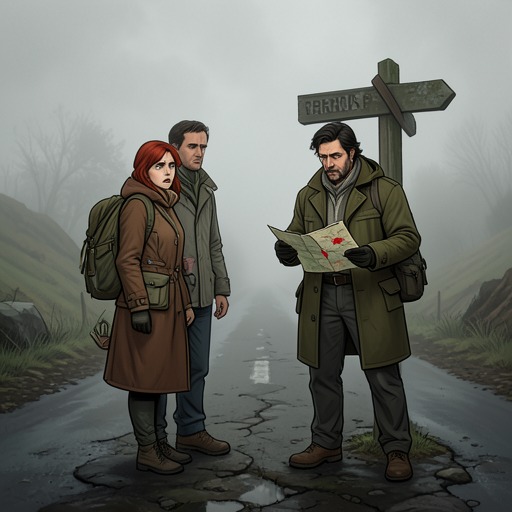
The mountain journey is shaped by warnings and signs that make the region feel culturally and spiritually charged. At a crossroads, Edric Wright explains that local peasants believe criminals buried there cannot return from the dead. The graves turn a practical route into a place haunted by beliefs about undeath, making the mountains a landscape where death is not safely confined to the past. Glynis responds with morbid curiosity, while May Wright reacts with visible horror. Their different responses establish the range as a place that awakens both fascination and fear.
The route soon becomes physically impassable. A storm has blown large rocks down across the road to the village, and Ovidiu, the Transylvanian guide, reports that the only remaining road leads upward into the mountains. He describes it as very dangerous and appears close to despair. The family is not simply choosing a more difficult route; the landscape is narrowing their choices until the mountains direct them toward danger. Their intended connection in the village becomes subordinate to the blocked pass and the vertical road into the high country.
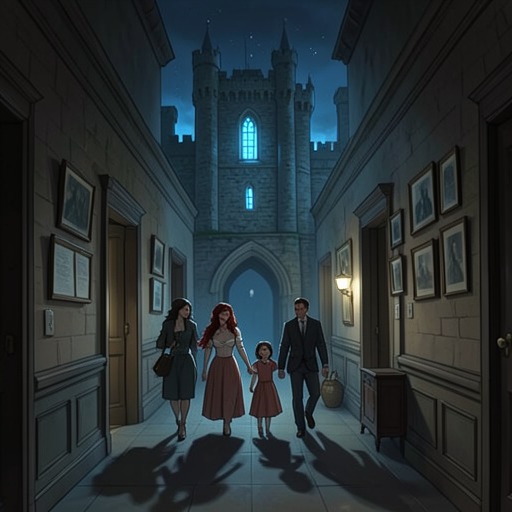
That forced ascent leads directly to Castle Dracula. As the forest disappears, the carriage lurches and Glynis finds herself looking into a dark chasm, with the road running toward a great castle balanced on the edge of a precipice. The castle’s position makes the mountains a threshold space: the family crosses from a recognizable journey into a realm whose architecture seems to grow out of the abyss. Even Mother, Antoinetta Wright, momentarily forgets her usual composure and leans from the carriage window to greet the sight of the castle as a promise of safety. The apparent refuge is thus introduced through a landscape that has already demonstrated its power to close roads and redirect travelers.
Storms, Ruptures, and Confinement
After the family leaves Castle Dracula, the mountains become an instrument of supernatural obstruction. For an hour, the carriage travels through misty passes while the sun struggles upward and is then overwhelmed by dark clouds billowing across the valley. Glynis feels that the storm is not merely strengthening but pursuing the travelers. The weather converts the range into something almost intentional, blurring the distinction between natural danger and Vlad Dracula’s power.
The threat becomes unmistakable when the family encounters a great chasm splitting the road apart. A deep gorge has opened through the mountain pass, although the family traveled that same road two days earlier. The sudden rupture makes ordinary explanations inadequate and turns the pass into a trap. Edric Wright is reduced to a terrified whisper, while Ovidiu identifies the cause as the “wicked” man whose hospitality had promised safety but whose powers now threaten those who have left him. The mountains supply the visible mechanism of captivity, but the scene reveals that the mechanism is supernatural: the landscape has changed in order to prevent escape.
This transformation of geography intensifies the Gothic meaning of the range. A road normally promises movement toward a destination; here, roads vanish, storms pursue, and a gorge appears where passage had recently been possible. The mountains’ apparent permanence is undermined by sudden change, so that even solid ground becomes unreliable. The family’s dependence on guides, roads, and physical distance is exposed as powerless against Dracula’s command of the environment.
The Mountains as Escape and Death Space
The Carpathian Mountains remain associated with entrapment after Glynis is confined at Castle Dracula. Determined to escape the fate imposed on her by Vlad Dracula and the vampire women, she climbs a crumbling stairwell and reaches a battlement. From there, the night sky stretches over the surrounding mountains, which stand around the castle like menacing sentinels. The range encloses the castle visually and emotionally, repeating the confinement already established by the blocked roads and broken pass.
Yet the same mountains also provide Glynis with the first apparent opening toward self-determination. She sees that the battlement lies near a sheer drop to the river below and moves toward its edge with grim resolve. The precipice offers no ordinary freedom; it offers death. Her thought that this is how she should die shows how completely Dracula’s captivity has distorted the meaning of escape. The mountains cannot yet return her to the human world, but their cliffs allow her to imagine refusing the fate prepared for her, even through self-destruction.
The range therefore holds a double function. It is a barrier that closes the family’s routes and protects Dracula’s isolation, but it is also the site where Glynis confronts the extremity of her resistance. Its height and darkness externalize the choice before her: submission within eternal darkness or a fall into death. In this sense, the Carpathian Mountains are not merely the setting of the castle’s approach and aftermath. They are the physical form of the story’s central conflict between captivity and freedom.
Gothic and Narrative Significance
The mountains embody the Gothic sublime because they produce fear through magnitude, obscurity, and loss of control while retaining an undeniable beauty. Glynis can admire the summits, the wind, and the night sky even as the same environment carries her toward a precipice and makes escape impossible. Beauty does not neutralize terror; it makes terror more powerful by giving the threatening world grandeur. The mountains are therefore repeatedly described through contrasts between the majestic and the brutal, the protective and the imprisoning, the natural and the supernatural.
Their narrative role also follows a threshold pattern. The Wright family begins in a world governed by ordinary travel, family protection, and expected destinations, but the mountain roads lead them into Castle Dracula. Crossroads connect the landscape to folklore about the dead; storms and rockfalls disrupt human plans; the chasm reveals the intervention of powers beyond human understanding; and the battlement turns the surrounding peaks into witnesses to Glynis’s despair. Each stage deepens the range’s association with passage into danger and the failure of return.
By the time Glynis stands above the river, the Carpathian Mountains have become an image of the story’s wider structure. They surround the supernatural household, preserve its secrecy, and make distance from it seem almost impossible. At the same time, their precipices mark the point at which resistance becomes imaginable. The mountains do not offer a simple path to liberation, but they force the imprisoned heroine to confront the cost of remaining within Dracula’s world. Their decisive significance lies in that tension: the Carpathian Mountains are both the prison wall and the edge from which freedom, however terrible, can first be conceived.