Castle Dracula's decay
The Tale of the Vampire BrideCastle Dracula’s decay is more than a matter of neglected stone: it shapes the Wright family’s first impressions, sharpens a dispute over Glynis Wright’s future, and complicates Vlad Dracula’s effort to present the castle as a suitable home. The building is described as cold and deteriorating, yet parts of it have been repaired and made hospitable. That contrast leaves the family looking at the same place in sharply different ways: as a prospective residence, a menacing ruin, or an unsuitable setting that its owner intends to leave behind.
Condition and First Impressions
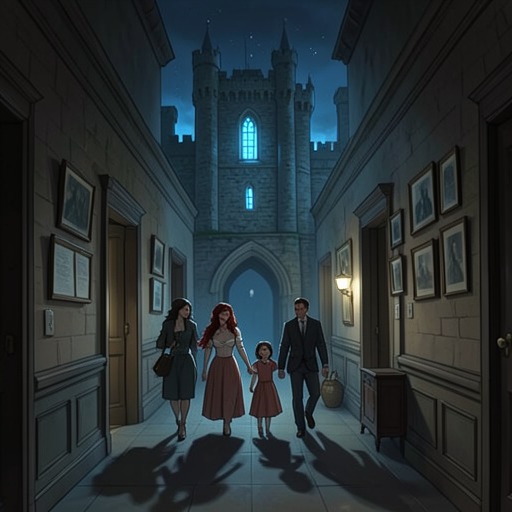
The castle’s condition is established through the corridor the Wrights encounter on arrival. It is long, cold, and decrepit; the passage makes the family’s search for shelter feel less reassuring than they may have expected. Edric Wright appears to be reconsidering whether they should have sought refuge there. The decay therefore has an immediate practical effect: it unsettles a family that has arrived needing shelter and makes the building itself part of the uncertainty of their welcome.
Vlad Dracula responds to that unease by explaining that he does not intend to live in the castle much longer. He plans to move to England, invest in an estate there, and live with his family; Castle Dracula is to serve as a vacation home. He also has a home in Buda, where he had been staying before being called back. His explanation reframes the disrepair as a condition of a residence he regards as temporary rather than as an obstacle to his plans. He then points the family toward the repaired, hospitable parts of the castle and the supper prepared for them. The welcome is thus accompanied by a distinction between the visibly deteriorated building and the portions Vlad considers fit for guests.
Restoration and Visible Ruin
In daylight, Antoinetta Wright offers Glynis Wright a more reassuring view. Some areas urgently need repair, she acknowledges, but what has been restored is pleasant, and she imagines the castle becoming a lovely home. The assessment is neither a denial of the damage nor an account of a completely ruined building: restoration has made some parts comfortable even as other parts remain in disrepair. The castle’s condition is uneven, and its appearance can support competing judgments depending on which parts receive attention.
Glynis rejects her mother’s optimism. She runs to the window, looks toward the broken battlements, and calls the place horrible, insisting that she hates it and asking how her mother could wish her to stay there. The battlements give physical form to her rejection: rather than weighing the repaired rooms against the damaged areas, she fixes on the castle’s exposed signs of age and ruin. The view becomes part of an argument about whether she should remain, not simply a description of the property. Antoinetta’s appeal for her daughter to be kind and respectful does not resolve that conflict; it makes the pressure to behave properly inside the castle explicit while Glynis continues to resist the prospect of staying.
The Castle as a Contested Home
The dispute over the building is also a dispute over marriage and security. Antoinetta wants Glynis to be married, cared for, and respected, and considers Vlad a husband whom the family should treat with respect. Glynis refuses to consider him. Against that disagreement, the castle’s decay acquires a particular force: to Antoinetta, the restored areas offer the possibility of a future home; to Glynis, the broken battlements and the building’s overall appearance make that future repellent. The same architecture is thus invoked from opposite positions in the family’s argument, without either woman disputing that deterioration is real.
Edric Wright’s response further separates hospitality from permanence. He acknowledges that the furnishings are lush and beautiful, but emphasizes that they are very old and that the castle is falling apart in some places. His assessment qualifies the comfort Vlad has offered: attractive furnishings do not erase the building’s structural neglect. It also resists treating the restored interior as proof that the whole castle is in good condition. The physical setting becomes part of the family’s attempt to judge the circumstances in which Glynis is being asked to remain.
Narrative Significance
The castle’s decay is conveyed through contrasts rather than through a comprehensive inventory of damage. A cold corridor, restored and hospitable areas, old furnishings, and broken battlements establish different facets of the place, while the characters’ responses show what each facet means to them. The building can shelter the Wrights and receive them with supper, yet its visible deterioration makes refuge feel uneasy and the prospect of residence unwelcome. Its condition is neither uniformly ruinous nor simply repaired; the tension between those states is central to how the castle is introduced.
Vlad’s plan to relocate gives the decay a further narrative dimension. He presents England and an estate there as the intended basis for his future household, while describing Castle Dracula as a place he does not expect to inhabit permanently. The castle’s worn condition therefore stands beside an announced plan for departure, rather than being framed as a renovation project. For the Wright family, however, the immediate question is not what Vlad intends to do later but whether Glynis can be expected to stay now. In that conflict, the building’s decay becomes concrete evidence through which competing hopes for her future are expressed.