Csilla Dosza
The Tale of the Vampire BrideCsilla Dosza, chiefly known as Baroness Dosza, is a beautiful and influential aristocrat of Buda whose fascination with Vlad Dracula becomes an instrument of his power. She presents herself as a gracious hostess and arbiter of elite society, yet behind the polished opera invitation lies a woman who helped direct Vlad toward Glynis Wright, assisted the scheme that brought Glynis’s family into his orbit, and longs to become immortal herself. Her double position—as social intermediary and aspiring vampire—makes her one of the clearest figures through whom the novel connects aristocratic performance with predation.
Identity and Social Position
Csilla Dosza is introduced through an invitation to an opera at the palace of the Dosza family, addressed to the Count and Countess Dracula. The invitation reveals that she knows Vlad has returned to Buda without informing her and has already heard, through Maria, the wife of Sir Stephen Sheridan, that he has taken a wife from England. Her knowledge of the household is not casual: she monitors the movements of people within the city’s finer circles and treats Vlad’s marriage as an event requiring her personal attention.
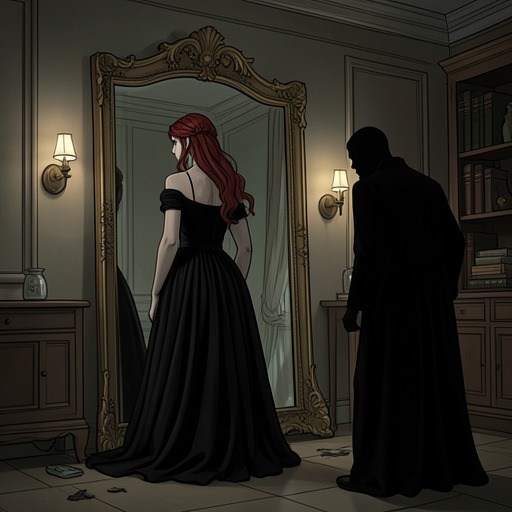
At the opera, Csilla appears in a bright red gown and an enormous gold-and-red satin turban set over her coiled black hair. Her eyes are described as black, wise, and cunning, and her pleasure at seeing Vlad is visibly intense. She greets him in a smooth, sensuous voice and immediately assumes control of the social encounter, welcoming his return while measuring the significance of the foreign bride beside him. Her clothing and manner establish her as a performer of aristocratic authority, someone who converts spectacle into influence.
Csilla’s authority depends on her ability to manage other people’s visibility. She is especially attracted to Glynis as a dramatic object: a veiled English noblewoman presented as the survivor of a family tragedy. Rather than treating Glynis’s mourning as private grief, Csilla recognizes its value as gossip and entertainment. She calls Glynis a tragic figure and declares that she now understands the veil, taking evident delight in the story’s dramatic possibilities.
The Opera and the Performance of Tragedy
When Vlad introduces Glynis as his wife and Andrew Wright as her brother, he explains that Glynis wears mourning for her parents and sister. The explanation is false, but Csilla accepts it because it supplies the narrative she wants. She links her arm with Glynis’s and leads her through the crowded marble hall, promising to show her to Buda’s finest people. For the next hour, she presents Glynis to influential guests through glowing, poetic introductions, transforming a captive vampire bride into an aristocratic spectacle.
The scene gives Csilla a form of power that is social rather than openly supernatural. She controls the room’s attention, assigns Glynis a public identity, and folds the supposed tragedy into the rituals of elite hospitality. Glynis, who once belonged naturally to this world as the daughter of an English aristocratic family, experiences the evening as a return to a life she had hated but now craves. Csilla’s introductions therefore do more than entertain: they temporarily restore Glynis’s access to rank, finery, and social fluency while concealing the violence that made the performance possible.
Csilla’s invitation also exposes her appetite for possession. She is intrigued by Vlad, by his return, and by the news that he has acquired an English wife. Her welcome is warm, but it is not innocent. She wants to know everything that happens within her circle of influence, and Vlad’s mystery gives her curiosity a particularly charged object. The opera becomes a meeting point where marriage, reputation, mourning, and supernatural secrecy are all staged as forms of public theater.
Conspiracy and Vlad’s Use of Her
Csilla’s deeper importance is disclosed when Brice warns Glynis that Vlad is evil and that his mistress is his faithful servant. Through a narrow opening, Glynis sees the Baroness’s bedroom: a young woman lies dead on a table, bearing vampire bites at her throat and wrists, while Csilla lounges on her bed and watches Vlad. Vlad’s teeth are still tinged with blood, and the room’s candlelit shadows make the private chamber a grotesque counterpart to the opera’s marble elegance.
Csilla admits that she directed Vlad’s attention toward Glynis. She says that she chose Glynis for him, but Vlad sharply corrects her, insisting that he alone chose her. The distinction reveals the structure of their alliance: Csilla can identify, recommend, and place a target before Vlad, but he claims the final power of selection and possession. Her influence is real, yet it remains subordinate to his authority.
Vlad explains that Csilla told him Glynis was the most perfect of the English noblewomen in Buda and emphasized her beauty. He also states that Csilla helped Sir Stephen Sheridan convince Glynis’s parents to come to him, effectively giving Glynis over to Vlad’s control. Csilla’s social knowledge thus becomes a weapon. Her familiarity with aristocratic families and her access to their confidence help transform a courtship into an abduction disguised as hospitality.
Vlad tells Csilla that Glynis is necessary because he intends to move to England and needs her to establish a mortal life there. In his scheme, Glynis can provide him with the appearance and social foundation of an English gentleman. Csilla is consequently not merely jealous of a rival bride; she is confronted with the fact that Glynis has strategic value in Vlad’s plan to relocate. The English wife is both a desired woman and a political instrument.
Jealousy, Immortality, and Subordination
Csilla resents Glynis because Glynis is immortal while Csilla is not. She tells Vlad that it hurts her that the woman he selected for him possesses the supernatural condition she desires. Her jealousy is therefore inseparable from envy of the dark gift: Glynis has been forced into immortality, while Csilla longs for it and remains excluded from the power that governs the household.
Csilla’s desire is explicit. She says that she longs to become what Glynis is, to take life as Vlad does and make it her own. The dead young woman on the table becomes the immediate material proof of what Csilla wants: blood, power, and the ability to convert another person’s life into her own strength. Her aristocratic refinement does not oppose vampiric violence; it gives that violence a cultivated setting and a language of privilege.
Vlad’s response makes the hierarchy between them unmistakable. He seizes Csilla’s face and reminds her that she directed his eyes toward Glynis, helped Sir Stephen persuade the family, and gave Glynis to him. He promises that Csilla will eventually become Glynis’s sister and his Bride, but he also orders her to serve Glynis because Glynis is the first among his Brides. He kisses Csilla roughly, throws her to the ground, and insists that she must not forget her subordinate place.
The exchange reveals Csilla’s central contradiction. She is powerful enough to influence marriage arrangements, circulate information, summon an aristocratic gathering, and shape the reputation of a new Countess. Yet she is powerless before Vlad’s command and must accept the promise of future transformation on his terms. Her ambition seeks entry into the vampire hierarchy, but the same hierarchy that promises her immortality also defines her as a servant.
Narrative Function and Thematic Significance
Csilla embodies the overlap between social femininity and political manipulation. She uses gowns, ceremony, introductions, gossip, and the prestige of the opera to organize how others are seen. The veil that conceals Glynis’s face becomes, in Csilla’s hands, a source of dramatic value; mourning becomes a fashionable story; a captive bride becomes an object to be displayed. Her world depends on appearances, but the hidden truth beneath those appearances is bloodshed.
Her relationship with Vlad also complicates the novel’s pattern of marriage and bridehood. Vlad describes Glynis as his wife and first Bride, while Csilla longs to become another Bride and hopes for his love. The language of marriage does not provide mutuality: it orders women into a hierarchy of possession, service, and rivalry. Csilla participates in that order because she desires its promised immortality, even as Vlad humiliates and subordinates her within it.
Csilla’s betrayal of Glynis is especially significant because it is enacted through recognition rather than ignorance. She sees Glynis’s beauty, rank, and usefulness and helps convert those qualities into the reasons Vlad wants her. In doing so, she becomes both broker and victim of the same system. She helps deliver another woman to a predatory master while yearning to be admitted into the role that has been imposed on Glynis.
The character’s dramatic force lies in this unstable mixture of sophistication, appetite, jealousy, and dependence. At the opera, Csilla appears to possess the city; in the bedroom, Vlad reminds her that she is not yet immortal and not yet a favored Bride. Her public brilliance and private submission are not separate identities but two faces of the same power structure. She can command attention among Buda’s aristocrats, but Vlad commands the meaning of her desire, and he reserves the right to decide whether that desire will ever be fulfilled.