Dracula’s Castle
The Tale of the Vampire BrideDracula’s Castle is the decisive setting in which the Wright family’s search for refuge becomes an encounter with the hidden supernatural world. Perched beside a precipice, visibly abandoned yet inhabited by Prince Vlad Dracula and his household, the castle appears to offer safety while concealing death, vampirism, and the destruction of ordinary family life.
Appearance and First Approach
The castle is introduced through the journal of Lady Glynis Wright as a place saturated with death. Its atmosphere offers no solace: Glynis experiences it as something that can be heard, tasted, and felt, a presence whose coldness reaches beyond the building’s walls. This perception establishes the castle not merely as a ruined residence but as a space whose physical decay expresses an active moral and supernatural corruption.
The Wright family first sees the castle during a terrifying carriage journey. After the surrounding forest disappears, the carriage seems to face a dark chasm, while the road leads directly toward a great castle resting on the edge of a precipice. The location therefore functions as both destination and threat: it promises an end to the journey while appearing to stand at the boundary of an abyss.
Its exterior gives no genuine welcome. Glynis observes a craggy, disused structure that seems unlikely to contain any inhabitants. A face appears briefly in one of the long, narrow upper windows, then vanishes when clouds pass over the full moon. The fleeting vision turns the building’s height and darkness into instruments of uncertainty, allowing the castle to announce its watcher before the family understands who is watching them.
A False Refuge
The castle initially satisfies the family’s desperate need for shelter. May Wright is frightened, and Antoinetta Wright clutches her youngest daughter while calling the building a place of refuge. The relief is immediate but unstable: the same threshold that comforts the family also opens onto a domain that Ovidiu recognizes as dangerous. He urges them to leave, while Edric Wright insists that the family must consult the castle’s master and protect the women.
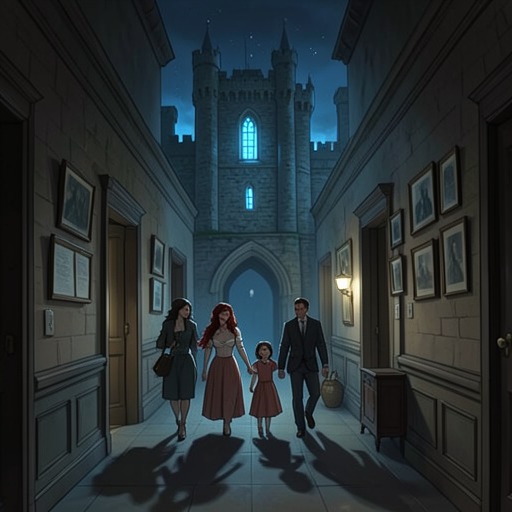
Inside, the promise of hospitality quickly deteriorates. The corridor before the family is cold and decrepit, and Edric begins to question the decision to seek shelter there. The architectural transition from the carriage to the corridor marks a value shift from uncertain safety to mounting entrapment. The family has reached shelter, but the shelter itself is already becoming an antagonist.
Vlad Dracula attempts to make the castle appear temporary and manageable. He tells the Wright family that he plans to move to England, invest in an estate there, marry, and live with his family, presenting the castle as a kind of vacation home. He also speaks of a residence in Buda, where he had been staying before being unexpectedly called back. This explanation gives the decaying building a respectable domestic frame, but the frame cannot contain what the castle actually houses.
The Castle as Supernatural Threshold
The family’s attempted departure confirms that Dracula’s Castle is not simply a physical location that can be entered and exited at will. After a long and terrifying ride, the horses drive the carriage straight back to the castle’s front door. They stop in the courtyard, tossing their heads and refusing to move, while the terrified driver issues harsh orders. The journey away from the castle thus becomes a return to it, converting geographical escape into supernatural submission.
Blue fire rolls and sways at the mouth of the courtyard, its iridescent flames appearing to enshroud three figures. The courtyard becomes a boundary guarded by an unnatural force, and the castle’s entrance is no longer a passive architectural opening. It is a point at which the family’s movement is intercepted and redirected. The building exerts power over the road, the horses, and the people attempting to flee.
The castle’s threshold also governs Glynis’s transformation. In its depths, she realizes that the apparent monsters are not external figures alone: the three beautiful women are monsters, and, to her horror, she has become one of them. The castle therefore operates as a place of recognition as well as terror. It reveals the nature that captivity and blood have forced upon her, making the building’s interior a map of her altered identity.
Chapel, Tombs, and Daylight Sleep
The deepest architecture of the castle is organized around concealment and suspended life. Cneajna leads Glynis down a narrow, spiraling staircase into the blackness below, explaining that they are going to the place where the vampires sleep during the hours of the sun. The descent turns the castle into a vertical hierarchy: the inhabited upper spaces give way to subterranean chambers associated with secrecy, burial, and the undead.
The vampires’ resting place is a chapel. Vlad waits there beside an ornate coffin whose lid has been drawn back. Ariana enters a nearby tomb, and Glynis hears a coffin lid slide into place. Elina presses herself against Vlad and kisses him passionately before he gently pushes her away; she then disappears into another tomb. These movements define the chapel as both domestic and sepulchral, a place where erotic allegiance, family hierarchy, and burial ritual coexist.
For Glynis, the chapel’s use is especially profane. Raised by an ardent Catholic, she finds it abhorrent that a once-holy space shelters vampires, and she senses the chapel pulsing with the evil that will sleep there. The castle thus contains a corrupted sacred center. Its religious architecture has not been erased but appropriated, turning the vocabulary of sanctuary into a structure for supernatural concealment.
Narrative Significance
Dracula’s Castle embodies the Gothic convergence of ruin, family history, and imprisoned identity. Its precipice, narrow windows, abandoned exterior, corridors, courtyard, staircase, chapel, coffins, and tombs progressively replace ordinary domestic space with a system of surveillance and confinement. The building first appears to be a refuge for a vulnerable family, then becomes the mechanism that prevents escape, and finally reveals itself as the environment in which vampirism is reproduced.
The castle also reverses the familiar journey toward safety. The Wright family travels toward shelter, but the destination is a threshold into death; they attempt to leave, but the road returns them to the same door; Glynis descends seeking knowledge and finds that the knowledge is inseparable from her own transformation. In this structure, the castle is not background scenery. It is the material form of the story’s central passage from the ordinary world into captivity, supernatural initiation, and the loss of human certainty.