Edric Wright
The Tale of the Vampire BrideEdric Wright, known in the family as Father and publicly as Earl Wright, is the patriarch whose authority cannot protect his family once their journey carries them into Vlad Dracula’s domain. He begins as a decisive husband and father, accustomed to directing travel and speaking for the household, but becomes an unwilling guest, captive, and finally a murdered spectacle. His death is not merely a family tragedy: it supplies the violence through which Vlad Dracula destroys the Wright family’s former social order and forces its surviving members into the world of vampirism.
Identity and Family Authority
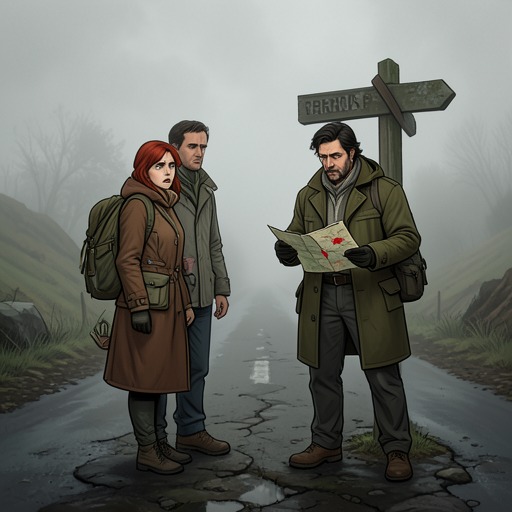
Edric Wright is presented through Glynis Wright’s recollections as the father whose presence organizes the family’s movements and social responses. During the journey toward the pass, he asks Glynis for her opinion, inviting the daughter who is outspoken enough to call their circumstances “bloody awful,” while Antoinetta Wright immediately corrects her as an improper young lady. The exchange places Edric within a conventional family structure, but it also shows that his authority is less punitive than connective: he asks, listens, and remains part of the conversation between his wife and daughters.
His practical authority becomes clearer when the carriage begins moving at alarming speed. Edric notices the danger, opens the window, and calls to Ovidiu to ask why the vehicle is traveling so rapidly. The answer is lost beneath the rattling carriage, yet his bewildered expression confirms that even the adult responsible for the journey no longer understands what is controlling it. The scene marks the first collapse of ordinary paternal competence. Edric can question the driver and guide, but he cannot master the forces carrying the family toward Dracula’s Castle.
Encounter with Vlad Dracula
At the castle, Edric is identified by Vlad Dracula as “Earl Wright,” a title that preserves the language of aristocratic hospitality while concealing the threat beneath it. Vlad approaches the carriage, recognizes Edric’s family, and treats their arrival as a “delightful accident,” although Edric insists that the family came through the Count’s invitation and that the castle was found by chance. The exchange exposes the imbalance between them. Edric still speaks as a guest explaining himself to a host; Vlad already speaks as the power that has received and enclosed him.
Edric’s resistance hardens during the meal. When Vlad’s behavior becomes intolerable, Edric sets down his fork and announces that the family intends to leave at dawn. He has already spoken with his driver and guide, and his stiff posture and cool voice show an attempt to recover control through orderly decision-making. Vlad’s rage at the announcement reveals that the proposed departure is not a matter of etiquette but a challenge to supernatural possession. Edric’s declaration therefore becomes the immediate trigger for the open conflict between the family’s will and Vlad’s claim over them.
Defiance and Execution
When the family is dragged into the castle, Edric does not submit quietly. Guards restrain him while gypsy women pull Glynis away from her relatives, and he continues struggling even as Antoinetta carries the collapsed May Wright. Seeing Vlad approach, Edric finally breaks free and launches himself at the Prince. His threat to kill Vlad is the clearest expression of his role as protector: faced with the abduction of his daughter and the captivity of his family, he converts paternal outrage into direct physical resistance.
The attack is futile. Vlad moves with such speed that Edric’s blow never lands; the impact of Vlad’s hand sends Edric to the floor, stunned. Vlad then declares that Edric will die first, turning the father’s attempted defense into the reason for his punishment. The sequence strips away every conventional safeguard surrounding Edric. Rank does not protect him, masculine force does not protect him, and the family’s status as invited guests does not protect them. Vlad’s power replaces law, hospitality, and social hierarchy with arbitrary possession.
Glynis later finds Edric displayed in the dining room, impaled on a huge golden ten-foot stake at the foot of the table. His body is blue, shrunken, and reduced to a husk, while his face remains fixed in an expression of terror and pain. The table’s prepared meal makes the setting especially cruel: ordinary domestic nourishment is placed beside the desecrated body of the family’s provider. Glynis’s refusal to accept the scene and her plea that he be taken down preserve Edric as a beloved father even after Vlad has transformed him into an object of intimidation.
Effects on Antoinetta and Glynis Wright
Edric’s death continues to govern the emotional lives of those left behind. Antoinetta records that his blood fell on her “like rain,” a memory that joins physical horror to helplessness. Imprisoned in the castle, she fears that May is also dead and even prays for Vlad to kill her so that her soul may be free. Her grief is inseparable from guilt: she believes that her insistence on arranging Glynis’s future and finding her a husband helped bring her daughter into the path of the Prince of Darkness, while Edric’s death confirms that the family’s former assumptions about protection and respectable marriage have failed.
When Antoinetta encounters Glynis after the transformation, Edric’s absence defines what she sees. The pale, fierce, beautiful vampire before her is still recognizably her daughter, but also the bride of Vlad Dracula. Glynis tells her mother that Vlad forced her to do horrible things and that she hates him for what he did to Father and May. Edric thus remains present in Glynis’s new existence as both a wound and a motive: his murder helps preserve her hatred of Vlad even while she is bound to him as a vampire bride.
Edric’s death also becomes part of Vlad’s psychological manipulation. While traveling with Glynis, Vlad boasts that he sent a storm after Edric when the Earl tried to escape with his family. He presents the pursuit as an impressive achievement and compares it to the beauty of his new bride, deliberately forcing Glynis to confront the role she played in the destruction of her own household. The boast turns Edric’s failed escape into a recurring emblem of Vlad’s control, while Glynis’s discomfort shows that her father’s death remains an active source of shame, grief, and resistance.
Narrative Role and Legacy
Edric Wright is a comparatively brief but structurally decisive presence. His early actions establish the ordinary world of family travel, paternal responsibility, and aristocratic self-command; his confrontation with Vlad then demonstrates how completely those values fail inside the castle. He is not defeated because he lacks courage. On the contrary, his attempt to strike Vlad gives his death moral clarity. He becomes the man who recognizes the threat and acts against it, even though the supernatural hierarchy has already made resistance nearly impossible.
His final significance lies in the contrast between fatherhood as protection and vampiric power as possession. Edric tries to move the family away from danger, questions the reckless journey, announces their departure, and attacks the captor who seizes his daughter. Vlad answers each act with acceleration, imprisonment, violence, and execution. Afterward, Edric survives only through the memories and guilt of Antoinetta and Glynis, through Vlad’s cruel recollections, and through the transformed identity forced upon Glynis. His death therefore closes the Wright family’s mortal order while becoming one of the central causes of Glynis Wright’s continuing conflict with Vlad Dracula.