Erzsébet Dolingen
The Tale of the Vampire BrideErzsébet Dolingen, also known as the Countess of Dolingen, is a vampire, Vlad Dracula’s once-favored bride, and the living prisoner he keeps impaled in a tomb. Her punishment makes the cost of defying Vlad physically visible; her curses, warnings, and recognition of Lady Glynis Wright’s strength make her more than an example of his cruelty. Even while trapped between life and death, she speaks and acts in ways that help Glynis imagine a future beyond his control.
Identity and History
Vlad identifies Erzsébet as his beloved wife and his most favored bride, and tells Glynis that she came from Gratz in Styria. The date above the tomb records that she “Sought and found death in 1801,” but this inscription describes neither her present condition nor a release: she remains alive, and the word “death” names the fate she sought rather than the state she has attained. The contradiction between the memorial wording and the woman still suffering beneath it establishes the tomb as a place where ordinary boundaries between life and death have been made brutally uncertain.
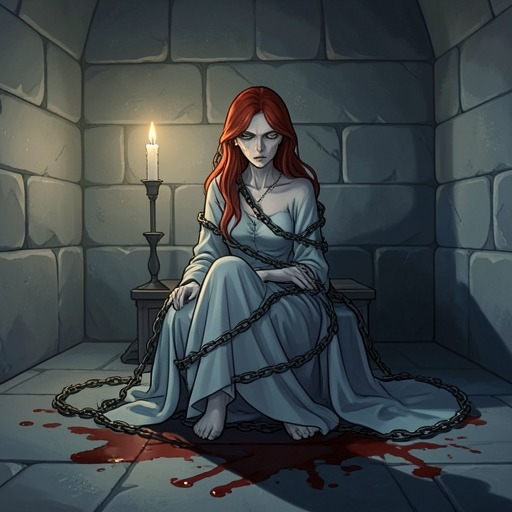
Her imprisonment began when she refused to obey Vlad. He says that her defiance drove him to punish her, but the scene gives the physical terms of that punishment more force than his explanation: a great iron stake enters through the roof, passes through her body, and is driven into the stone below. Each movement brings pain. Her elegant red-and-gold dress has faded and worn away, and pieces of its fabric lie across the floor amid the smell of old, dried blood. The once-fashionable garment preserves a trace of her former status even as the tomb reduces that status to a relic.
The Prisoner in the Tomb
Vlad brings Glynis to see Erzsébet as an object lesson in the fate that may follow disobedience. Torches flare at his gesture, revealing a beautiful woman on a raised platform, with thick black hair falling to the floor and amber eyes beneath dark lashes. The spectacle initially invites the gaze through her striking appearance, then turns that beauty into part of the horror: the stake holds her in place, and even reaching for it causes pain. A fresh body lies curled at the head of the platform, another grim detail in a chamber marked by old blood and continuing torment.
Erzsébet does not accept Vlad’s presentation of her as a cherished wife. She rejects him, calls him damned, and curses him while he insists that he loves her. His response—kissing her fiercely before withdrawing from her fangs—makes the contradiction in their marriage stark: he claims intimacy while maintaining the instrument of her torture. When she calls him a monster, he answers that he is Dracula. The exchange exposes the violence beneath the language of love and bridehood, while Erzsébet’s continued refusal to bless or forgive him preserves a voice Vlad has not silenced.
Her curse turns toward Vlad’s own history and vulnerability. She wishes that someone will cut off his head and impale it on a stake, as the Turks had planned, and laments that an impostor’s head was raised over Constantinople instead. She says she lives in agony to see his death. This is not a neutral account of the past but Erzsébet’s furious invocation of a punishment she wants reversed upon her husband. Her words transform the stake from a private instrument of control into the image of a possible reckoning.
Kinship Among the Brides
Erzsébet’s captivity is not absolute isolation. Ariana, Cneajna, and Elina have visited and fed her, and Ariana answers Erzsébet’s call with tenderness when she brings Glynis to the tomb. In front of Glynis, Ariana nourishes her by pressing their lips together and transferring blood from her own mouth. The intimacy unsettles Glynis, who recognizes that she is witnessing an act of care as well as feeding. Cneajna explains that the women used to come every few days, but Erzsébet has been starving since Glynis’s rebirth.
That shared care complicates the household Vlad rules. The women remain bound to the same master, yet their affection for one another creates a form of kinship not reducible to his claim over them. Erzsébet calls them her sisters, and when Glynis joins the group around the platform, she realizes that she has become part of this strange sisterhood. Blood, elsewhere the means by which vampiric power and hunger operate, is here also the means by which one imprisoned woman sustains another. The exchange does not free Erzsébet, but it prevents Vlad’s punishment from wholly defining the relationships within the tomb.
Erzsébet and Glynis
Vlad introduces Glynis to Erzsébet as his newest bride, a lady from England. Glynis recoils from the spectacle and promises to free the impaled woman. Erzsébet responds not with a plan for immediate escape, but with a warning shaped by her own experience: if Glynis escapes Vlad, she must keep running and not let him destroy her as he has destroyed Erzsébet. The warning gives Glynis a direct account of what life under Vlad’s affection can become, from the person who has endured its most visible consequence.
On a later visit, Erzsébet appears still more drawn, pale, and tormented by hunger. Yet she offers Glynis more than a warning. She touches Glynis’s face with maternal tenderness and tells her that, when Vlad first brought her to the tomb, she saw in Glynis her own will, pride, and strength. Erzsébet says she has seen in dreams that Glynis will escape and that Vlad will not be able to hold her. Glynis answers that she will escape. The exchange links the imprisoned woman’s insight to Glynis’s emerging resolve, without pretending that a prediction itself breaks the stake or opens the tomb.
Narrative Role and Significance
Erzsébet is a counter-image to Vlad’s claim that marriage and possession can be made permanent. He calls her his beloved wife, but her suffering and curses reveal the coercion that claim conceals. Her body records his punishment; her speech contests his version of their bond. The tomb makes the conflict architectural as well as personal: a woman who refused obedience is enclosed in a chamber bearing the language of death, yet remains present to condemn the man who put her there.
Her importance to Glynis lies in this combination of warning and recognition. Erzsébet knows the danger of staying, urges flight, and sees in Glynis a strength that the vampire household’s rules are meant to suppress. At the same time, her own continuing captivity limits the promise of their bond: the other brides can visit and feed her, but the stake remains in place. When Vlad later says that Erzsébet’s jewels will be given to Glynis for her journey to Buda, even her possessions appear available for reassignment by the man who imprisoned her. Erzsébet thus embodies both the persistence of female solidarity under Vlad’s domination and the unresolved cost of resistance: she can help Glynis name the possibility of escape, while remaining herself trapped in the tomb.