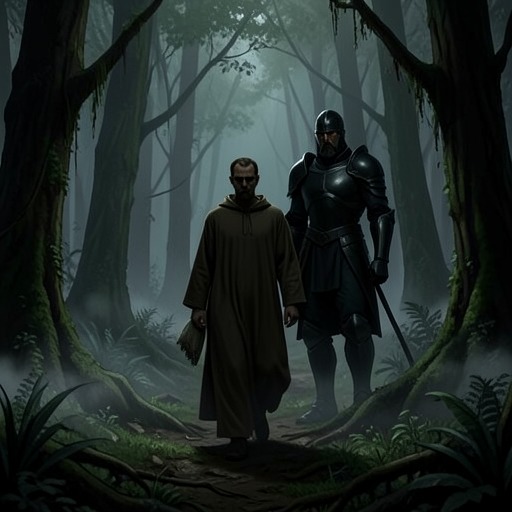
Gregor
The Tale of the Vampire BrideGregor is a Dhamphir vampire hunter whose pursuit of Glynis turns him from a shadowy presence into a recurring physical threat. He hunts vampires with silver weapons and insists that his violence is personal as well as purposeful: later, he identifies the death of his sister as the reason he bears a grudge against those he considers responsible.
Identity and First Encounter
Gregor first appears from the shadows near Glynis’s carriage as a tall, wiry, unnaturally pale man dressed in black, with white hair and eyes pale as frozen water. Glynis senses that he carries formidable power, though he seems neither wholly vampire nor wholly mortal. He introduces himself as a Dhamphir and announces his intention to end her existence, treating her vampirism as proof that she belongs to an enemy kind. He also claims that vampires gave birth to his kind, a statement that makes their conflict one of origin as well as pursuit.
His appearance announces the practical means of that pursuit: tiny silver daggers concealed in his sleeves. Gregor taunts Glynis as a devil’s bride, and she runs toward the bridge over the Danube to Buda. She has not fed, and her strength is already diminished. When his thrown daggers force her to the ground, she draws the night around herself to become invisible. Gregor does not immediately see her, but he searches the place where she vanished, moving with daggers ready; even when she evades his sight, he seems able to follow her trail. She manages to kick him hard enough to snap his head back, but the brief advantage does not end the hunt.
Gregor catches up with Glynis in a street after her powers fail. He seizes her from behind, holds a knife to her throat, and demands to know her name and the identity of her master. When she refuses to expose Vlad, Gregor cuts open her dress and presses his knife into her breast, burning her with the silver as he threatens further mutilation. Glynis believes that revealing the truth would bring immediate death, so she continues to resist despite her pain and fear. An unseen force suddenly knocks the knives from Gregor’s hands and throws him against a building; it strikes him again as Glynis escapes. A gentleman vampire then lifts her into the night sky, leaving Gregor below, howling in frustration.
Return to the Hunt
Gregor’s pursuit resumes in Buda during the flight toward Astir’s haven, where Glynis rides with Ignatius, Magda, and her child while Vlad follows. Gregor appears suddenly in the street before Ignatius’s horse, dressed in black and reaching for the daggers concealed in his coat. This time his motive is explicit: he says that he will not forgive those who killed his sister. The accusation makes his hunt more than an abstract campaign against vampires; he sees the people fleeing with Glynis as answerable for a personal loss.
A flash of silver sends Ignatius’s horse rearing and crashing down. Magda is thrown with the child but holds on and cushions his fall with her body. Gregor advances on the fallen Ignatius, apparently unaware of the others, and Glynis’s horse leaps over its injured companion toward the hunter. When the horse later rises and strikes Gregor, knocking him to the ground, the fugitives gain a moment to escape. At Vlad’s command, Ignatius leads Glynis, Magda, and the child through Buda’s streets toward the haven, carrying Magda and her son across his shoulders. Their flight is urgent: Ignatius warns that the vampires are weakened by lack of blood, while Gregor is full of it.
Gregor nonetheless overtakes the danger on the road. Vlad appears bleeding heavily, and Glynis believes he has defeated the hunter, but Gregor comes up behind him and plunges both daggers into his back several times before disappearing. With a sword in hand, Gregor confronts Vlad again; Ignatius turns back toward the street, leaving the others inside the haven. Gregor follows the fugitives to the threshold and steps across it, bringing his pursuit into the protected space.
Astir confronts the intruder in a transformed, towering aspect, with wings of flame and a glowing white robe. Gregor’s entry ends his advantage: Astir’s force casts him away from the haven. Rather than being killed, he is left sputtering and wailing as he swims out through the Danube. The outcome reverses the hunt’s earlier pattern. Gregor had pursued Glynis as though he could dictate the terms of every encounter; at the haven, his violence meets a boundary he cannot master, and he is driven from the scene alive.
Ideology, Revenge, and the Limits of His Authority
Gregor frames his attack on Glynis as an act of salvation: he treats her as a devil’s bride and presents her destruction as the proper end of a vampire’s existence. His language turns the hunt into a moral judgment, but the encounter itself exposes its brutality. After Glynis refuses to reveal who her master is, Gregor uses a knife to torture and threaten her, making his supposed deliverance inseparable from coercion. The scene does not establish that his religious language reflects a broader code; it shows how he uses it to cast his violence as righteous.
His later accusation that the fugitives killed his sister supplies a personal grievance behind the pursuit. The claim sharpens his hostility, but it does not explain the circumstances of her death or establish the responsibility of each person he targets. In Buda, he attacks the group as they flee, then turns on Vlad, stabbing him from behind before disappearing. That reversal makes Gregor more than a hunter closing in on Glynis: he is also a threat to the vampire who commands her, though the text does not show him defeating Vlad.
Gregor’s repeated appearances are structured around a contest over who controls the encounter. On the road, weakened powers leave Glynis vulnerable to his weapons; at the haven, his own pursuit crosses a boundary he cannot overcome. Astir drives him into the Danube, but does not kill him. Gregor therefore ends this sequence alive and expelled rather than reconciled or defeated outright, preserving the possibility of renewed danger while showing that his authority as a hunter has limits.
Narrative Function and the Reversal of the Hunt
Gregor’s two attacks reveal different limits on his power. In his first pursuit, Glynis’s weakening strength and fading concealment let him seize and torture her, but an unseen rescuer interrupts the assault before he can learn who commands her. In Buda, he returns with a grievance made explicit and turns his weapons against the fleeing party, even striking at Vlad. Yet the chase carries him across the threshold of Astir’s haven, where the hunter becomes the one forcibly removed. His survival matters: Astir sends him into the Danube rather than killing him, so the confrontation closes with expulsion, not resolution. Gregor remains a danger whose pursuit has been checked, while the repeated reversal—from hunter to prey—marks the boundary of what his violence can command.