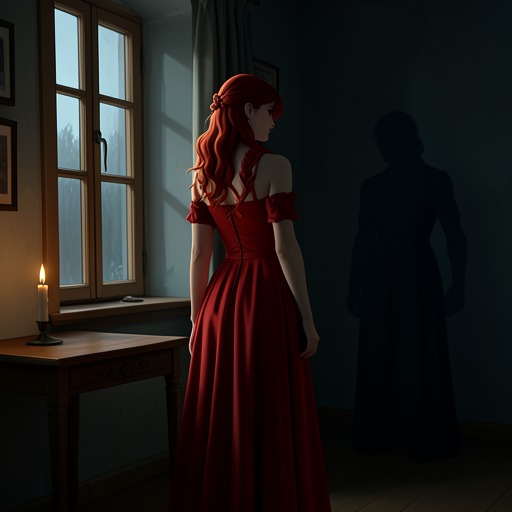
I will escape. I will be free.
The Tale of the Vampire BrideI will escape. I will be free. names the vow that gives Lady Glynis Wright a purpose inside the captivity imposed by Vlad Dracula. It begins as a plea from her dying mother and becomes Glynis’s own promise, spoken while hunger threatens to overwhelm her. Its force lies not in a single declaration of victory but in its recurrence as a discipline: Glynis survives, resists immediate retaliation, and continues to look for a way out even as the conditions of her imprisonment change.
Origin in Her Mother’s Plea
The resolve takes shape in the cell where Glynis’s mother, Antoinetta Wright, asks her to fight Vlad and escape. Antoinetta makes Glynis’s future freedom the condition on which she can die in peace. The request joins escape to resistance: leaving is not merely a wish to get away, but something Glynis must actively struggle to achieve. Glynis answers with a promise while she is already being torn by the hunger that calls her to feed on her mother.
That promise is tested almost immediately. After Antoinetta dies, Glynis cradles her body, weeps, and recognizes that feeding has appeased the hunger. She tells her mother she is free, then renews her vow to escape. The sequence places the promise beside an act Glynis experiences as unbearable: her survival is bound to the death of the person who asked her to live and resist. Antoinetta’s body has given birth to Glynis; now, as Glynis understands it, her mother’s blood gives her the strength to endure what Vlad will inflict.
Antoinetta’s final gestures give the vow a sacred and personal dimension. She lays aside her journal, makes a small hole in the dirt and straw, genuflects, kisses her rosary, and buries it. Glynis later interprets her mother’s body and blood not as a desecration Vlad intended, but as a holy sacrament. Escape is therefore connected to memory and inheritance: Glynis carries forward Antoinetta’s edict, and makes survival an answer to her mother’s sacrifice.
A Promise That Governs Conduct
The vow does not make Glynis immediately powerful or free. Instead, it gives her a reason to endure the limits of her power without surrendering her longer purpose to the anger of the moment. When she longs to unleash violence against Vlad and the others, she remembers what she promised her mother. She obeys the warning not to act, recognizing that defiance could delay her escape or leave her killed or imprisoned. The promise functions as restraint, but not as acceptance: Glynis suppresses an immediate impulse in order to preserve the possibility of acting on her own terms later.
Her captivity also gives the idea of freedom a daily, bodily dimension. Glynis resents having to abandon her own clothes for an outfit she finds degrading, and describes her new life in the castle as another restrictive society after the constraints of her former one. Earlier, she had imagined living as a woman with the freedom men possess to do as they please. That earlier desire makes her later vow more than a response to a locked room: the freedom she seeks includes control over how she lives and appears, not simply release from one place.
The conflict continues through the rules governing her appearance. Vlad orders that she wear a veil around Andrew Wright, and in Buda she finds the organza and lace so obstructive that she rips the veil from her face. He also tells her to avoid clothing or jewelry her brother would recognize, supplying dresses her mother bought in Paris and jewels belonging to Erzsébet Dolingen instead. These details show Vlad managing what Glynis can reveal and how others will read her. Her refusal to remain comfortably within that managed image gives material form to the independence her promise demands, even though removing the veil does not itself end her captivity.
From Endurance to Strategy
The vow’s persistence becomes most consequential when Glynis has reason to fear for Andrew. Vlad permits her to leave the castle for Buda and visit her brother, but sets the terms: she must answer the Beckoning, conceal her former possessions, and demonstrate loyalty as he prepares her for the position of his true bride. The promised freedom to hunt on her own is conditional, and Vlad’s plans for her remain part of his larger design. Glynis’s journey is thus a change in circumstance, not proof that she has escaped his authority.
At the opera, the contrast between Andrew and Vlad sharpens her awareness of the life she is trying to recover. She sees her brother as alive with light and goodness, while Vlad’s presence seems dark and menacing. In her fine black-and-gold dress, she feels radiant and, for a moment, alive rather than undead. Yet she also identifies herself as Countess Dracula. The scene holds together the competing identities through which Vlad’s control operates: sister, wife, vampire, and noblewoman. The outward splendor offers no simple resolution, but makes visible the distance between looking free and possessing freedom.
By the later confrontation in the throne room, Glynis’s promise has become a practical calculation as well as an act of loyalty to Antoinetta. She leaves the violence transformed and determined, and, writing alone afterward, judges that Vlad has begun to respect her strength and cunning. She considers using that new regard to free herself. Her resolve is no longer simply to escape the castle by enduring until an opportunity appears; she intends to make her own judgment and intelligence instruments of escape.
Meaning and Development
The expression’s development follows Glynis’s changing relationship to power. At first, freedom is something Antoinetta begs her to pursue, and Glynis accepts the burden in the midst of hunger and grief. Later, memory of the promise checks her anger when acting violently would endanger her larger aim. Finally, she reads Vlad’s response to her strength as a possible opening. The underlying purpose stays constant, but the means shift from endurance, to restraint, to strategy.
This movement also distinguishes resistance from a clean return to Glynis’s former life. She has fed, and she no longer claims to be untouched by the hunger; she says she is not afraid of it and still identifies herself as Lady Glynis Wright. Her promise does not undo the transformation or restore what captivity has taken. It preserves a claim to agency within those conditions. By turning Antoinetta’s last request into a continuing commitment, Glynis makes freedom both a future objective and the principle by which she judges what to do next.