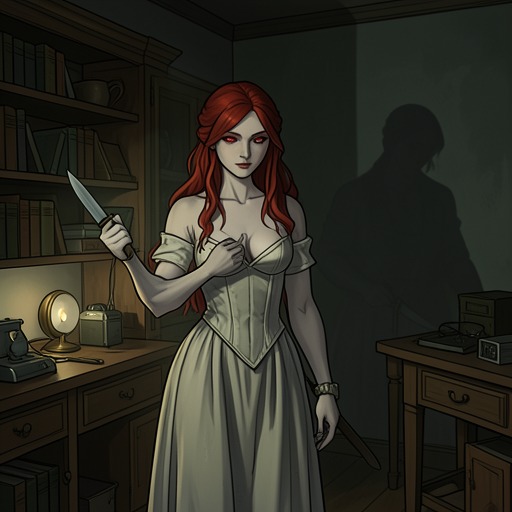
Ilona
The Tale of the Vampire BrideIlona is the old gypsy servant who helps operate Vlad Dracula’s castle and repeatedly appears at the points where hospitality, captivity, and vampiric discipline meet. She prepares rooms, oversees the kitchen, warns against forbidden spaces, delivers the Prince’s commands, and explains the household’s rules to Glynis Wright. Though she is not one of the castle’s ruling vampires, her knowledge and obedience make her an essential intermediary between Vlad Dracula, the vampire brides, the gypsy servants, and the Wright family.
Identity and Position
Ilona is introduced as a small, old gypsy woman who emerges from the shadows carrying a lantern after Vlad Dracula receives the Wright family. When Vlad orders that the rooms be prepared immediately, Ilona answers with a quick nod and disappears into the darkness to carry out the command. Her first appearance therefore establishes her as both a servant and a creature of the castle’s obscurity: she belongs to the household’s laboring structure, but she also seems perfectly adapted to its hidden passages and nocturnal authority.
Her duties extend beyond isolated errands. In the dining room, Ilona supervises several gypsy women as they set the table, and she turns toward the arriving family with a toothy smile and an invitation to enter. The scene presents her as the practical manager of the castle’s domestic surface. Meals, rooms, servants, and ceremonial welcome all pass through her hands, even though the power behind them belongs to Vlad Dracula. Her service gives the castle an appearance of order while concealing the violence that sustains it.
Guardian of the Castle’s Boundaries
Ilona also acts as a warning presence. When Glynis Wright is drawn toward the dangerous lower regions of the castle by seductive whispering voices, Ilona finds her at the top of the stairs with May Wright behind her. With her hands on her hips and an angry expression, she commands Glynis to come at once and declares that the area is unsafe. This intervention interrupts Glynis’s trance, but it does not remove the attraction of what lies below. Ilona can police the boundary; she cannot make the hidden world beyond it cease to call.
After the Wright family’s destruction, Ilona enters Glynis’s room with a disapproving, craggy face and tells her that it is time to eat. When Glynis pleads for news of her family, Ilona does not offer comfort or concealment. Instead, she directs attention to the gold goblet Vlad Dracula has provided and presents the choice between it and the prepared meal. She tells Glynis to drink and frames the blood as restoration of the life taken from her. In this moment, Ilona becomes the interpreter of the transformation’s first practical demand: the captive must choose between human food and the blood that will sustain her new existence.
Her explanations continue after Glynis becomes a vampire. When Glynis looks at the servants and asks whether they are food, Ilona answers that they are servants and must not be touched. Glynis is thus taught that the castle has a hierarchy even within predation. The human attendants are vulnerable, frightened, and subordinate, but they are protected by a rule of the household. Ilona’s instruction makes her the immediate voice of that rule, translating Vlad Dracula’s system into a command Glynis can understand.
Ilona and Glynis Wright
Ilona’s relationship with Glynis Wright is marked by surveillance, instruction, and fear. When Glynis turns her attention toward Ilona, the old woman freezes with the brush suspended in her hand. Her dark eyes, surrounded by countless wrinkles, are fixed upon Glynis’s gaze, and Cneajna whispers that Glynis must not act. The small domestic object in Ilona’s hand emphasizes how abruptly household service can become mortal danger: the woman who brushes and tends the vampire brides may at any moment become their prey.
The danger becomes explicit when Ilona later encounters Glynis after the latter has begun to hunger for blood. Ilona is frightened, and Glynis’s concentrated gaze exerts a predatory pressure over her. Glynis asks whether she is beautiful, turning appearance into a test of power, while Ilona’s vulnerability exposes the cost of the new vampire’s awakening. Yet Ilona survives this encounter. Her survival suggests that the castle’s servants are not merely available victims; their protected status and the household’s prohibitions still constrain Glynis’s impulses.
Ilona also carries out the domestic enforcement of Glynis’s status as Vlad Dracula’s new bride. When Vlad summons company to his bedchamber, Ilona tells the women that the Master desires company. Glynis refuses, insisting that she does not love him and will not allow him to touch her again. Ilona anxiously explains that Vlad has asked for the new bride, while Cneajna physically pulls Glynis toward the door and declares that going is her duty. Ilona’s role is quieter but structurally important: she conveys the summons and embodies the expectation that a bride must answer it.
Servitude, Knowledge, and Household Order
Ilona’s authority comes from proximity to the household’s rules rather than from personal sovereignty. She knows which parts of the castle are unsafe, which people may be touched, when meals must be served, and how the Master’s summons must be obeyed. Her English is described as thick, and her speech often carries the weight of inherited custom rather than abstract explanation. She does not debate the legitimacy of Vlad Dracula’s commands; she makes them operational.
That position places her between the human and supernatural orders. To the Wright family, she is one of the gypsy women serving their meals. To the vampires, she is a servant who can be summoned, questioned, and threatened. To Glynis, she becomes one of the first figures through whom the new rules of vampirism are learned. Even when her face reveals fear, she continues to perform her duties. The combination makes her both a participant in the castle’s violence and one of the people most exposed to it.
Ilona’s work also reveals the political character of the castle’s domestic rituals. Clothing, food, rooms, and summons are not neutral comforts. They regulate identity and obedience. Glynis’s later frustration with the restrictive clothing imposed on her and with the expectation that she attend Vlad Dracula demonstrates how the household turns service into discipline. Ilona is the person who delivers or facilitates these disciplines, but the structure belongs to the Master. Her apparent ordinariness therefore makes the supernatural regime more convincing and more disturbing: the machinery of imprisonment operates through meals, dress, grooming, and formal calls to the bedchamber.
Narrative Significance
Ilona is a threshold character. She appears at doors, stairways, dining tables, bedrooms, kitchens, and moments of transition, repeatedly marking movement from one condition to another. She welcomes the Wright family into the castle, interrupts Glynis’s approach to its forbidden depths, announces the meal that begins Glynis’s vampiric existence, warns that servants cannot be eaten, and conveys the demand that the new bride submit to Vlad Dracula’s summons.
Her presence gives the castle a human face without making it safe. The frightened old woman can be stern, efficient, and even welcoming, yet she remains bound to the same oppressive order that threatens Glynis. Through Ilona, the narrative shows that the castle’s terror is not produced only by the vampires’ spectacular violence. It is maintained by a network of servants who prepare rooms, carry lanterns, supervise meals, groom the inhabitants, and repeat commands. Ilona’s recurring appearances make that system visible: she is the household’s aging hands and wary eyes, an indispensable servant whose labor turns vampiric domination into everyday routine.