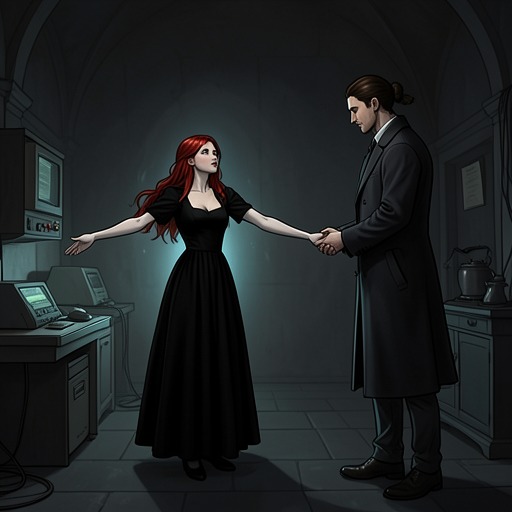
István
The Tale of the Vampire BrideIstván, Cneajna’s mortal husband, is remembered not as a supernatural power but as the human agent through whom her first life becomes a tragedy of marriage, inheritance, and dispossession. A great warrior favored at the court of King Matyas of Hungary, he initially appears to Cneajna as a man she can love and build a future with. His later demand for an heir, however, turns affection into judgment: when Cneajna cannot bear a child, István’s love fades, his household shifts toward another woman, and the marriage becomes the structure that confines and humiliates her.
Identity and Marriage
Cneajna describes István as a warrior who had fought under King Matyas and whose marriage to her was encouraged by the king, who was also her mother’s cousin. She first refused the proposed match, but changed her mind after meeting him and came to love him. In her recollection, István may genuinely have loved her at the beginning of their marriage, and this remembered tenderness makes his later rejection more devastating. Her account is not of a union that was always openly cruel; it is of affection eroded by dynastic expectation.
The decisive condition of the marriage is István’s wish for an heir. Cneajna believes that he loved her until her failure to produce the child he wanted altered his feelings. Years without children lead him to withdraw from her and take a young woman named Piroska into the household. Cneajna presents this arrangement as something permitted by the husband’s social and marital rights: István was understood to have the right to secure an heir, even at the cost of his wife’s emotional and domestic position. The language of right therefore masks a transfer of power, allowing his reproductive ambition to determine the status of both women.
Piroska and the Loss of Position
Piroska eventually bears István three sons, while Cneajna remains childless. The contrast turns an already unequal household into a continual display of Cneajna’s displacement. Piroska taunts her, takes over her position among the servants, occupies her chambers, wears her gowns, and claims her jewels. Cneajna is forced into smaller rooms while the woman who has replaced her rises to control the household. She fears that, without the protection of her royal cousin, István would have cast her out entirely in Piroska’s favor.
István’s own behavior intensifies the humiliation. He ridicules Cneajna in Piroska’s presence, telling her that her beauty is wasted and associating her worth with the supposed dryness and failure of her womb. The insult joins physical appearance, fertility, and marital value into a single patriarchal measure. Cneajna is not merely denied affection; she is made to experience her body as evidence against her. Her repeated pleas that István return to her and give her another chance to bear his child show how thoroughly the household’s hierarchy has shaped her hopes.
For a brief moment, István does return to Cneajna, and she becomes pregnant. The pregnancy seems to promise the restoration of the marriage and the fulfillment of the role from which she has been excluded. That promise ends when Piroska, jealous because her youngest son, János, has become attached to Cneajna, confronts her and pushes her to the floor. Cneajna bleeds and loses her only child by nightfall. When she tells István that Piroska caused the miscarriage, he refuses to listen. His response is not protection or investigation but disgust, followed by a final withdrawal from her bed.
From Neglect to Violence
Cneajna’s isolation is made more complete by the absence of refuge. Her parents are dead, her brothers are occupied fighting the Turks, and she is too proud to seek sanctuary from King Matyas. She remains in the home where another woman lives the life she believes should have been hers. István’s failure to hear her accusation leaves Piroska’s power intact and confirms that Cneajna’s position depends not on justice but on whether her husband chooses to recognize her.
The final rupture occurs when Piroska announces another pregnancy while mocking Cneajna, wearing her clothing, displaying her jewels, and carrying István’s child. Cneajna has been eating and still holds a knife when Piroska enters. She intends to strike her, but instead cuts her cheek. The sight of blood and the sound of Piroska’s screams intensify her rage; she slashes Piroska again and then repeatedly drives the knife down until she is silent. The violence is not presented as a calculated political act. It erupts from accumulated humiliation, reproductive grief, jealousy, and the destruction of Cneajna’s place within her own home.
István discovers Cneajna kneeling over Piroska with the knife still in her hands. What horrifies him most, according to Cneajna’s recollection, is not only the murder but the fact that she is licking Piroska’s blood from her lips. That gesture becomes a disturbing threshold between mortal rage and the blood-centered existence that will later define Cneajna as one of Vlad Dracula’s Brides. István recognizes the act as monstrous, while Cneajna herself later admits that she had become insane with jealousy and desperation and felt no remorse at the time.
Punishment and Afterlife of the Marriage
István does not kill Cneajna after discovering Piroska’s corpse. Instead, he takes her before King Matyas, transferring the matter from the household to royal judgment. The king is less horrified than István because, as a ruler who had fought for his throne, he understands the force of a desire so desperate that it can lead to killing. Even so, Cneajna must be punished. Matyas sends her to Visegrád, his summer palace, where she is confined to the grounds until her death.
The sentence exposes the limits of István’s authority as well as its cruelty. He had been able to bring Piroska into the home, permit her ascent, and abandon Cneajna after the loss of the child; yet once Cneajna turns that domestic hierarchy into bloodshed, he places her under royal control rather than seeking reconciliation or acknowledging the conditions that helped produce the violence. Cneajna’s confinement is nevertheless paradoxical. Visegrád, with its beautiful views and red marble fountains, feels to her like heaven compared with the household she has left. She spends hours in the sun beside the Danube River, discovering in punishment a serenity that marriage never provided. István therefore remains central to her mortal history even after he disappears from the immediate action: his marriage creates the wound, while the royal sentence gives her the first space in which that wound is no longer being actively reopened.
Narrative Function and Thematic Significance
István is remembered through Cneajna’s account rather than through an independent voice, and that structure makes him both a person and the embodiment of a social order. He is introduced as a desirable warrior and favored court figure, not as an obvious villain. His transformation from beloved husband to rejecting patriarch follows the logic of inheritance: affection survives only while it appears compatible with the production of a male heir. His conduct shows how marriage, household rank, sexuality, and property can be organized around a woman’s fertility.
His relationship with Piroska also reveals that the household’s apparent domestic arrangement is a competition produced by male privilege. István’s acceptance of a mistress and her children does not simply create a romantic triangle; it creates rival claims to rooms, clothing, jewels, servants, and recognition. When Piroska takes Cneajna’s chambers and possessions, the material world confirms the change in status. István’s ridicule gives that displacement an ideological justification, reducing Cneajna’s beauty and worth to the condition of her womb. The resulting conflict resembles a struggle between women, but its governing standard is established by the husband’s demand for an heir.
The marriage also provides a mortal precedent for later relationships in the narrative. Cneajna’s story helps Glynis understand how the titles of wife, Bride, and helpmate can conceal coercion. Glynis is herself commanded to go to Vlad Dracula because it is considered her duty, and she later resists the clothing and confinement imposed upon her as a new Bride. Cneajna’s history gives those conflicts a longer genealogy: both women are expected to become legible through male possession, reproductive or erotic usefulness, and obedience. István’s household is mortal, but the structure of domination that shapes it reappears in supernatural form.
At the same time, Cneajna’s later intimacy with Glynis complicates the legacy of the marriage. Cneajna feeds Erzsébet by transferring blood through a kiss, and she later kisses Glynis softly on the lips and brow while confessing love for her. These acts of female tenderness and blood exchange stand against the marriage model that reduced Cneajna to a failed bearer of heirs. They do not erase her violence, but they show that her capacity for attachment survives outside the marital order that destroyed her mortal happiness.
Legacy in Cneajna’s Character
Cneajna’s confession makes István the absent human origin of several traits that define her later conduct: jealousy, fear of displacement, possessiveness, and an acute awareness of how quickly affection can become rejection. Her murder of Piroska is a horrifying act, but the narrative places it within a chain of humiliation rather than treating it as inexplicable evil. Cneajna can name both the cruelty done to her and the madness into which she descended. That double recognition gives her account a tragic complexity: she was wronged, and she became a killer; she was denied power, and she exercised it destructively.
For Glynis, the story is more than historical information. She responds with sympathy because she recognizes the desperation of wanting to destroy the person who seems to be destroying her. Her identification links Cneajna’s mortal rage to Glynis’s own hatred of Vlad Dracula, while the image of Cneajna licking blood from her lips foreshadows the way vampiric violence can transform grievance into appetite. István’s importance therefore lies less in his later presence than in the pattern he leaves behind. He is the husband whose demand for an heir turns love into a hierarchy, whose refusal to believe Cneajna completes her isolation, and whose household becomes the first setting in which her suppressed self breaks into bloodshed.