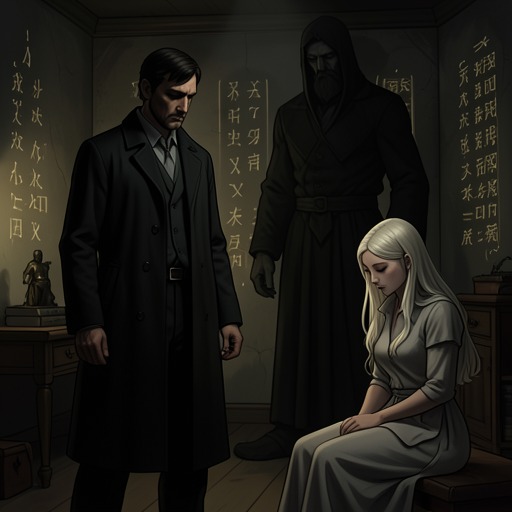
May Wright
The Tale of the Vampire BrideMay Wright is the younger sister whose vulnerability makes the Wright family’s captivity at Dracula Castle personal before it becomes monstrous. Timid, frequently ill during travel, and fearful of adventure, she is nevertheless adored by Glynis Wright, who remembers both bullying her into taking part in family excursions and reading to her while May curled against her. May’s death is not merely one casualty in the family massacre: it becomes the wound around which Glynis Wright’s guilt, resistance, and fractured identity are organized.
Identity and Early Character
May Wright is presented during the family’s journey through the Carpathian Mountains as wan, sickly, and habitually frightened. Her dark blue eyes look fearfully from beneath her bonnet, and she worries aloud that the carriage will fall down the mountain. Travel by both water and land makes her ill, so that even ordinary movement becomes an ordeal for her. Glynis Wright describes herself as loving May while also admitting that she had to bully her timid younger sister into joining any adventure. The contrast establishes May as physically delicate and emotionally cautious, but not insignificant: her gentleness is precisely what makes Glynis feel protective and responsible for her.
May’s innocence also appears in her spontaneous response to Prince Vlad Dracula. When the family first encounters him, she whispers that he is handsome, while Glynis Wright, already sensing something disturbing in his presence, struggles to regain her composure. May therefore sees the surface of the encounter more readily than Glynis does. Her response does not make her foolish; it shows how completely the family’s expectations are overturned by Vlad’s commanding appearance and concealed violence.
Captivity and Separation at Dracula Castle
The family’s arrival at Dracula Castle turns May’s fear of travel into actual helplessness. During the forced removal of the Wright family, May collapses, and Lady Antoinetta Wright carries her into the castle. From a distance, Glynis Wright sees her mother holding May in her arms with May’s eyes closed and her long hair spilling across her mother’s shoulder. At the same moment, Edric Wright struggles against the guards and confronts Vlad, only to be struck down when he attempts to attack him. May’s unconscious body and Edric’s failed resistance show the family being dismantled through both physical force and emotional terror.
Glynis later finds May alone in a small storage room among huge trunks. May crawls out to her sister, filthy, disheveled, and swollen-eyed from weeping. She explains that she fainted after the family was brought into the castle and woke alone without knowing where her parents were. Her reunion with Glynis briefly restores the protective bond of their former life: Glynis embraces her, rocks her gently, and kisses her forehead despite her own pain. The scene makes the castle’s horror legible through May’s immediate need for shelter and reassurance rather than through supernatural spectacle alone.
That shelter proves temporary. When the vampire brides awaken and demand that Glynis join them in feeding, May screams and searches for her in the darkness. A blond vampire pulls Glynis into a trunk and shuts the lid while May beats against it, repeatedly calling her sister’s name and asking where she can hide. May’s cries transform the trunk from a hiding place into a barrier between the sisters. Glynis’s refusal to abandon her is made physically impossible, and the sound of May outside intensifies the coercion surrounding Glynis’s initiation.
Death and the Afterlife Image
During Vlad Dracula’s forced feeding of Glynis, May appears to Glynis as a radiant figure emerging from a light brighter than the sun. The vision reaches toward Glynis and represents the freedom and peace she longs for while blood is being taken from her body. Glynis whispers May’s name, and Cneajna urgently orders Vlad to stop because Glynis’s heart is weakening. May’s image thus functions as a possible rescue at the threshold between mortal life and vampiric transformation, whether understood as supernatural truth, dying vision, or the mind’s final attachment to its most beloved person.
After Glynis becomes a vampire, she learns the full horror of the fate imposed on her. Cneajna tells her that Vlad wanted her to feed on May. Glynis cannot bear the thought and runs through the castle, searching anxiously for Lady Antoinetta Wright and fearing that her mother may have become her first kill. When Ariana approaches and claims a sisterly relation, Glynis rejects her completely: her sister was May, and May is dead. Ariana’s mocking suggestion that being dead and being Glynis’s sister are therefore much the same exposes the vampire brides’ attempt to absorb May’s identity into their own unnatural community. Glynis refuses that substitution.
May’s presence returns in a second, more painful form when Glynis feeds on her mother. Lady Antoinetta Wright speaks of a light and calls for May, but Glynis sees no angelic apparition. The contrast with Glynis’s earlier vision matters: May may have come to Glynis at the moment of her own death, but she does not appear to bless the killing of their mother. The absence leaves Glynis facing the material reality of what she has done rather than receiving supernatural consolation.
Memory, Family, and Later Consequences
Glynis’s memories of May remain among the most painful remnants of her mortal identity. She recalls May as wide-eyed, innocent, calm, and rarely willing to undertake adventures, yet also remembers her with unmistakable tenderness: May was warm, frail, delicate, and sweet as she curled against Glynis while Glynis read to her on the bed. These memories resist the vampire hunger’s pressure to reduce the past to disposable prey. They keep May present as a loved person rather than as an object of feeding.
That memory also becomes inseparable from guilt. Glynis remembers Edric Wright and Lady Antoinetta Wright with affection, but May’s death is especially piercing because Glynis was forced to hear her cries, was prevented from protecting her, and later understands that Vlad intended May to become her first victim. The family’s destruction therefore continues inside Glynis as a conflict between love and imposed predation. May is the clearest proof that Glynis’s humanity has not vanished even when her body and appetites have been remade.
May’s name persists into Glynis’s later life in Buda and in the plans surrounding England. Andrew Wright tells Glynis that Angeline Wright is waiting for them and that their infant son, John Andrew Glenn, bears the same shade of red hair as Glynis; the child’s name includes Glenn after her. This family future does not restore May, but it places the dead sister within a larger chain of family remembrance. Andrew’s attempt to bring Glynis home consequently carries the promise of renewed kinship while also confronting the permanent absence created at Dracula Castle.
Glynis’s attachment to May also shapes her distance from the vampire household. In Buda, she realizes with guilt that she scarcely misses the vampire sisters. Cneajna remains vivid because of her teasing smile and motherly affection, but Glynis recognizes that she can continue without her vampire mother. Freedom from the castle where her mortal family perished is more compelling than the comfort of the undead sisterhood. May’s death is therefore part of the reason Glynis cannot treat the vampire household as an adequate replacement family.
Narrative and Thematic Significance
May Wright occupies the position of the absent beloved: she has little power over the events that destroy her, yet her face, voice, and remembered body govern Glynis Wright’s moral consciousness long afterward. Her fear summons protection before the supernatural plot fully unfolds; her cries reveal the violence of the brides’ initiation; her death marks the point at which family love is converted into vampire hunger; and her recurring image prevents that conversion from becoming complete.
May also embodies the ethical claim of the vulnerable other. Her smallness and terror are not simply decorative signs of innocence. They place Glynis under a responsibility that cannot be fulfilled because Vlad Dracula and the castle’s servants physically separate the sisters. Glynis’s later refusal to recognize Ariana as May’s equivalent is an act of moral discrimination: death has not made all sisters interchangeable, and vampirism has not erased the difference between a beloved child and a predatory imitation.
The character’s trajectory is consequently defined by what happens to her rather than by a conventional transformation of her own. May begins as a timid mortal child, becomes a captive dependent on Glynis’s protection, dies as part of the vampire brides’ violence, and survives afterward as memory, vision, grief, and accusation. Her ending is final in bodily terms, but narratively unfinished: every time Glynis chooses resistance, remembers her former family, or longs for a home beyond Vlad’s power, May remains one of the dead who makes freedom matter.