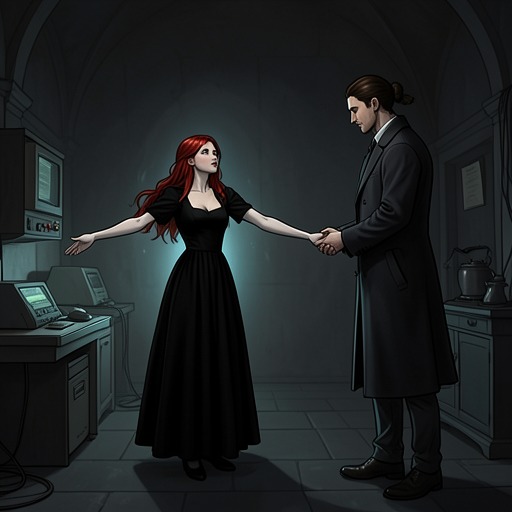
Piroska
The Tale of the Vampire BridePiroska is the young woman whom István brings into his household after Cneajna fails to produce the heir he wants. She first appears in Cneajna’s account as a mistress tolerated under the principle that a husband possesses the right to secure a male successor. Her importance is therefore not merely personal: she becomes the instrument through which István’s marital power, dynastic expectation, and domestic authority are transferred away from Cneajna. By giving birth to three sons, Piroska acquires the position that Cneajna had been expected to occupy, while the marriage that should have protected Cneajna becomes the structure of her dispossession.
Arrival and Rise in István’s Household
Cneajna remembers that István initially loved her, but that his affection faded after years without children. He eventually stopped coming to her and instead slept with Piroska, who had been brought into their home as a young woman. At first, Cneajna says, she did not resent Piroska greatly. The arrangement was presented as István’s right, and Piroska’s presence could therefore be absorbed into the household without openly challenging the marriage. That apparent tolerance ends when Piroska gives birth not to one son but to three, making her reproductive success the basis of a new domestic hierarchy.
Piroska’s children secure her position, while Cneajna remains without a child of her own. Piroska then begins to torment her with derisive remarks and to usurp her authority within the home. She takes Cneajna’s chambers, wears her gowns, possesses her jewels, and rises to control the household before Cneajna’s servants. Cneajna believes that only the protection of her cousin, Matthias Corvinus, King of Hungary, prevents István from casting her out entirely in Piroska’s favor. Piroska thus becomes both a rival woman and the visible sign of a system in which a wife’s security depends on fertility and a husband’s approval.
Humiliation, Jealousy, and the Lost Child
Piroska’s power is reinforced by István’s cruelty. He ridicules Cneajna in Piroska’s presence, declaring that her beauty has been wasted and that her body should be as dry and shriveled as her womb. Piroska taunts Cneajna without mercy and belittles her before the servants, converting private reproductive grief into public humiliation. Cneajna is forced into Piroska’s smaller rooms while Piroska occupies the spaces, clothing, ornaments, and authority formerly associated with the wife.
Cneajna eventually begs István to return to her and give her another chance to bear his child. When he does, she becomes pregnant and is overwhelmed with happiness. Piroska responds by demanding that Cneajna stay away from her children, especially the youngest, János, who has grown fond of Cneajna. Their confrontation turns physical: Piroska pushes Cneajna, who falls and begins to bleed. By nightfall, Cneajna has lost her only child. István refuses to believe that Piroska caused the miscarriage and never touches Cneajna again. The loss makes Piroska more than a competitor for status; in Cneajna’s memory, she becomes the immediate agent of the final destruction of the life and family Cneajna had hoped to preserve.
Murder and Narrative Function
Piroska later returns to Cneajna carrying another pregnancy, dressed in Cneajna’s clothes, wearing her jewels, and carrying István’s child. Cneajna experiences the scene as deliberate mockery. She is eating when Piroska enters, and she does not realize that she still holds a knife. She intends to strike Piroska, but cuts her cheek instead. The sight of blood and the sound of Piroska’s screams intensify her rage; she slashes Piroska again, knocks her to the floor, and repeatedly drives the knife down until Piroska is silent.
When István enters, he finds Cneajna kneeling over Piroska with the knife still in her hands. What horrifies him most is not only the murder but the fact that Cneajna is licking Piroska’s blood from her lips. Cneajna later admits that she was insane with jealousy and desperation and felt no remorse. Piroska’s death therefore completes the violent reversal of their household rivalry: the woman who gained power through childbirth and possession of the wife’s domestic signs is destroyed by the wife whose authority she helped erase. Yet the murder does not restore Cneajna’s marriage or child. It instead confirms that the household’s patriarchal order has converted deprivation into female violence while leaving its original structure intact.
Piroska’s fate also shapes Cneajna’s later existence. István does not kill Cneajna; he takes her to Matthias Corvinus, who confines her at Visegrád until her death and forbids her to leave the palace grounds. The punishment is comparatively gentle, and Cneajna comes to love the palace’s serenity, red marble fountains, and views over the Danube River. Piroska’s death thus ends one phase of Cneajna’s life but does not free her from confinement, loss, or the consequences of a system that measured women through marriage, fertility, and possession. In the larger narrative, Piroska remains an absent but decisive figure: a mother of three sons, an occupant of another woman’s rooms and wardrobe, a persecutor whose violence precipitates the miscarriage, and the victim through whom Cneajna’s buried rage becomes visible.
Piroska in the Vampire Household’s Memory
Although Piroska is dead before Glynis Wright enters the vampire household, her name remains embedded in Cneajna’s account of marriage, motherhood, and displacement. Cneajna’s later position as Vlad Dracula’s wife and one of his Brides repeats the older structure in altered form: a household organized around a powerful husband, several women attached to him, and a hierarchy in which affection and status are never secure. Piroska’s mortal history helps explain why Cneajna recognizes rivalry as a threat to survival rather than as a merely private quarrel. The memory of the woman who took her rooms, clothing, jewels, children, and authority shadows Cneajna’s uneasy treatment of Glynis, the new Bride whom Vlad openly favors.
That repetition is visible when Cneajna tells Glynis that she must answer Vlad’s summons because it is her duty. The language of obligation recalls the marital order that once made István’s desire for an heir a right and Cneajna’s resistance impossible. Piroska is not present in the castle, yet the domestic logic associated with her continues to govern the women: the husband commands, the established wife enforces obedience, and the newcomer is inserted into an already coercive household. The old violence has not vanished; it has been transformed into the supernatural hierarchy of Master and Brides.
Contrast with the Brides’ Blood Economy
Piroska’s role as a reproductive rival also contrasts with the later forms of female intimacy in Vlad Dracula’s household. The Brides are bound to a shared master, but their relations include forms of care that do not depend on childbirth or exclusive possession. When Ariana feeds Erzsébet Dolingen by transferring blood directly from her own mouth, the act creates an intimate exchange among women and sustains a starving sister whom Vlad has neglected. Cneajna explains that the Brides once fed Erzsébet every few days, but that Erzsébet has been starving since Glynis’s rebirth. This exchange presents female solidarity as an alternative to the household competition that defined Piroska’s life.
The contrast is not absolute. Blood, like marriage, can sustain and dominate at once. Vlad declares that Glynis is his wife and that he will share her with no one, turning affection into possession through the Master–Bride blood bond. Piroska had carried István’s child and occupied Cneajna’s domestic signs; Glynis is made first in Vlad’s affections and within his household. In both arrangements, a woman’s position is measured by her relation to a male center of authority, while the women are encouraged to interpret one another as rivals. Piroska’s story therefore provides the mortal precedent for a pattern that the vampire narrative enlarges into a system of blood, obedience, and enforced intimacy.
Gender, Property, and Female Agency
Piroska’s characterization is filtered entirely through Cneajna’s recollection, and that perspective makes her both oppressor and product of a gendered order. She is granted security because she bears István’s heirs, but the same system requires her to compete for rooms, clothing, jewels, servants, and conjugal attention. Her rise is not independent of patriarchal power; it is achieved by becoming useful to it. The sons she bears make her difficult to dislodge, while Cneajna’s childlessness makes the wife vulnerable despite her prior status.
Her conduct nevertheless exceeds the role assigned to her. She publicly taunts Cneajna, takes control of the household, and objects when the youngest child, János, becomes attached to Cneajna. The confrontation over the child reveals that Piroska’s authority is possessive as well as maternal: she guards the children as the most valuable source of her place in the home. Her push precipitates the loss of Cneajna’s pregnancy, after which István accepts the consequences without investigating the violence that produced them. Piroska acts within a structure that privileges her fertility, but the structure also turns motherhood into a contested possession.
Cneajna’s murder of Piroska is the most extreme expression of agency available within that closed system. The knife initially appears in Cneajna’s hand as an ordinary object during a meal, then becomes the instrument through which accumulated humiliation erupts. The first slash is not planned as murder; the sight of blood and Piroska’s screams transform an intended blow into repeated violence. Cneajna’s later admission that she felt no remorse does not make the killing a simple triumph over a hated rival. It shows how a woman denied legitimate authority can be driven to seize power through destruction, only to receive confinement rather than restoration.
Significance in Cneajna’s Characterization
Piroska is crucial because she gives historical shape to Cneajna’s later vampiric identity. Glynis observes that Cneajna’s immortal household is a cruel mockery of the family life she once desired: servants remain, but they are gypsies; a husband remains, but he is a vampire lord; and young Brides stand in place of children. Piroska belongs to the lost mortal world that made this substitution necessary. Her presence in the narrative explains why Cneajna’s attachment to domestic rank is so intense and why the arrival of a favored new Bride threatens an old wound.
Piroska also becomes a warning about the false promise of possession. She acquires the house, the garments, the jewels, the heirs, and the husband’s attention, but none of those gains produces safety. Her murder leaves Cneajna bereft rather than victorious, and Cneajna’s subsequent confinement at Visegrád demonstrates that the household can punish female violence without correcting the conditions that bred it. Piroska’s story thus turns domestic rivalry into a study of institutional power: women are set against one another over privileges defined and distributed by men, and even the apparent victor remains trapped within the same order.
In the wider plot, Piroska is an offstage dead character whose narrative force comes from recurrence. Her replacement of Cneajna anticipates Glynis’s elevation over the older Brides; her possession of another woman’s clothing and jewels anticipates the way identity and rank are displayed through dress; and her conflict over a child contrasts with the later exchange of blood that sustains the immortal women. She is remembered not as a fully independent participant in the present but as the concentrated history of a household in which love, legitimacy, fertility, and violence have never been separable.