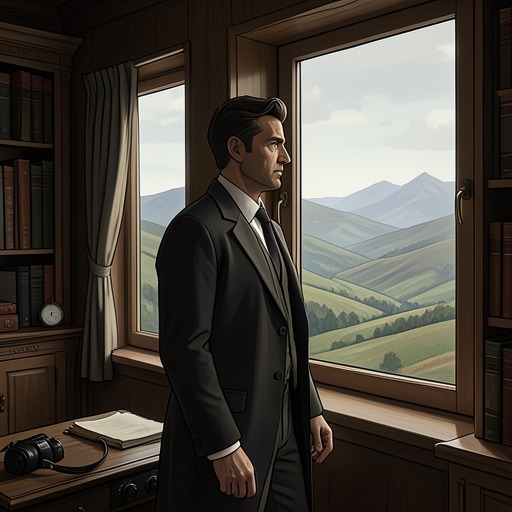
The Dracula Estate in Buda
The Tale of the Vampire BrideThe Dracula Estate in Buda is Vlad Dracula’s Hungarian mansion, reached after the journey from his decaying mountain castle and used as a safer, more presentable base for his plans involving Glynis Wright and her family. It represents a striking change in architectural atmosphere without offering genuine freedom: the estate’s civilized appearance, loyal servants, concealed rooms, and defenses against Vampire hunters turn domestic comfort into another form of captivity.
Setting and Arrival
The estate stands in the hills of Buda, Hungary, reached on 9 March 1820 after a carriage journey across the Danube and over the pontoon bridge connecting Buda with Pesth. The approach places the house within a recognizably urban and historical landscape. Glynis Wright sees the Royal Palace above the trees and feels relief at returning to a modern city, especially because Buda recalls the last place where she had been happy as a mortal. That memory gives the destination an emotional charge that the mountain castle lacks: the estate appears to restore access to civilization even while Vlad Dracula continues to control her movements.
When the carriage passes through a huge gate and along a lane guarded by tall pines, the mansion emerges as a vision of wealth and order. Its lights, grand scale, uniformed servants, luggage, and carefully managed horses create a spectacle of established domestic authority. Glynis Wright is moved to tears by the contrast between the beautiful Hungarian mansion and the wretched castle from which they have traveled. Yet the title attached to the new residence is itself coercive. She is presented as Countess Dracula, and the marriage is described as a union by blood rather than a sacred union, making the estate’s apparent respectability a public disguise for a supernatural bond.
A Household Built on Secrecy
The estate operates through inherited loyalty as much as through immediate intimidation. Vlad Dracula explains that the servants know what he and Glynis Wright truly are, that he pays them well, and that many of their families have served him for centuries. Their knowledge does not make the household open or equal; it makes the servants part of a long-standing system of obedience. The estate is therefore not merely a residence staffed by employees but a hereditary structure of service surrounding its vampire master.
The house also provides the setting for Vlad Dracula’s proposed deception of Andrew Wright. He plans to have Andrew stay with Sir Stephen Sheridan while Glynis Wright and Vlad remain at the Buda residence. The stated reason is that the house is undergoing restorations and cannot accept guests, including additions intended to protect it against Vampire hunters. At the same time, Vlad intends to tell Andrew that he and Glynis Wright have married, that she is now Countess Dracula of Wallachia, and that her disfigured face resulted from the staged accident. The estate thus supports both physical security and narrative fabrication: it is a place where walls, servants, titles, and letters can all be used to manufacture an acceptable public story.
Hidden Refuge and Defensive Architecture
Vlad Dracula has constructed a concealed refuge inside the estate specifically in anticipation of attack. At the base of the stairs, he slips through a narrow crack in a shadowed corner, leading Glynis Wright through a passage between the bricks. She follows by using her vampiric power to drift through the slim space and enters a small room draped in red velvet, with a bed at its center and candles lining the walls.
The refuge has no doors or windows, and its surrounding walls are four feet thick. Vlad Dracula says that no mortal man can enter and that even an attempt to burn the vampires out would not reach them inside. A second room of the same kind is being built above it, indicating that the protection is part of an expanding defensive design rather than an improvised hiding place. His confidence that he is prepared for the hunters gives the room an almost military function, while its bed, velvet, and candlelight preserve the appearance of a chamber. Glynis Wright compares it to a tomb, and Vlad Dracula’s response that they are Vampires confirms the house’s central paradox: the domestic bedroom has become a burial space for the living dead.
From Shelter to Instrument of Control
The estate’s security does not loosen Glynis Wright’s dependence on Vlad Dracula. Her movement from the mountain castle to Buda is organized by his decisions, and her presence there serves his larger strategy of deceiving Andrew Wright and relocating his household into a more advantageous setting. Even in a house that gives her the intoxicating sensation of being mistress of her own household, Vlad Dracula can summon her at will and remind her that the servants, the defenses, and the household’s secrets remain under his authority.
That authority is reinforced through direct coercion. Vlad Dracula orders Glynis Wright to write to Andrew Wright that she has married him and that they are happy together. When she refuses, he threatens her physically, drags her against him, and commands her not to defy him. Later he acknowledges that her fear for what remains of her family has been the leverage that made her obey. The estate therefore becomes an administrative center for domination: from within its polished rooms, Vlad can coordinate travel, correspondence, family deception, surveillance, and punishment.
Its power also extends beyond fixed architecture through the blood bond. When Glynis Wright leaves the house, the Beckoning can seize her body with piercing pain and draw her back through the wind and forest toward the castle. The supernatural pull transforms distance into an illusion. The Buda estate may be safer and more beautiful than Vlad Dracula’s original fortress, but neither residence is outside his power; both belong to the same geography of captivity.
Narrative and Gothic Significance
The estate’s most important contrast is between visible civilization and concealed violence. Buda offers the moonlit Danube, the Royal Palace, cobbled streets, wealth, servants, and a mansion that seems to restore Glynis Wright to the modern world. Beneath that surface are blood marriage, falsified letters, ancestral servitude, secret passages, thick walls, and the expectation of Vampire hunters. The building does not erase the Gothic castle; it translates its logic into a more socially acceptable form.
As a Gothic space, the estate makes private architecture carry the burden of suppressed truth. The hidden chamber resembles a tomb, the servants’ knowledge is institutionalized across generations, and the public identity of Countess Dracula masks a coercive supernatural relationship. The house offers shelter from external enemies while enclosing the person Vlad Dracula seeks to possess. Its beauty intensifies rather than cancels the horror, because the polished domestic setting demonstrates how domination can pass through comfort, title, protection, and apparent respectability.
The Dracula Estate in Buda consequently marks a change in Vlad Dracula’s methods rather than a release from them. It is a fortified refuge, a stage for social deception, and a domestic machine for sustaining blood-bound control. For Glynis Wright, its attraction lies in the memory of mortal happiness and the illusion of household authority; its deeper meaning lies in the discovery that even a beautiful home can function as a prison when every entrance, letter, servant, and wall answers to the same master.