The Golden Stake
The Tale of the Vampire BrideThe Golden Stake is both a physical weapon and a concentrated emblem of Vlad Dracula’s power. First encountered behind his throne, it evokes the remembered death of Glynis Wright’s father and the violence that sustains Dracula’s household. Yet when the castle’s internal order reaches its breaking point, Glynis seizes the same object and turns it against Vlad. The stake therefore marks a dramatic passage from inherited terror to chosen resistance: what once represented the master’s power becomes the means of ending it.
Appearance and Symbolic Setting
The Golden Stake stands behind Vlad Dracula’s throne in the throne room, where its placement makes violence part of the architecture of authority. When Glynis enters and sees Cneajna seated upon the throne, the stake is immediately visible behind her. Its presence summons the memory of the opera concerning Vlad and the death of Glynis’s father, a memory she tries to dismiss because the object makes the past physically present in the room. The stake is not merely stored there; it is displayed as though the throne and the means of execution belong to one political order.
That arrangement gives the weapon a double meaning. It is associated with Vlad’s capacity to destroy, but it also exposes the fragility of the hierarchy he has built. The throne signifies command, while the stake signifies the punishment awaiting those who resist. When Glynis later reaches for it, she does not acquire an unfamiliar weapon so much as appropriate the central emblem of the regime that has enslaved her. The object’s symbolic transfer precedes the actual transfer of power.
Glynis’s Seizure of the Weapon
The Golden Stake becomes decisive during the confrontation in the throne room, after Vlad has wounded Cneajna and is preparing to destroy her. Glynis has already recognized the pattern of his violence: he slaughtered her mortal family, transformed her into his Bride, and now threatens the vampire family that has replaced the one he took from her. Her decision is consequently framed as a choice made for those she loves rather than as a private escape. Vlad’s violence has made every attachment a target, and the stake offers the only immediate means of interrupting that destruction.
Healed from her wounds, Glynis rises and snatches the stake from behind Vlad’s throne. She then gathers her power until her feet leave the floor, gliding toward him through the air while Elina and Ariana retreat to the ceiling in alarm. The weapon is thus joined to the supernatural abilities that mark Glynis’s transformation: the physical object gives her attack form, while her new power allows her to cross the room and strike from behind. Her movement reverses the expected direction of command. Instead of answering Vlad’s summons, she approaches him under her own purpose.
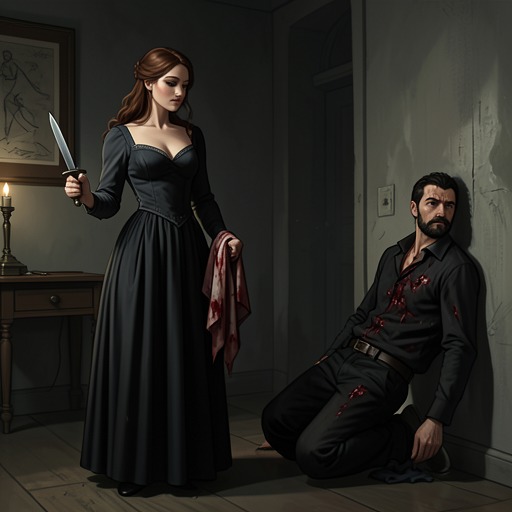
As Vlad looks over his shoulder, Glynis declares that the attack is for her family and drives the stake upward through his back and torso until it emerges from his chest just left of his heart. The blow releases Cneajna, who falls in a bloody heap, but it does not produce an immediate clean death. Glynis lifts the stake, raising Vlad from the ground, while his blood showers over her and he struggles to escape. The image makes the reversal unmistakable: the master who once controlled bodies is now suspended by the weapon displayed behind his throne, held aloft by the Bride he intended to possess.
Destruction of Vlad’s Blood-Power
The stake’s function extends beyond physical impalement. Glynis orders the Brides to burn Vlad’s blood, because destroying the blood will destroy the power carried through it. Elina and Ariana take torches from the walls, and fire spreads around the impaled body as the household turns the mechanisms of Vlad’s authority against him. The Golden Stake pins him in place, while the burning blood prevents his power from surviving in its former form. Its role is therefore both immobilizing and sacramental: it opens the body, and the fire completes the destruction of the power that body contains.
As Vlad weakens, his body withers, his hair develops threads of silver, and his eyes slowly lose their vitality. He remains alive, but his condition changes from active domination to suspended existence. Glynis holds him as the blood continues to flow, and Vlad recognizes that she, of all people, has become the one who could destroy him. The weapon’s violence is consequently bound to recognition: the master understands the identity of his executioner only after the hierarchy has already collapsed.
The aftermath leaves the stake physically embedded in Vlad until Cneajna removes it and prepares him for burial in his coffin. Glynis warns that feeding him would allow him to rise again and proposes taking his head to finish the work. Cneajna refuses, choosing instead to place him in the chapel and care for him as his faithful wife in death. When Glynis later finds Vlad dressed in royal robes, with his hands folded over his chest and the wine-red royal cloak arranged around him, the stake has been drawn from his body, but the threat it represents has not disappeared. The object has ended his active reign without guaranteeing that his dormant power is permanently gone.
Connections to Glynis’s Rebellion
The Golden Stake’s significance is sharpened by the forms of confinement that precede its use. Glynis had once imagined freedom through clothing, rejecting the restrictions represented by corsets and prescribed feminine dress; after becoming a Vampire, she finds herself trapped again, now by Vlad Dracula’s castle, commands, blood bond, and the enforced costume of a Bride. Vlad orders her to abandon recognizable English clothing, wear veils around Andrew Wright, and prepare to become his true bride. Against that regime of imposed appearances, the stake offers a different kind of declaration. It does not disguise Glynis or make her acceptable to another authority. It allows her to act openly, physically, and irreversibly against the master who has defined her existence.
That contrast explains why the weapon carries more than tactical value. Glynis’s first impulse is not simply to survive the throne-room attack but to prevent Vlad from repeating the destruction of her mortal family against her vampire family. The stake becomes the instrument through which she recognizes those two histories as connected: the father whose death it recalls, the mother whose life she was forced to take, Cneajna wounded before Vlad’s throne, and Ignatius threatened by the same ruler all belong to the pattern of loss that has made Vlad the center of her life. By seizing the object associated with that pattern, Glynis converts accumulated grief into deliberate action.
The Stake and the Limits of Victory
The Golden Stake changes the balance of power, but it does not resolve every danger. Vlad is impaled and deprived of his active blood-power, yet he is not destroyed in the final sense. His body becomes a husk that remains alive in deep sleep, a condition suspended between the living world and the undead one. Glynis therefore understands that the stake has produced containment rather than absolute security. Her warning that Vlad will destroy everyone if he rises again shows that his authority has been interrupted, not erased.
Cneajna’s response further complicates the weapon’s meaning. Glynis wants to take Vlad’s head and finish the killing; Cneajna refuses, removes him from the scene of combat, and places him in a coffin while preserving the gestures and signs of his former rank. She dresses him in royal robes, folds his hands over his chest, wraps him in the wine-red royal cloak, and sets the crest of the Dracul family above his head. The stake is gone from his body, but the funeral arrangement restores a ceremonial image of sovereignty. Physical defeat and symbolic continuity thus coexist: the weapon breaks Vlad’s immediate rule, while the coffin preserves the possibility that his authority may return.
Narrative and Thematic Significance
As a recurring visual object, The Golden Stake binds memory, spectacle, and action together. It first appears as part of the throne-room setting, where it recalls the opera about Vlad and the death of Glynis’s father. Its theatrical placement makes the weapon resemble a prop of inherited legend, but the later attack gives that legend a new performer and a new direction. Glynis is no longer merely the woman represented, threatened, or transformed by Vlad’s story; she takes possession of the object and rewrites the scene through her own choice.
The weapon also embodies the novel’s unstable boundary between family and violence. Glynis’s attack is an act of revenge, but it is explicitly directed toward protecting a family: she strikes for Cneajna, the other Brides, and Ignatius, just as Vlad’s earlier violence destroyed the mortal family from which she came. The same gesture can therefore be read as both execution and attempted rescue. Its moral force arises from that tension rather than from a simple opposition between innocence and brutality. Glynis has become capable of the violence required to oppose Vlad, and the stake makes visible the cost of that transformation.
Finally, the object marks the transfer of agency without making Glynis free of the supernatural order she has inherited. She uses her power to wield the stake, orders the Brides to burn Vlad’s blood, and becomes the effective agent of his downfall; nevertheless, the blood-power, the throne, the coffin, and the possibility of resurrection remain part of the world she must navigate. The Golden Stake ends Vlad’s active domination while leaving behind the political and intimate structures that domination created. Its decisive achievement is therefore not the disappearance of darkness, but the conversion of a weapon of Dracula’s authority into the first unmistakable instrument of Glynis’s independent rule.