Vampire Hunters
The Tale of the Vampire BrideVampire Hunters are the organized human threat that makes concealment a condition of survival for vampires. Glynis Wright encounters them first in Buda as a group equipped with religious and physical weapons; later, they lead a coordinated nighttime attack that drives her and Vlad Dracula from their home and kills its defenders. Their recurring presence links individual vampire predation to the danger of public exposure: the more violently vampires feed and the more visible their existence becomes, the more likely the hunters are to act.
Identity and Purpose
Vlad Dracula describes Vampire Hunters as a response to vampires who are too dangerous or conspicuous to leave unchecked. He tells Glynis that some vampires are mad and must be destroyed on sight lest they expose the hidden supernatural world. In his account, excessive human deaths caused by vampire attacks bring the hunters. This explanation presents their activity as part of a cycle: predation risks discovery, and discovery invites a human counterattack. It is Vlad who supplies this account, so it also functions as instruction from a powerful vampire to his newly made progeny about the risks she must anticipate.
Vlad distinguishes between regions, telling Glynis that vampires are numerous in the country where they are travelling but much fewer in places less rich in legend and magic. He also claims that other vampires will leave Glynis alone if she identifies herself as his progeny. That protection does not remove the human threat. The hunters remain a danger to the vampire population, and Glynis's question about whether they will attack the carriage shows that their possible intervention shapes even the household's movements. Vlad advises her to feed and return to her haven before sunrise, then pointedly asks whether she can get home without alerting every hunter in the city. The exchange makes stealth part of the practical discipline he expects of her.
Glynis's First Encounter in Buda
Glynis recognizes the hunters when several young men in fine black suits rush into the street and take in a ghastly scene with horrified expressions. They cross themselves, making their religious response visible before she knows who they are. Their arrival turns the scene from an immediate confrontation into a moment of recognition: Glynis understands that the men belong to the force Vlad warned her about.
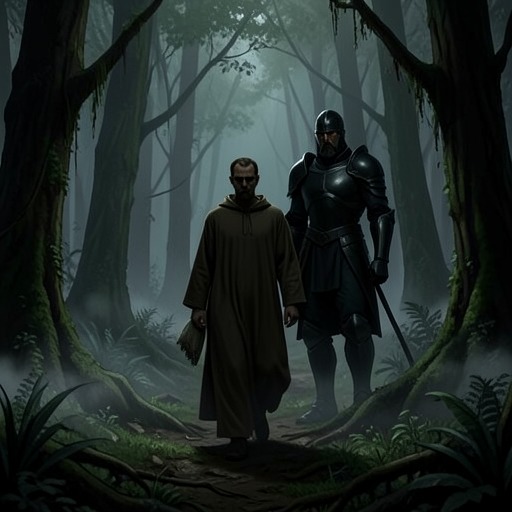
The group includes an Eastern Orthodox priest holding a large crucifix, its gold catching the torchlight. Another hunter, distinguished by pale blue eyes and blond hair, kneels to open a case containing a formidable knife. The party therefore presents more than one form of opposition: the priest carries a sacred emblem, while the case holds a weapon suited to physical attack. The details establish the hunters as equipped and prepared, without reducing them to a single method of combat.
Glynis leaps from the shadows, calling them murderers in a burst of indignation before she has fully considered her action. Her intervention exposes her own conflict: she is now a vampire, yet she responds to the hunters' arrival with moral outrage rather than simply retreating. The men, meanwhile, have entered after encountering a scene they find horrifying and cross themselves in response. The encounter stages opposing judgments of violence without making the hunters' full knowledge, motives, or procedures explicit.
Arms, Belief, and the Limits of Safety
The first encounter gives the hunters a recognizable visual and material vocabulary: black suits, torches, a crucifix, and a knife drawn from a case. The objects matter because the vampires' danger is not only physical. In a later clash, a priest chants as the Gypsy guards approach him, and one of them seizes the crucifix and struggles to wrench it away. The episode makes the sacred object contested in the middle of a human confrontation; the priest is fighting mortals, not vampires. It therefore cautions against treating every appearance of religious weaponry as proof that a hunter is facing a vampire. The hunters' presence belongs to a wider, volatile human world in which sacred objects and violence can also be caught up in conflicts among mortals.
Vlad's advice gives Glynis another measure of their reach: returning safely means avoiding notice, and a carriage may attract their attention. Their threat is consequently not confined to a formal encounter with an armed group. It shadows travel and feeding, the very activities through which a vampire sustains life and moves through human society. Yet the evidence does not make them omniscient or invulnerable; it presents concealment as a pressing concern, not as a guarantee that the hunters can find every vampire.
The Buda Ambush and Burning of the Estate
The hunters become a direct military force when Glynis and Vlad are ambushed at night. Glass shatters and flames break out around Glynis; Vlad grabs her and leaps into the night as rifle shots sound and wounds pierce her torso. Looking down, she sees hunters on the rooftops of nearby poor homes, carrying torches and rifles. Their elevated positions and firearms show an assault coordinated across the surrounding streets, not merely an unexpected meeting between individuals.
As the hunters spread through the streets to track the fugitives, one voice rises above the others: Svend is again leading them into battle. His leadership gives the pursuit a named focal point, while the hunters' movement through the streets shows that the attack continues after Glynis and Vlad escape the immediate danger. The group can press a pursuit through the city rather than relying on a single confrontation.
The assault reaches the estate that Glynis has come to regard as home. From behind the dark outline of trees, she and Vlad see the house burning, while servants try to defend themselves against hunters armed with guns and daggers. The defenders are being struck down and losing the fight. Vlad points out Arminius among the attackers, identifying his presence without explaining his role in the group. For Glynis, the scene makes the cost of the hunters' assault intimate: the target is not only the vampire household but also the people who serve and defend it, and the building she has come to love is being consumed.
Gregor and the Hunters' Narrative Role
Gregor provides a distinct extension of the hunters' threat. He is identified as a Dhampir hunter and appears abruptly in the street in front of the horse carrying Ignatius. Pale and dressed in black, he approaches with daggers at hand, his fingers twitching over the weapons sheathed in his coat. His arrival confronts the fugitives with a pursuer who can meet them at close range and who is not simply one of the young men first seen in Buda. The account identifies his nature and purpose, but does not establish that he is subordinate to Svend or describe a formal hierarchy among the hunters.
Across these encounters, Vampire Hunters function as the consequence that vampires fear but cannot wholly avoid. Vlad's warnings connect their intervention to exposure and uncontrolled killing; Glynis's first sight of them makes the threat concrete through their weapons and religious signs; and the attack on the estate shows how far that threat extends beyond a vampire's own body. They are not shown as a uniformly characterized institution with a fully explained code. Instead, the narrative reveals them through what Glynis sees and what Vlad tells her: an armed, recurring human opposition whose pursuit can turn a hidden existence into a fight for escape, shelter, and survival.