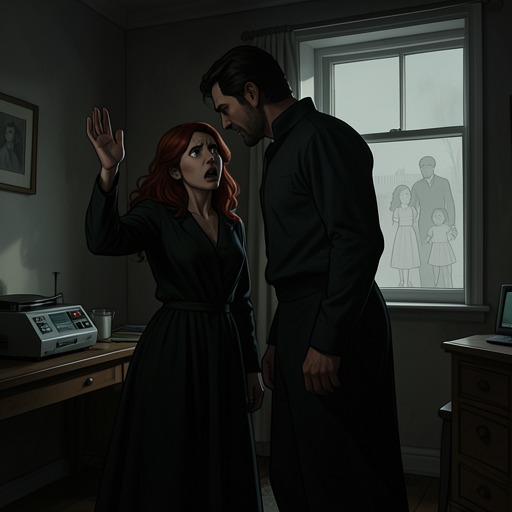
Vlad forces Glynis to forge letters to Andrew
The Tale of the Vampire BrideVlad forces Glynis to forge letters to Andrew in order to control what her brother learns and to make a lie serve his plans. A letter from Andrew has exposed that he knows of Vlad and is worried about Glynis and her family. Vlad responds not by letting her answer freely, but by scripting a false history: the Wright family’s deaths are to be blamed on a storm and a carriage swept from Bârgău Pass into the river, while Vlad is recast as the man who rescued and cared for Glynis. He then demands that the deception grow into a false account of love and marriage. Glynis’s eventual agreement is obtained through fear, not consent.
Discovery and the imposed story
Vlad’s demand begins when he learns that Andrew’s letter mentions him by name. Sir Stephen Sheridan had been under strict orders to keep Glynis’s destination secret, and Vlad recognizes that the attempt at secrecy has failed. The disclosure changes the problem he faces: Andrew is not merely a distant relative, but a concerned brother whose questions might threaten Vlad’s control of Glynis and his intentions for the family. Vlad takes Andrew’s letter and directs Glynis to answer it.
The reply he prescribes is specific. Glynis is to tell Andrew that a storm overtook the family’s carriage as they journeyed to the castle, swept it off the pass and into a river, and left her the sole survivor. Vlad’s men, in this account, find her half-drowned and bring her to the castle, where Vlad nurses her back to health. The story turns the evidence of a family disaster into an accident narrative and places Vlad in the role of rescuer. It also gives Andrew an explanation for Glynis’s disappearance that conceals the violence and coercion behind her captivity.
The later letter bearing this account is sealed with red wax stamped with a dragon. Its polished, formal address to Andrew contrasts with the circumstances in which Glynis was ordered to produce the lie. The letter claims that the other members of the family were lost in the river and that searches by Vlad’s men found no survivors. The account is not simply an attempt to explain where Glynis is: it fixes the family’s fate in a version of events designed to prevent suspicion from falling on Vlad.
Resistance and escalating demands
Glynis immediately understands what Vlad is asking her to hide. She protests that he wants her to tell Andrew what he has done to the family, and she refuses to become an accomplice in his deceit. Her response is not a negotiation over wording; it is a rejection of the false role Vlad has assigned her. She will not present him as a hero or help him reach England by misleading her brother.
Vlad broadens the script beyond the false accident. Glynis must continue writing to Andrew, describe Vlad as compassionate and caring, and claim that she is beginning to love him. In time, she is to tell her brother that she has married Vlad and that they are happy together. These ordered stages would make the first lie appear to lead naturally to a rescue, then affection, then marriage. The progression is Vlad’s construction, not Glynis’s account of her own feelings: she answers the marriage demand with another refusal and identifies the whole performance as duplicity.
Her resistance also names the practical danger she sees in the correspondence. She will not help Vlad go to England and destroy what remains of her family. The letters are therefore tied to his larger plan, not merely to his wish to manage Andrew’s understanding of events. By controlling what Andrew hears, Vlad seeks to isolate Glynis from her brother while presenting their relationship as willing and settled.
Coercion and submission
When Glynis refuses, Vlad rises to confront her and insists that she will obey. He grips her by the hair, drags her against him, and tells her not to defy him. The physical handling makes explicit what the carefully composed letter would conceal: Glynis is being compelled both to remain in Vlad’s power and to speak for him in her correspondence. The demanded declarations of love and happiness are backed by the same force as the false account of the family’s deaths.
Later, Vlad asks again whether she will write to her brother. Glynis looks up at the great iron stake looming over a sepulcher and shudders at the fate it represents; she slowly nods, then confirms that she will write and weeps as Vlad kisses her. The scene links the correspondence to bodily terror. Her agreement is the outcome of pressure, not a change of belief, and the kiss does not resolve the conflict: it follows her submission under threat.
The letter’s consequences and significance
The letter eventually read to Andrew preserves Vlad’s invented explanation in the form he wanted. It reports the deaths of Glynis’s family as the result of a terrible accident on Bârgău Pass, says that Glynis alone survived, and claims that Vlad’s men recovered her on the riverbank. It also says that she remains ill and disfigured, postponing her return to Andrew’s care, and directs him to Sir Stephen for further inquiries. These details extend the deception beyond the cause of the family’s deaths: they offer a reason for Glynis’s continuing absence and channel Andrew’s questions toward Vlad’s agent.
The episode makes writing itself an instrument of captivity. Vlad does not only dictate what Andrew should believe; he attempts to make Glynis’s own voice certify the lie and disguise their coerced relationship as a happy marriage. Her refusal keeps the moral distinction between truth and the story Vlad wants told sharply visible, even when fear finally makes her promise to write. The correspondence thus serves two opposed purposes: Vlad uses it to seal Glynis’s isolation, while the scene exposes the force required to produce the appearance of her consent.