Gita and Ivana's friendship
The Tattooist of AuschwitzGita and Ivana's friendship is one of the sustaining bonds of the women's camp at Birkenau, a relationship forged in the shared ordeal of Block 29 that becomes a lifeline of practical care, emotional refuge, and mutual devotion. Ivana stands beside Gita through the typhus crisis, the grief of family loss, and the death march, embodying the solidarity that makes survival possible in the camp. Their friendship, inseparable from Gita's bond with Dana, forms a small circle of loyalty within the vast machinery of the camp, a counterweight to the dehumanization that surrounds them.
Origins in Block 29
Gita and Ivana first appear together in Block 29 of the women's camp, where Gita curls up with her friends Dana and Ivana in the cramped quarters. The intimacy of their shared space is captured in a single night scene: a beam from a floodlight seeps through a small crack in the timber wall, and Gita strains to read Lale's letter by its faint light. When Dana teases her about how many times she will read it, Gita replies that she will read it until she knows every word by heart. Ivana is present in this moment, part of the small circle that witnesses and shelters Gita's emerging love for Lale, a love that becomes a secret treasure shared among the three women.
The friendship is built on the daily realities of camp life, where the women support each other through the endless routines of roll call, work, and the constant threat of selection. When Gita is taken to work in the administration office, Dana and Ivana rush to her as she enters the women's camp, their faces a mixture of fear and relief. Dana demands to know where Gita was taken and why, and Gita reassures them that she is all right, that she has been assigned to work in the administration office. The scene reveals the protective anxiety that defines their bond: every separation, however brief, carries the possibility of permanent loss.
The Typhus Crisis
When Gita falls gravely ill with typhus, Ivana's role shifts from companion to caretaker. Lale, desperate to keep Gita from being taken to the hospital where the sick are sent to die, instructs Dana to carry or drag Gita to the Canada warehouse each day, hide her among the clothes, and bring her back to the block for roll call. Dana agrees, saying that Ivana will help, but insists that Gita must have medicine. The plan requires both women to risk their own lives, smuggling a desperately ill woman across the camp under the eyes of the guards, all to keep her off the hospital list.
The strain of the vigil becomes visible as the illness worsens. In the evening, Dana and Ivana sit beside a now fully unconscious Gita, the pull of typhus stronger than they are, the black stillness completely overtaking her. They talk to her, but she gives no sign that she hears them. From a small vial, Dana places several drops of liquid into Gita's mouth as Ivana holds it open, a scene of quiet, desperate tenderness. An exhausted Ivana confesses that she does not think she can keep carrying Gita to the Canada, and Dana insists that she will get better, that they only need a few more days. Ivana's exhaustion is real, but so is her persistence; she asks where Lale got the medicine from, a question that acknowledges the extraordinary lengths being taken to save their friend.
Grief and Shared Sorrow
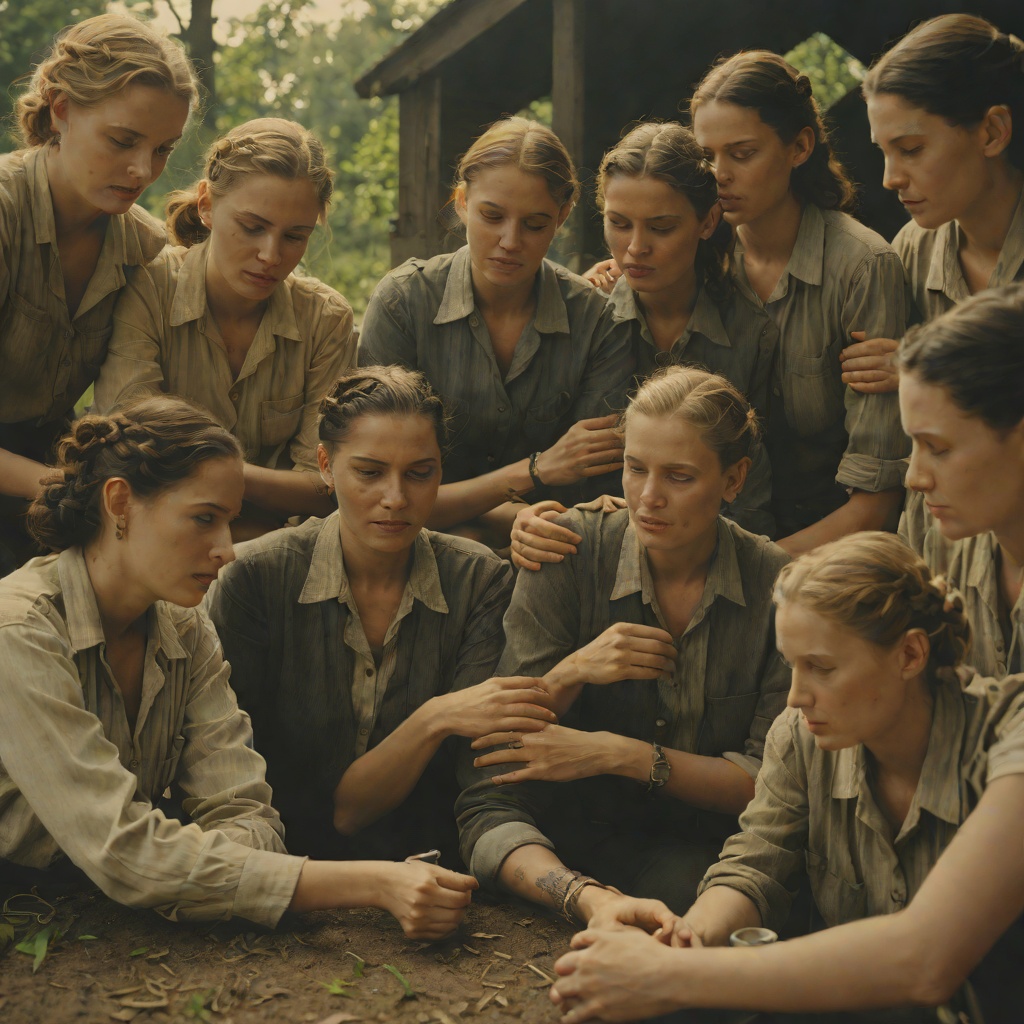
When Gita learns that her family has been killed, the friendship becomes a vessel for grief. Mrs. Goldstein delivers the news, dropping her head and apologizing, saying that they were told the family was gone. Gita crumbles to the floor as Dana and Ivana rush to her, sit on the ground, and embrace her. Above them, Mrs. Goldstein continues to speak her apologies, and both Dana and Ivana are crying, holding the dry-eyed Gita. They babble words of condolence at her, but Gita feels a terrible emptiness inside. She turns to her friends and asks in a halting, broken voice whether it might be all right for her to cry, just a little bit. When Dana offers to pray with her, Gita refuses, saying she will only allow these murderers a few tears, nothing more. The scene shows the friendship as a space where even the most private grief can be held, where Gita can ask permission to feel, and where her friends' tears stand in for the ones she cannot yet shed.
The Escape of Love
Ivana and Dana also serve as the guardians of Gita's love for Lale, the one bright thing in their shared darkness. When Gita confesses that she has not told Lale about her family's fate, she explains to Dana that if she tells him, they will both be sad, and she wants their time together to be different. She wants to forget where she is and what has happened to her family, and when he holds her in his arms, she does forget, just for those few brief moments. She asks whether it is wrong to want to escape reality for a bit, and Dana assures her it is not. Gita tells them she is sorry that she has her escape, her Lale, and wishes with all her heart the same for them. Ivana responds that they are very happy that she has him, and Dana adds that it is enough that one of them has a little happiness, that they share in it, and that Gita lets them, and that is enough for them. The friendship here becomes an act of radical generosity: the two women find joy in their friend's joy, refusing to let envy or despair corrode the one good thing in their midst.
The Death March and Separation
As the camp is evacuated and the women are forced onto the death march, the friendship faces its ultimate test. Gita and her friends march with thousands of other women from Birkenau and Auschwitz, trudging along a narrow track through ankle-deep snow. As carefully as they can, Gita and Dana search the rows, all too aware that any straggling is dealt with by a bullet. They ask a hundred times whether anyone has seen Cilka or Ivana, and the answer is always the same. The women try to support each other by linking arms, and at seemingly random times they are halted and told to rest, sitting in the snow despite the cold to give their feet some relief. Many remain there when the order to move on comes, dead or dying, unable to take another step.
During the night, Dana drops to her knees, unable to go on. Gita stops with her, and for a while they are unseen, screened by other women. Dana keeps telling Gita to go on, to leave her, but Gita protests, saying she would rather die here with her friend in a field somewhere in Poland. Four young girls offer to help carry Dana, but Dana will not hear of it, telling them to take Gita and go. As an SS officer advances on them, the four girls pull Gita to her feet and drag her with them. Gita looks back at the officer, who has stopped beside Dana but moves on without drawing his pistol. No shot rings out; clearly he thinks she is already dead. The girls continue to drag Gita, refusing to let her go as she attempts to break free and get back to Dana. The scene is a testament to the depth of the bond: Gita is willing to die with her friend, and Dana is willing to die so that Gita might live. Ivana's absence from this moment, her fate unknown, hangs over the march as the women stumble on through the dark, the sound of random shots barely registering, no longer turning around to see who has fallen.
The Meaning of the Bond
Before the evacuation, Lale takes leave of the women who have been Gita's companions through the ordeal. He takes Dana by both hands and tells her how grateful he will always be to her for being Gita's friend, knowing that she has kept Gita going many times when she wanted to give up. He embraces Dana, kisses her on the forehead, and hands her over to Gita. He turns to Cilka and Ivana and wraps them both in a bear hug, telling Cilka she is the bravest person he has ever met. The moment acknowledges the debt that Lale, and Gita herself, owe to Ivana and Dana: without their care, their strength, and their willingness to share in Gita's happiness and grief, the love story at the heart of the camp might never have survived. Ivana's friendship with Gita is thus not merely a private comfort but a form of resistance, a refusal to let the camp strip them of their capacity for loyalty, tenderness, and joy.