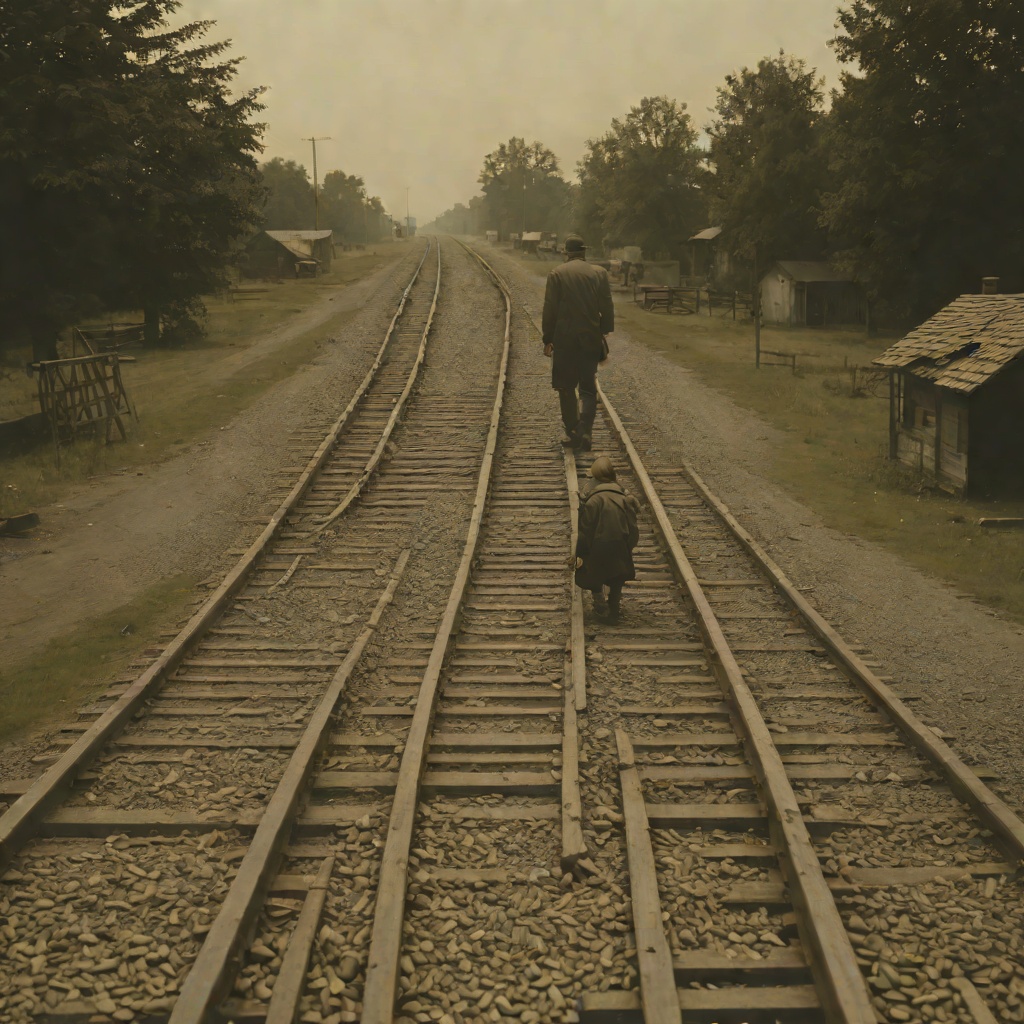
I will live to leave this place. I will walk out a free man. If there is a hell, I will see these murderers burn in it.
The Tattooist of AuschwitzI will live to leave this place. I will walk out a free man. If there is a hell, I will see these murderers burn in it. is the private vow Lale Sokolov makes to himself in the darkness of Auschwitz-Birkenau after witnessing the casual, laughing murder of three fellow prisoners by SS officers. This expression crystallizes his core survival instinct and moral defiance, becoming the existential foundation upon which he builds his entire campaign to endure the camp, protect others, and ultimately reunite with Gita Furman. It is not merely a hope but a performative act of self-definition, a declaration that transforms his identity from that of a victim into that of a witness and a survivor who refuses to be extinguished by the machinery of death around him.
The Moment of the Vow
The vow is born in the semidarkness of the camp's latrine area, a place of crude wooden planks laid over long ditches. Lale, waking still in the dark and needing to relieve himself, scrambles over his sleeping companions and makes his way to the back of the block, thinking it the safest place. There he finds three prisoners sitting across the ditch, shitting and talking quietly, while from the other end of the building two SS officers approach, smoking and laughing, their rifles hung loosely down their backs. The flickering perimeter floodlights cast disturbing shadows, and Lale cannot make out what they are saying. His bladder is full, but he hesitates. In unison, the officers flick their cigarettes up into the air, whip their rifles around, and open fire. The bodies of the three men are thrown back into the ditch. Lale's breath catches in his throat as he presses his back against the building while the officers pass him, catching the profile of one of them—a boy, just a kid. It is in the immediate aftermath of this arbitrary, almost playful slaughter that Lale makes his vow, thinking of his family back in Krompachy and hoping that his presence here is at least saving them from a similar fate. The vow is thus not an abstract philosophy but a direct, visceral response to the specific horror of seeing men murdered while they shit, killed not for any crime but for the amusement of young guards.
The Vow as a Performative Act
The expression functions as a speech act, a performative utterance that does not merely describe a hope but constitutes a commitment. By speaking these words to himself, Lale is not just expressing a desire; he is actively choosing a course of action and an identity. The vow's three clauses form a complete existential program: survival ("I will live to leave this place"), freedom ("I will walk out a free man"), and justice ("If there is a hell, I will see these murderers burn in it"). The final clause is particularly significant, as it transforms his suffering into a moral mission. He is not merely trying to survive; he is surviving in order to bear witness and to ensure that the murderers face consequences. This is a rejection of the camp's attempt to reduce him to a passive, numbered object. Instead, he asserts his agency and his role as an active moral agent who will hold the perpetrators accountable, even if only through the imagined justice of a hell he may not himself believe in.
The Vow's Role in Lale's Actions
This vow becomes the engine for Lale's subsequent actions throughout his time in the camp. It is the foundation of his decision to become the Tätowierer, the camp tattooist, a role that gives him a degree of mobility and access that he uses to build a black-market smuggling operation. The vow's demand for survival justifies the risks he takes, from getting penicillin for Gita to rescuing Mendel Bauer. When Lale changes Mendel's number into a snake to conceal it, he explains to the two boys looking on, "Where Mendel is going, no one is numbered. It wouldn't take long for his number to be seen, and then he would be right back here, to keep his appointment with the hangman." This act of rescue is a direct fulfillment of the vow's spirit: he is not just saving himself but actively working to ensure that others also live to leave this place. The vow's promise of freedom also sustains him through his arrest and torture in Block 11, and it is the thread that connects his survival to his eventual reunion with Gita in Bratislava. The vow is not a passive hope but a directive that shapes his every significant choice, turning his survival into a form of resistance.
The Vow and the Face of the Other
The vow's ethical dimension is deepened by its connection to the moments when Lale confronts the face of another person. The most profound of these is his first meeting with Gita, when he is tattooing her arm. As he holds her arm as gently as he can, a man in a white coat—later revealed to be Josef Mengele—takes her face in his hand and turns it roughly this way and that. Lale looks up into her frightened eyes, and when her lips move in readiness to speak, he squeezes her arm tightly to stop her, mouthing, "Shh." After Mengele releases her face and walks away, Lale whispers, "Well done," as he tattoos the remaining four digits—4 9 0 2. When he finishes, he holds on to her arm for a moment longer than necessary, looking again into her eyes. He forces a small smile, and she returns a smaller one. Her eyes, however, dance before him. As he looks into them, his heart seems simultaneously to stop and to begin beating for the first time, pounding, almost threatening to burst out of his chest. This moment of connection, where he sees her not as a number but as a person, is the emotional counterpart to his vow. The vow is made in the face of anonymous death; his love for Gita is born in the face of a specific, terrified young woman. Together, they form the twin pillars of his will to live: the abstract commitment to survive and the concrete, personal reason to do so. The vow's promise to see the murderers burn is thus not a call for indiscriminate vengeance but a demand for justice on behalf of the specific faces he has seen, including Gita's.
The Vow's Enduring Significance
The expression's power lies in its refusal to accept the camp's logic. In a place where prisoners are reduced to numbers, where their crime is simply to be Jewish, Lale's vow reasserts his humanity and his moral judgment. It is a declaration that the SS, despite their absolute power, are not the ultimate arbiters of meaning. By vowing to live, to walk out free, and to see the murderers burn, Lale rejects the camp's attempt to make him a passive victim and instead casts himself as an active agent of his own destiny and a witness to history. The vow is also a form of resistance that does not require weapons or overt defiance; it is a private, internal act of rebellion that sustains him through the darkest moments. It is the seed from which his entire story of survival, love, and eventual freedom grows, and it remains a testament to the human capacity to assert meaning and purpose even in the face of absolute horror. The vow is not just Lale's personal mantra but a universal statement of the will to survive and the demand for justice, a cry that echoes beyond the specific context of Auschwitz to speak to the resilience of the human spirit in any time of persecution.