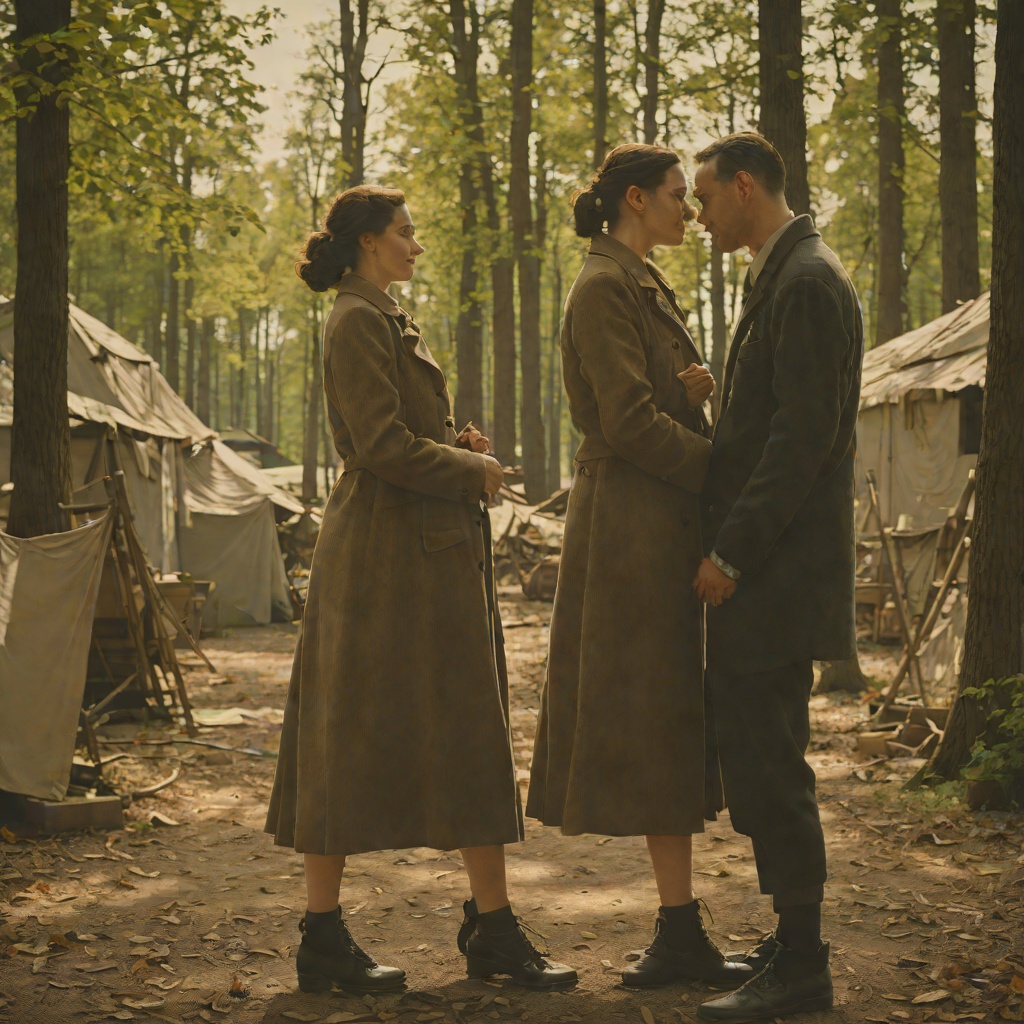
Lale and Gita's letters
The Tattooist of AuschwitzIn the dehumanizing machinery of Auschwitz-Birkenau, where prisoners were reduced to numbers tattooed on their forearms, Lale Sokolov and Gita Furman's letters stand as a defiant assertion of identity and humanity. These brief, carefully written notes, smuggled between the men's and women's camps, transform a chance encounter into a lifeline of love. They are the documentary heart of a romance that begins with a tattoo needle and ends with a marriage lasting over fifty years, a testament to the power of words when everything else has been stripped away.
The Perilous Beginning
The correspondence is born from an act of extraordinary risk. After Lale, the camp Tätowierer, first tattoos Gita — prisoner 34902 — he is consumed by the need to know her. He knows the penalty for a prisoner caught with a pen or paper is death, yet he accepts the offer of paper and pencil from Stefan Baretski, the SS officer who escorts him to his tattooing duties. The danger is asymmetrical: Lale, with his privileged position, is protected; Gita, a mere prisoner in the women's camp, is not. He agonizes over the first words he will write, eventually deciding to keep it simple: "Hello, my name is Lale." He tells her he is from Krompachy in Slovakia, his age, and the makeup of his family, who he hopes are safe. He asks her to be near the administration building the next Sunday morning, explaining that if he isn't there, it will be because of his work, which isn't regulated like everyone else's.
The Exchange of Notes
The letters travel through the hands of an unlikely and dangerous courier. Baretski, a Romanian-born SS man who ran away to Berlin and joined the Hitler Youth, delivers Lale's first letter and returns with Gita's reply. He reads the letter in front of Lale, teasing him: "Oh, Tätowierer," he says, "she doesn't say much. I think you should choose yourself another girlfriend." He playfully pulls the note away before handing it over, a game of cat and mouse that underscores the power imbalance. Gita's reply is equally careful — a few lines revealing she is also from Slovakia, has been in Auschwitz since early April, and works in one of the warehouses nicknamed "Canada," where prisoners sort through the belongings confiscated from fellow victims. She will be in the compound on Sunday and will look for him. Lale rereads the note, turns the paper over several times, and scribbles in bold on the back: "Your name, what is your name?"
The First Meeting
The letters culminate in a face-to-face encounter that changes everything. Walking among his fellow prisoners, Lale feels the tiny hairs on the back of his neck rise — the tickling sensation of being watched. He turns, and there she is, chatting with three other girls who step back, having heard about Lale. He comes close, drawn again to her eyes. She smiles a weak, tentative smile. He hands her the bread and a letter in which, unable to stop himself, he has told her that he can't stop thinking about her. "What's your name?" he asks. "I need to know your name." Behind him, someone says, "Gita." That night, Lale lies on his bed saying her name over and over: "Gita. Gita. What a beautiful name." In Block 29 in the women's camp, Gita curls up with her friends Dana and Ivana, straining to read Lale's letter by a beam of floodlight seeping through a crack in the timber wall. When Dana asks how many times she is going to read it, Gita replies, "Oh, I don't know, until I know every word by heart."
The Letters as Lifeline
The correspondence becomes a lifeline that sustains Lale through the darkest moments. When he is arrested and tortured in Block 11, he sits in a cell for two days, the only light coming through a crack under the door, and relives every moment he has spent with Gita. The letters are not just words; they are the accumulated memory of a love that must survive. Even after the war, the letters' legacy endures. Lale and Gita marry in October 1945 and set up home in Bratislava. Their son, Gary, recalls that his mother, when asked how she and his father stayed together for so many years, responded simply: "Nobody is perfect. Your father has always taken care of me since the first day we met in Birkenau. I know he is not perfect, but I also know he will always put me first." The letters, born of a single act of courage, grow into a devotion that is total and uncompromising.
The Burden of Memory
The letters also carry a hidden weight. Lale carried for more than fifty years the fear that he and Gita might be seen as Nazi collaborators, a burden he shed only when he finally told his story to the author who recorded it. The letters, and the love they represent, are part of a larger narrative about memory and history. As the teller of Lale's story noted, Lale's memories were remarkably clear and precise, matching research into people, dates, and places. There was no parting of memory and history for this beautiful old man — they waltzed perfectly in step. The letters, like the story itself, are a unique lesson in humanity, a record of two ordinary people living in an extraordinary time, deprived not only of their freedom but also their dignity, their names, and their identities. They are proof that even in the most brutal circumstances, love can be written, read, and remembered.