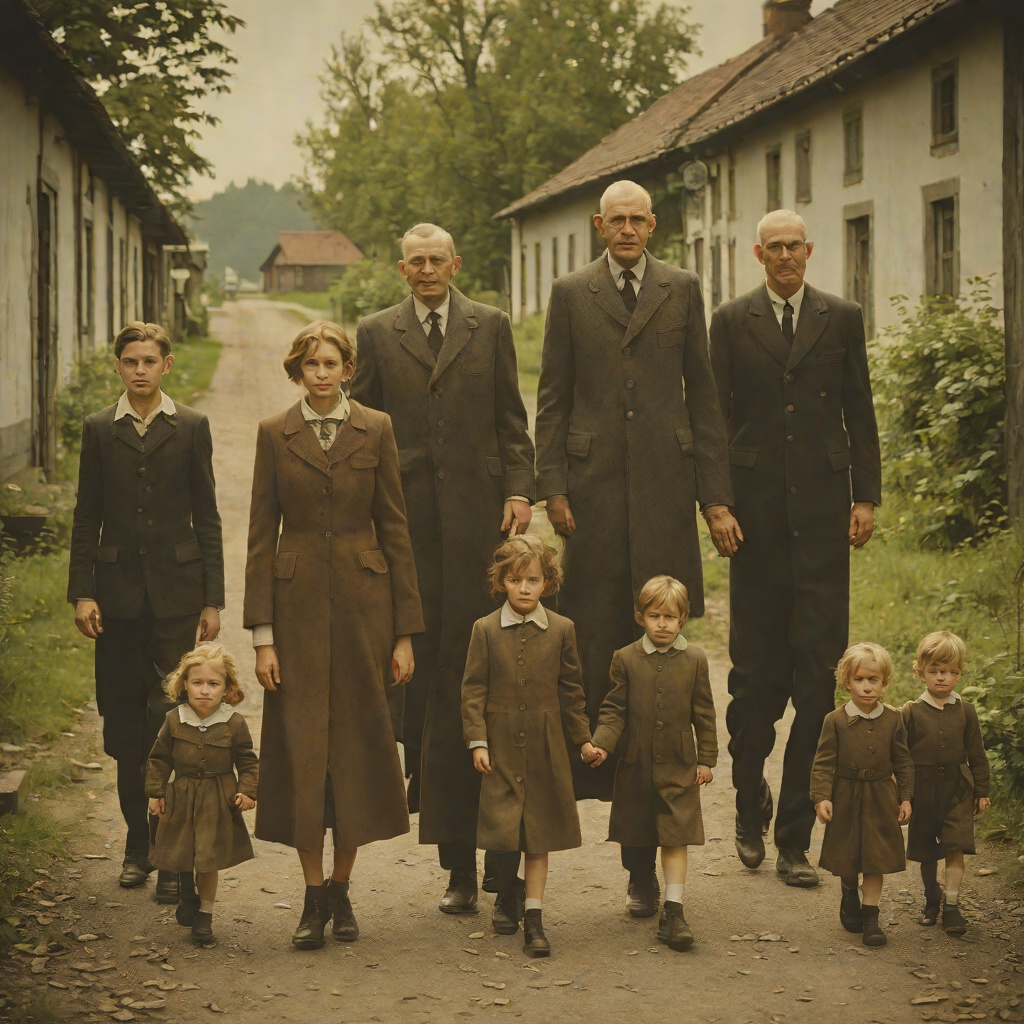
Lale and Goldie Sokolov's relationship
The Tattooist of AuschwitzLale and Goldie Sokolov's relationship is one of the most emotionally charged threads in The Tattooist of Auschwitz, a bond forged in the crucible of family sacrifice and tested by the Holocaust's near-total destruction of the Eisenberg family. Goldie, Lale's sister, is the only member of their immediate family he discovers alive after the war, and her survival becomes the foundation upon which Lale rebuilds his identity. Their reunion in the war's aftermath is not merely a personal relief but a pivotal narrative moment that propels Lale toward his final quest to find Gita, and ultimately shapes the very name he carries for the rest of his life.
Family Bonds Before the War
Before the war, Goldie was an integral part of the Eisenberg family household in Krompachy, Slovakia. When Lale returned to his parents' home following news that Jews in small towns were being rounded up for transport to work for the Germans, he found a family already under immense strain. His sister was the only family member earning an income, working as a seamstress. She had to travel to and from work in secret, before dawn and after dark, because Jews were no longer allowed to work and their businesses had been confiscated. Her boss was prepared to take the risk for her best employee, a testament to her skill and the family's desperate circumstances. During this period, Lale helped around the house, fixing things with his father and brother, and building new beds for his young nephews who had outgrown their cribs, while Goldie's secret labor kept the family financially afloat.
The family's fragile stability shattered when Goldie returned home one evening with a poster her boss had been asked to put in the shop window. The poster demanded that each Jewish family hand over a child aged eighteen or older to work for the German government, warning in bold type that if any family had such a child and did not surrender them, the whole family would be taken to a concentration camp. When Max, Lale's older brother, immediately said he would go, Lale would not hear of it. Max had a wife and two young children and was needed at home. Lale's decision to offer himself for transportation was thus made in direct protection of his siblings, including Goldie, and their families—a sacrifice he later reflected on with no regrets, thinking of his family back home, safe, and insisting he would make it again and again to keep them together.
The farewell at the train station as Lale left for Prague was devastating for the whole family. His mother had helped him pack his suitcase, and in between wiping away tears, she kept taking out clothes he had packed and putting in books "for comfort and a reminder of home, wherever you end up." As they stood on the platform, Lale saw tears in his father's eyes for the first time, and his mother ran the length of the platform, her arms outstretched, trying desperately to reach out to her baby boy. His two young nephews, oblivious to their changing world, ran innocently along the platform, chasing the train. Goldie was among those who helped their father away from the platform, a small but telling detail of her role as a caretaker within the family even as her brother departed for an unknown fate.
The War Years and Separation
During his time in the camps, Lale carried the memory of his family with him, though the war would bring him no news of them. In a moment of profound emotion at Auschwitz, when a young child toddled up to him and he swept the boy up in his arms, the child's weight and smell reminded him of the young nephew he had said goodbye to more than a year ago. Overcome, he placed the child back down and hurried inside, lying on his bed and thinking back to the last time he was with his family. The separation from Goldie and the rest of his family was a wound that the camp's horrors could not erase, and it surfaced in these unexpected moments of tenderness.
Lale's love for Gita, which grew and deepened in the camp, became intertwined with his longing for his family. When he finally declared his love to Gita, telling her "My beautiful Gita. You've bewitched me. I've fallen in love with you," he was also, in a sense, reaching toward the possibility of a future family, a home rebuilt from the ashes of the one he had lost. The relationship with Gita and the memory of Goldie and his family were two poles of his emotional life, one pointing toward a future he desperately hoped for, the other toward a past he feared was gone forever.
The Reunion in Krompachy
After the war, Lale's return to his family home in Krompachy was met with a shock that nearly felled his sister. When he arrived, a neighbor, Mrs. Molnar, asked him what he was doing standing outside, and told him to go on in, go home. When Lale asked if anyone was living there, she replied, "Your sister, of course. Oh, my—she doesn't know you're alive?" Lale's response was a cry of disbelief: "My sister! Goldie is alive?" He ran across the street and knocked loudly on the door, and when no one answered immediately, he knocked again. From inside he heard, "I'm coming, I'm coming."
When Goldie opened the door and saw her brother, she fainted. Mrs. Molnar followed Lale inside as he picked his sister up and laid her on a sofa, and she brought a glass of water. Cradling Goldie's head lovingly in his arms, Lale waited for her to open her eyes. When she came to, he offered her the water, and she sobbed, spilling most of it. Mrs. Molnar let herself out quietly as Lale rocked his sister, letting his own tears flow, too. It was quite some time before he could speak and ask the questions he so desperately wanted answers to.
The news Goldie had to give was bleak. Their parents had been taken away only days after Lale left, and Goldie had no idea where they went or if they were still alive. Max had gone off to join the partisans and was killed fighting the Germans. Max's wife and their two small boys were taken—again, she did not know where to. The only positive news Goldie had to offer was her own: she had fallen in love with a Russian, and they were married. Her name was now Sokolov, and her husband was away on business and due back in a few days.
A New Bond and a Shared Purpose
In the aftermath of the reunion, Lale and Goldie's relationship deepened into a partnership of survival and hope. Lale followed her into the kitchen, not wanting to let her out of his sight, as she prepared a meal for them. After they had eaten, they talked late into the night. As much as Goldie pushed Lale for information about where he had been for the past three years, he would only say he had been in a work camp in Poland and that he was now home. The next day he poured his heart out to both his sister and Mrs. Molnar about his love for Gita and how he believed she was still alive.
Goldie's response was immediate and forceful: "You have to find her. You must look for her." When Lale said he didn't know where to start looking, it was Mrs. Molnar who asked where Gita had come from, and who later suggested that people were starting to come home from the camps, all arriving in Bratislava. When Lale said he needed transport to get there, Goldie smiled and said, "So what are you doing sitting here, then?" Her encouragement was the push Lale needed, and her final words as he climbed into the back of a cart drawn by a single horse were a command: "Don't come back without Gita." As the horse took off, nearly throwing Lale out, he looked back at the two women standing outside his family home, each with an arm around the other, smiling, waving.
The Legacy of the Sokolov Name
Goldie's influence on Lale's life extended far beyond their reunion. After the war, Lale changed his name to Sokolov, the Russian last name of his married sister—a name more readily accepted than Eisenberg in Soviet-controlled Slovakia. This act of adopting Goldie's married name was both a practical survival strategy and a profound symbol of their bond: in taking her name, Lale was anchoring his new identity to the one family member who had survived, and to the new life she had built. He and Gita were married in October 1945 and set up home in Bratislava, where Lale started importing fine fabrics—linen, silk, cotton—from throughout Europe and Asia.
The relationship between Lale and Goldie, forged in the shared loss of their parents and brother, and cemented by her insistence that he find Gita, stands as a testament to the resilience of family love in the face of unimaginable horror. Goldie's survival gave Lale a reason to return, a home to come back to, and a name to carry forward. Her command that he not return without Gita was the final push that led to the couple's reunion in Bratislava, and her existence as his surviving sister was a constant reminder that even in the midst of total devastation, something of the family he had sacrificed himself to protect had endured.