Lale and Nadya's relationship
The Tattooist of AuschwitzLale and Nadya's relationship is one of the most quietly devastating bonds forged inside Birkenau, a friendship between the camp's young tattooist and a Romany woman old enough to be his mother that becomes a surrogate family for both of them. In a place engineered to strip prisoners of every human attachment, Lale and Nadya build a connection founded not on romance or shared history but on the simplest of human acts: listening, protecting, and remembering. Their bond, which begins with Lale's curiosity about a solitary woman and deepens into a mutual caretaking that mirrors his love for Gita, ultimately becomes a measure of what the camp takes from him and what he refuses to let it destroy. When Nadya is deported in the liquidation of the Gypsy camp, her loss joins the ranks of Lale's deepest wounds, and her memory endures in a painting that hangs in his son's house decades later, a testament to a friendship that outlasted the camp that tried to erase it.
The Solitary Woman in the Gypsy Camp
Lale first notices Nadya as a figure of isolation within the crowded chaos of the Gypsy camp, where he has been made an honorary Romany within days of his arrival. She appears to have no children or family, no one who engages with her or shows her affection, and she is often just an extra pair of hands for a mother struggling with too many children. She looks to be in her fifties, though Lale has learned that Romany men and women often look older than their years, a detail that hints at the hard life she has led. One evening, after they have both assisted with getting the children to sleep, Lale follows her outside, and she gives him a thin smile before sitting on a pile of bricks to rest. When he asks about her family, she shakes her head sadly and tells him that her husband and son died of typhus, leaving her alone. "It's only me now," she says, introducing herself as Nadya. Lale responds with a simple expression of sympathy and a request to hear about them, offering his own name in return.
That evening, Lale and Nadya converse long into the night, with Lale doing most of the talking while Nadya prefers to listen. He tells her of his family back in Slovakia and of his love for Gita, and in turn discovers that Nadya is only forty-one years old, her son having been six when he died three years earlier, two days before his father. When Lale asks for her opinions, he finds her answers similar to those his own mother would give, and he is drawn to wonder whether it is this resemblance that makes him want to protect her the way he wants to protect Gita. The conversation plunges him into an acute homesickness, and dark thoughts about his family's safety that he has kept at bay consume him. His resolution is telling: if he cannot help his own family, he will do what he can for this woman in front of him.
A Mother's Gesture and a Name That Means Hope
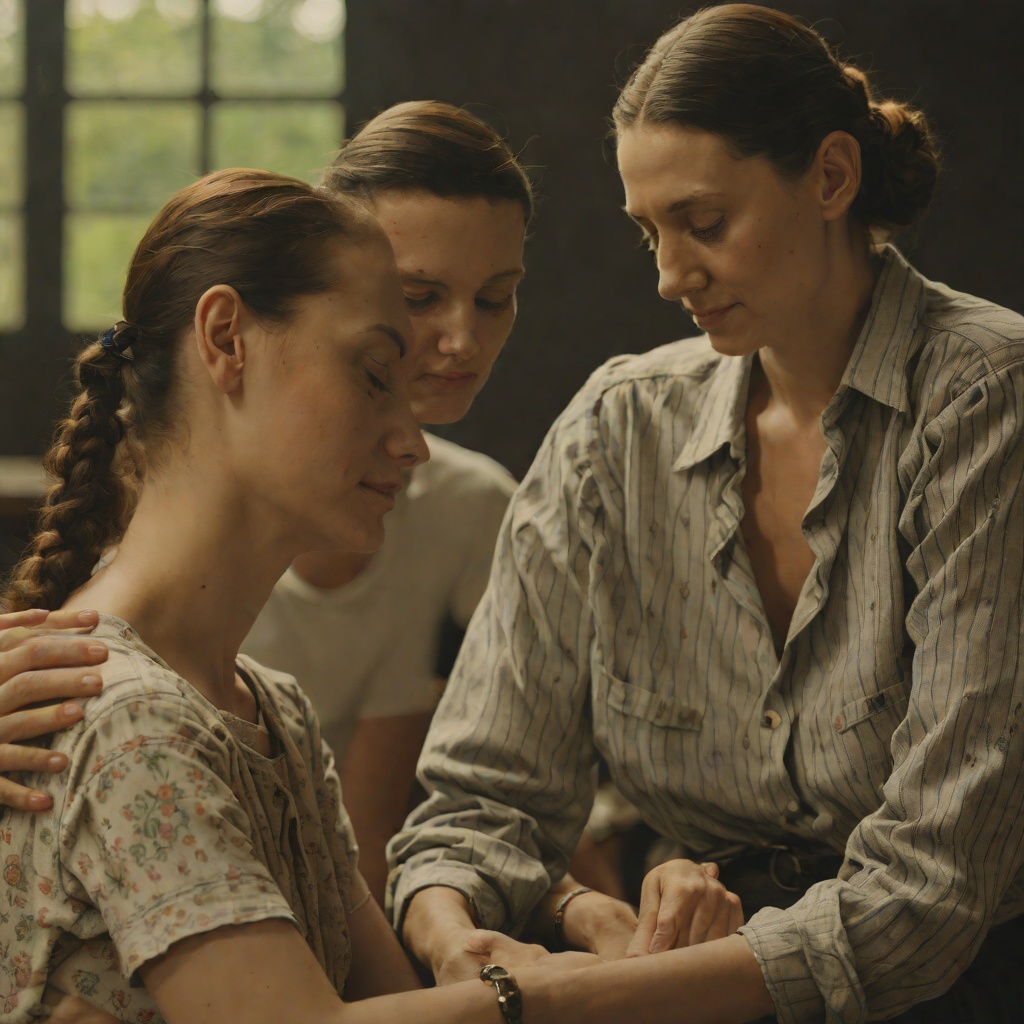
Nadya's presence in Lale's life is defined by small, precise gestures that echo his memories of home. He studies her face in profile one night and finds her quite beautiful, her unshaven brown hair cascading down her shoulders and blowing in the breeze so that she spends much of her time tucking it back behind her ears. It is a gesture so familiar to him, one his mother made all day, every day, as wayward strands escaped from her tight bun or from under the scarf that hid it. Nadya speaks with the quietest natural voice he has ever heard, not a whisper but simply her voice, and Lale eventually works out what saddens him about it: it is emotionless, unchanged whether she is relaying stories of happy times with her family or talking about the tragedy of being here. When he asks what her name means, she answers simply, "Hope. It means hope," before standing and saying good night and disappearing before he can reply.
The irony of her name is not lost on the narrative: a woman who has lost her entire family and lives in a place designed to extinguish hope carries a name that means exactly that. Lale's relationship with her becomes a way of holding onto hope in a hopeless place, and her quiet dignity in the face of total loss offers him a model of endurance. His protective instinct toward her is also a channel for his helplessness about his own family, a way of doing something, however small, in the face of overwhelming darkness.
Shared Grief and the Death of the Children
The deepest test of their bond comes during a catastrophe in the Gypsy camp, when the children are taken. Lale sets about gathering the young boys and girls to shepherd them indoors, some crying, some too shocked to cry, and several of the older women join him in taking the surviving children to the far end of the block to tell them stories. But this time the stories do not work; the children cannot be comforted, and most remain in a silent state of trauma. Lale goes to his room and returns with chocolate, which he and Nadya break up and offer around. Some of the children take it; others look at it as if it, too, will harm them. There is nothing more he can do, and Nadya takes him by the hand, raising him to his feet. "Thank you. You have done all you can," she says, brushing his cheek with the back of her hand before telling him to leave them now.
Lale staggers outside to help the men gather the small bodies into a pile for the SS to take away, and he notices that they are already picking up the bodies that lie in the compound. Several mothers refuse to hand over their precious children, and it is heartbreaking to him to see small, lifeless forms being wrenched from their mothers' arms. In this moment of absolute horror, Nadya is the one who recognizes that Lale has reached his limit and releases him from the unbearable task, her gesture of brushing his cheek a maternal benediction that allows him to step away without shame. Their partnership in this scene is one of mutual recognition: she sees what he has given, and she gives him permission to stop.
Return and Reunion
Lale's relationship with Nadya is tested by his absence when he is arrested and taken to Block 11, the punishment block, where he spends two days in a cell listening to the cries and screams of others while reliving every moment he has spent with Gita. When he is released and returns to the Gypsy camp, the children have been told that the Tätowierer is dead, and one of them runs to him and throws his arms around his waist, hugging him tight and welcoming him "home." The others join in, and before long adults are coming out of the block to greet him, asking where he has been and whether he is injured. Nadya is standing at the back of the group, and Lale makes eye contact with her. Pushing his way through the men, women, and children, he stops in front of her and, with a finger, wipes a tear from her cheek. "It's good to see you, Nadya," he says, and she replies, "We've missed you. I've missed you." All Lale can do is nod, needing to get away quickly before he breaks down in front of everyone. He rushes to his room, closes the door on the world, and lies on his old bed.
The reunion scene is charged with an emotion Lale cannot afford to show publicly. Her single tear and his wiping of it is the most physically intimate gesture between them, a wordless acknowledgment of how much his absence has cost her and how much her presence means to him. That he must flee to his room to avoid breaking down reveals the depth of feeling he has for her, a bond that has become as essential to his survival as his love for Gita.
The Liquidation of the Gypsy Camp
When the Gypsy camp is liquidated, Lale stops a passing officer he recognizes to ask where the people are being taken, and the man responds with a chilling invitation to join them. Lale sinks into the shadows, scanning the crowd, and sees Nadya. He runs to her and pleads, "Nadya, don't go." She forces a brave smile and tells him she does not have a choice, that she goes where her people go. "Goodbye, my friend, it's been . . ." she begins, but an officer pushes her along before she can finish. Lale stands paralyzed, watching until the last person has been loaded onto the trucks. The trucks drive off, and slowly he walks back into the eerily silent block. He goes back to bed, but sleep will not come.
Nadya's deportation is one of the few moments in the narrative where Lale is rendered completely helpless, unable to use his position, his connections, or his resources to save someone he loves. His plea, "Don't go," is the cry of a son watching a mother figure be taken, and her response, "I go where my people go," is a statement of solidarity and identity that he cannot argue with. The unfinished sentence, cut off by an officer's shove, leaves their farewell permanently incomplete, a wound that never fully closes.
The Painting That Survives
The most enduring testament to Lale and Nadya's relationship is a painting of a Romany woman that Gita brings with them from Slovakia when they emigrate to Australia. The painting still hangs in the house of their son, Gary, decades later, a silent memorial to the woman whose name meant hope and whose friendship meant home to Lale in the darkest place on earth. The painting's survival, carried across continents and generations, suggests that Nadya was never forgotten, that her image remained a fixture of the Sokolov family's life long after the camp was liberated. It is a quiet but powerful proof that the bond between the tattooist and the Romany woman was not a passing camp friendship but a relationship that shaped Lale's understanding of love, loss, and the duty to remember.
Lale's relationship with Nadya also illuminates his character in ways his romance with Gita cannot. With Gita, he is a protector and a lover, driven by passion and the determination to save one person from the machinery of death. With Nadya, he is a son and a friend, drawn to her by the echo of his mother and by the recognition of a grief as profound as his own. Their friendship shows Lale's capacity for love extending beyond the romantic, encompassing a kind of filial devotion that the camp both destroyed and, paradoxically, made possible. In Nadya, he found a way to be a family man even when his family was unreachable, and in him, she found someone who would remember her when everyone else was gone.