Lale and Victor's smuggling and trading relationship
The Tattooist of AuschwitzLale and Victor's smuggling and trading relationship is the black-market lifeline that sustains Lale Sokolov inside Auschwitz-Birkenau. What begins as a casual approach to two civilian bricklayers working on a construction site becomes a sealed alliance of food, medicine, and contraband — an arrangement that keeps the camp's Tätowierer fed, funds his courtship of Gita Furman, and ultimately saves lives. The relationship is built on a simple ethical principle that Lale voices almost to himself: "Save the one, save the world." It is a partnership of mutual risk, in which a Polish worker smuggles goods past the SS and a Jewish prisoner pays with jewels lifted from the Canada warehouse, each man trusting the other with his life.
Origins of the Alliance
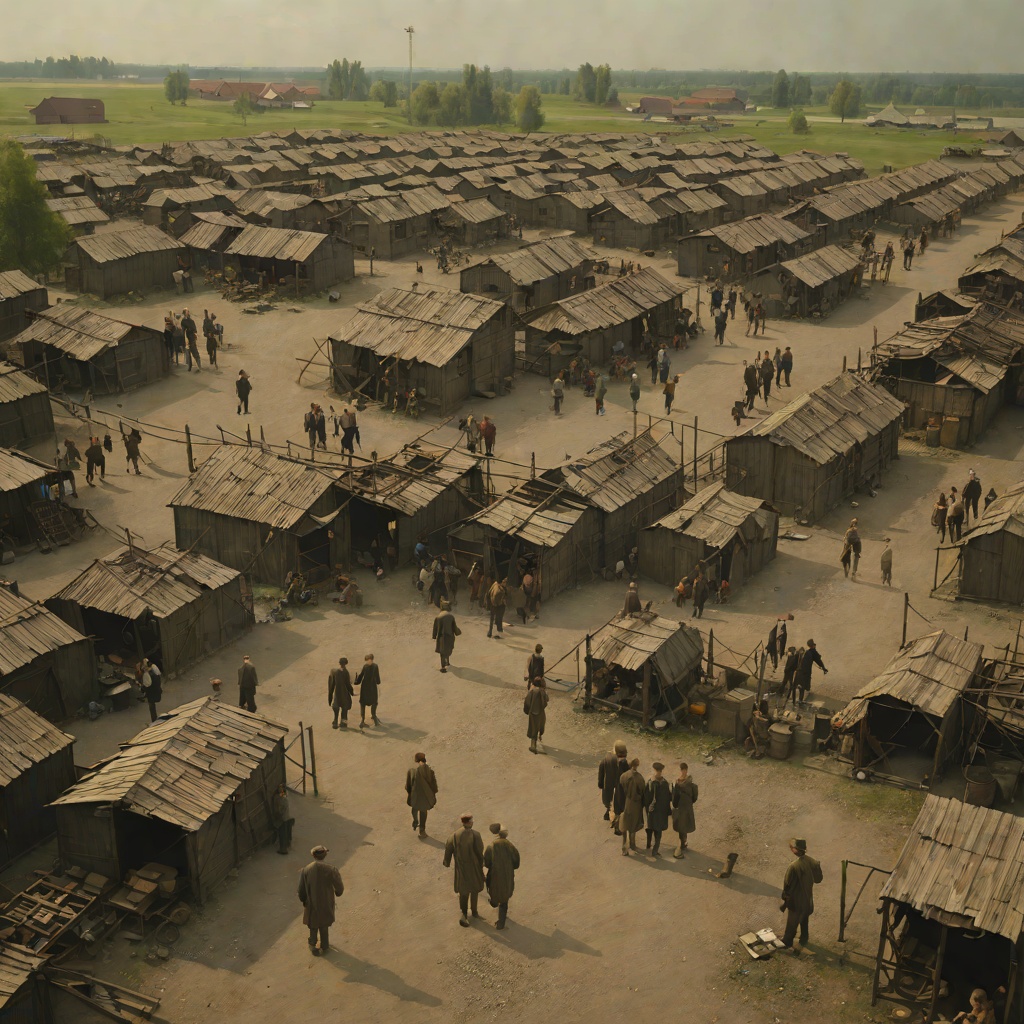
Lale first notices the civilian workers shortly after arriving in the camp. Groups of men dressed in ordinary clothing appear every day at the construction sites, work through the day, and vanish after "tools down," never to be seen again. Curious about who they are, and emboldened by the spring in his step from his time with Gita, Lale decides to approach them, trusting that his bag-shaped shield — the tattooist's kit that grants him a measure of protection — will keep the SS from shooting him. He strolls casually toward one of the new brick buildings under construction, squats beside a pile of bricks, and pretends to study one while the two men slow their work to watch him. When he introduces himself, the younger man reacts with hostility, but the older one intervenes: "Settle down, boy. Don't mind him," he says, his voice rough from too many cigarettes. "My name's Victor. The mouth here is my son, Yuri." Victor extends his hand, which Lale shakes; Yuri refuses to take it.
The First Exchange and the Promise of Payment
Victor reaches into a nearby bag and produces a piece of dried sausage wrapped in waxed paper — a gift offered without any expectation of return. When Lale hesitates, Victor insists: "Lale, take the sausage, and come and see us again tomorrow. I'll have more for you. Hell, if we can help just one of you, we'll do it. Right, Yuri?" It is in this moment that Lale murmurs the phrase that will define his moral code throughout the war: "Save the one, save the world." But Lale is uncomfortable accepting charity. He tells Victor there might be a way he could pay, and asks whether Victor could get him something else — specifically chocolate, because that is what a man gives a girl if he can get it. The request reveals the dual purpose of the smuggling operation from its very inception: it is not merely survival but courtship, a way to reach Gita through gifts.
The Sealed Alliance and the Flow of Goods
Lale is conflicted in the days that follow. He desperately wants the food Victor brings, but he has nothing to pay with. He decides to visit Victor and reassure him that he is working on obtaining a source of payment, telling him plainly: "I'm sorry, I haven't been able to get anything to pay you with, but I hope to have something very soon. Please don't bring anything else until I've paid you for what you've given me already." Victor refuses to accept the risk without compensation: "No, you're taking a risk. At the very least, you should get something in return. Just give me a day or two." The solution arrives at seven the next morning, when Lale hangs around the main compound gates as the local workers enter. He sidles up to Victor and opens his hand to reveal a ruby and a ring. Victor closes his hand over Lale's in a handshake, palming the jewels; Lale's bag is already open, and Victor quickly transfers packages into it. Their alliance is now sealed. From that point on, the exchange becomes routine: Victor places packages of food into Lale's open bag, and later adds medicine alongside the food. The goods flow in one direction, the stolen valuables in the other, each transaction a small act of defiance against the camp's economy of death.
The Relationship Deepens Through Crisis
When Lale learns that something urgent requires Victor's help, he grabs his bag and his boots, throws a blanket around his shoulders, and runs from his room to the front gates without checking who is around. He must get to Victor and Yuri immediately. The urgency of his flight shows how much he has come to depend on the pair — not merely for food but for the ability to act, to intervene in the camp's machinery of murder. On another occasion, as the Polish workers are heading out of camp, Victor summons Lale over and tells him, "We have supplies for you and thought we wouldn't be able to hand them over. Do you have room in your bag?" Lale answers, "No, I'll take it now, thanks. I'll see you tomorrow with payment." The exchange is so established that it requires almost no words. Even after Lale's arrest and torture in Block 11, when he sits for two days in a cell with only a crack of light under the door, listening to the cries and screams of others and reliving every moment he has spent with Gita, the relationship endures. When he is released and the workers enter the camp again, Victor and Yuri break from the line of men and greet him warmly.
The Changing Terms and the Final Diamond
As the war turns against Germany, the relationship shifts. Lale becomes more apprehensive than he used to be, though he still manages to pass the guards by naming the Politische Abteilung on both occasions. When Victor and Yuri greet him warmly, Lale tells them plainly: "Not like before. I'm scaling it down, OK? Just a little extra food, if you can. No more nylons." The contraband trade that once included luxury goods like nylons is reduced to bare sustenance as the camp's situation deteriorates. Yet even in this diminished form, the partnership holds. In their final recorded transaction, Lale extends his hand, Victor takes it, and a diamond changes hands. The gesture echoes their first handshake at the compound gates, when a ruby and a ring sealed the alliance — the same silent ritual of palm-to-palm exchange, now carrying a single diamond as the last payment of a relationship that has run its course.
Significance of the Partnership
The smuggling relationship between Lale and Victor is the engine that powers nearly every act of generosity and rescue Lale performs in the camp. The food keeps him alive; the medicine allows him to treat the sick, including obtaining penicillin for Gita when she falls ill; the chocolate and other gifts let him court Gita and maintain the hope of a future beyond the wire. The jewels Lale provides come from the Canada warehouse, where prisoners sort the possessions of the murdered — a grim irony that the dead fund the living. Victor's stated willingness to help "just one" prisoner, echoed in Lale's mantra "Save the one, save the world," transforms the relationship from a mere transaction into a moral compact. It is a rare instance in the camp of solidarity across the lines of nationality and status: a Polish civilian worker and a Jewish prisoner, bound not by blood or ideology but by a shared refusal to let the SS's machinery of dehumanization have the final word. The handshake that seals their alliance — first with a ruby and a ring, finally with a diamond — is the recurring image of a partnership built on trust in a place where trust was the most dangerous and most precious commodity of all.