Lale gets penicillin for Gita
The Tattooist of AuschwitzLale gets penicillin for Gita is the pivotal rescue sequence in which Lale Sokolov, the camp tattooist at Auschwitz-Birkenau, saves Gita Furman from typhus by mobilizing his black-market network, his own fortune in gems and currency, and the reluctant cooperation of an SS officer. The episode transforms their fragile acquaintance into a bond of total devotion, establishes Lale's role as a protector who will risk everything for one person, and sets the pattern of clandestine care that defines their relationship through the rest of the war. It is the moment the love story of the Tätowierer and prisoner 34902 ceases to be a matter of glances exchanged during tattooing and becomes a matter of life and death, with Lale staking everything he has on the chance that she will live.
The Discovery of Gita's Illness
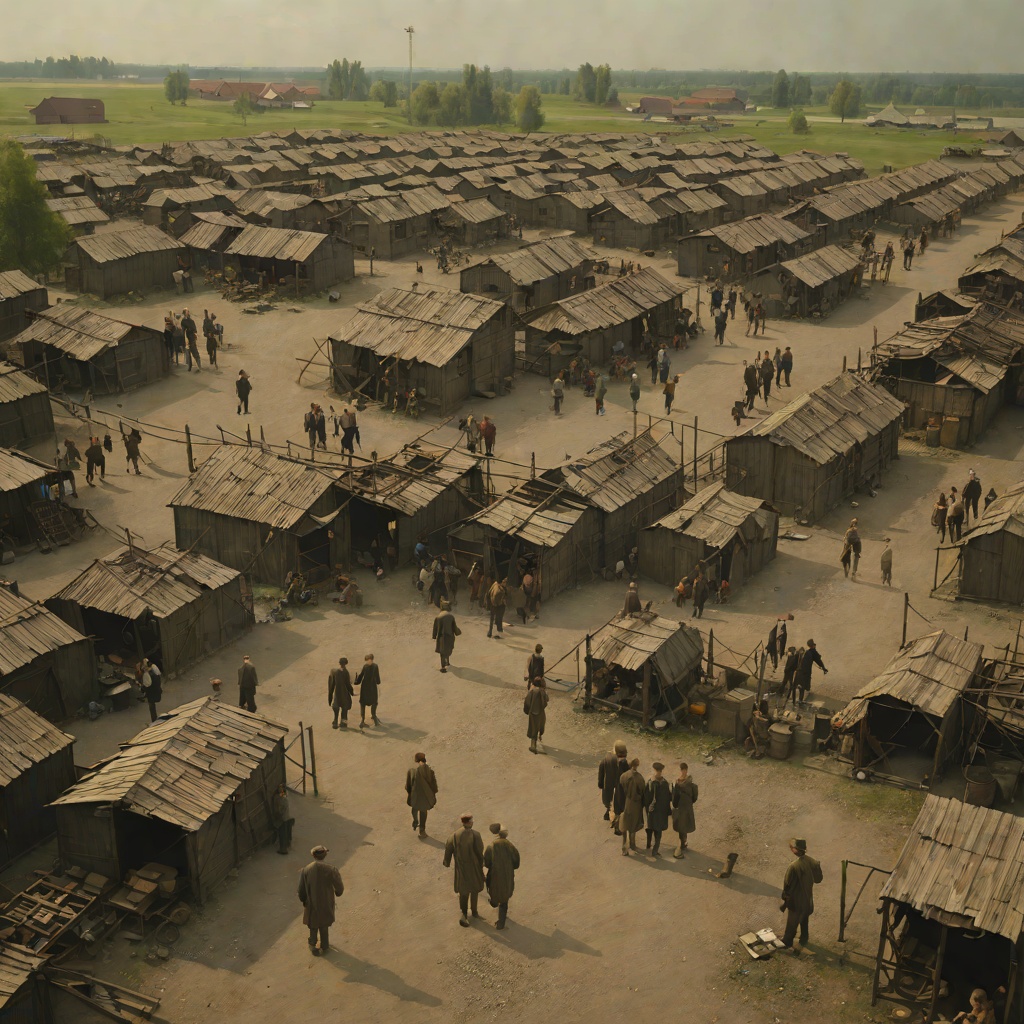
The crisis begins on a bitterly cold Sunday when Lale, upbeat despite the compound being a mess of snow and mud, paces the grounds hoping for a fleeting meeting with Gita. He walks by the women's camp as often as he can without raising suspicion, watching several girls come from Block 29, but no Gita appears. Just as he is about to give up, Dana hurries over, scanning the compound, and delivers the news that stops his heart: Gita is sick. His heart lurches to his throat in panic as he remembers the death cart, the close call, and the men who nursed him back to health. He insists he must see her, but Dana warns that their kapo is in a terrible mood and wants to call the SS to have Gita taken away. When Lale asks what is wrong, Dana tells him they think it is typhus and that they have already lost several girls in their block that week. The diagnosis is a death sentence in the camp, where the hospital is not a place of healing but a place where the sick are taken to be disposed of.
The Plan to Hide Her in Canada
Lale's response is immediate and desperate. He tells Dana that Gita needs medicine, penicillin, but Dana protests that if they go to the hospital and ask for it, they will just take her away. She pleads with him, confessing that she has lost all her family and cannot lose Gita too. Lale's mind races as he formulates a plan that is audacious in its simplicity and its danger. He instructs Dana to take Gita to the Canada the next morning, however she can, carrying or dragging her, and hide her there among the clothes during the day, getting as much water into her as possible, then bring her back to the block for roll call. This must be repeated for a few days until he can get medicine. It is the only way to stop her from being taken to the hospital. Dana agrees, saying Ivana will help, but insists that Gita must have medicine. Lale grips Dana's hand and asks her to tell Gita something, a message left unfinished as the scene closes.
The Price of Medicine
The next morning, Lale wakes from an out-of-body experience, feeling as though the room is empty even of himself, and jolts back to reality with the memory of yesterday's meeting with Dana. He grabs his bag and boots, throws a blanket around his shoulders, and runs to the front gates without checking who is around. He must get to Victor and Yuri immediately. The two men arrive with the others in their detail, sinking into the snow with each step toward work, and move away from the others to meet Lale halfway. Lale shows Victor the gems and currency in his hand, a small fortune's worth, and drops everything he has into Victor's bag. He asks for penicillin or something similar, and Victor, placing his packages of food into Lale's open bag, simply nods and says yes. The transaction is wordless in its efficiency, a testament to the trust built through their smuggling operation. Lale then hurries to Block 29 and watches from a distance, pacing up and down, oblivious to the eyes in the towers surrounding the camp, until he finally sees Dana and Ivana with Gita hanging weakly from their shoulders, two other girls helping to block the scene from easy view. He drops to his knees at the thought that this could be the last time he sees her.
The Delivery and the Vigil
That night, sleep evades Lale, his mind a whirlpool of the thought that he barely knows Gita, yet cannot live if she does not. The next morning, Victor places medicine, along with food, into Lale's bag, and that afternoon Lale is able to get it to Dana. In the evening, Dana and Ivana sit beside a now fully unconscious Gita, the pull of typhus stronger than they are, the black stillness having completely overtaken her. They talk to her, but she gives no sign that she hears them. From a small vial, Dana places several drops of liquid into Gita's mouth as Ivana holds it open. An exhausted Ivana confesses she does not think she can keep carrying Gita to the Canada, but Dana insists she will get better, that it will only be a few more days. The vigil is a test of faith, with the medicine working slowly against a disease that has already claimed several girls in their block.
The SS Officer's Price
Lale, not content to rely on the medicine alone, seeks an additional layer of protection for Gita. He approaches Stefan Baretski, the SS officer with whom he has a complex relationship, and asks if he can get Gita transferred from the Canada into the administration building. Baretski, tapping his foot, asks if Lale wants her where there is heating, and Lale confirms. Baretski says it might take a day or two, but he will see what he can do, with no promises. Lale thanks him, and Baretski, the smirk back as he fondles his swagger stick, reminds him: "You owe me, Tätowierer. You owe me." The debt is a dangerous one, placing Lale in the officer's power, but it is a price he is willing to pay.
Recovery and Reunion
The following Sunday, Lale walks slowly alongside a recovering Gita. He wants to put his arm around her like he saw Dana and Ivana do, but he does not dare; it is good enough to be near her. She wears a long woolen coat, no doubt something the girls have appropriated from the Canada with no objection from the SS, and it has deep pockets that Lale fills with food before he sends her back to her block to rest. The following morning, a trembling Gita is escorted into the main administration building by an SS officer, told nothing and automatically fearing the worst. She has been sick, and now she is weak, clearly the authorities have decided she is no longer of use. But instead of being disposed of, she is put to work transcribing details onto cards and into a large leather-bound book. Later that day, she hears a familiar voice and looks up to see Lale entering the room, handing papers to one of the civilian girls. As his glance passes Gita, he winks, and she cannot help herself, gasping and drawing the attention of a few women before Lale hurries from the room. The rescue is complete, and their secret is now a shared one, hidden in plain sight within the administration building.
The Deeper Significance
The penicillin rescue is more than a single act of mercy; it is the founding event of Lale and Gita's lifelong bond. Decades later, their son would recall his mother's explanation for their fifty years of marriage: "Nobody is perfect. Your father has always taken care of me since the first day we met in Birkenau. I know he is not perfect, but I also know he will always put me first." The rescue also reveals the moral economy of the camp, where a fortune in gems and currency, amassed through black-market dealings, could be spent in an instant to save one life, and where an SS officer's favor came with a debt that could be called in at any moment. Lale's willingness to risk everything, his own life included, for a woman he barely knows, establishes the pattern of self-sacrifice that defines his character throughout the war, from his rescue of Mendel Bauer to his endurance of torture in Block 11. The episode is the first proof that love could exist and flourish even in the heart of the Nazi death machine, and that saving one person could be an act of defiance against the entire system.