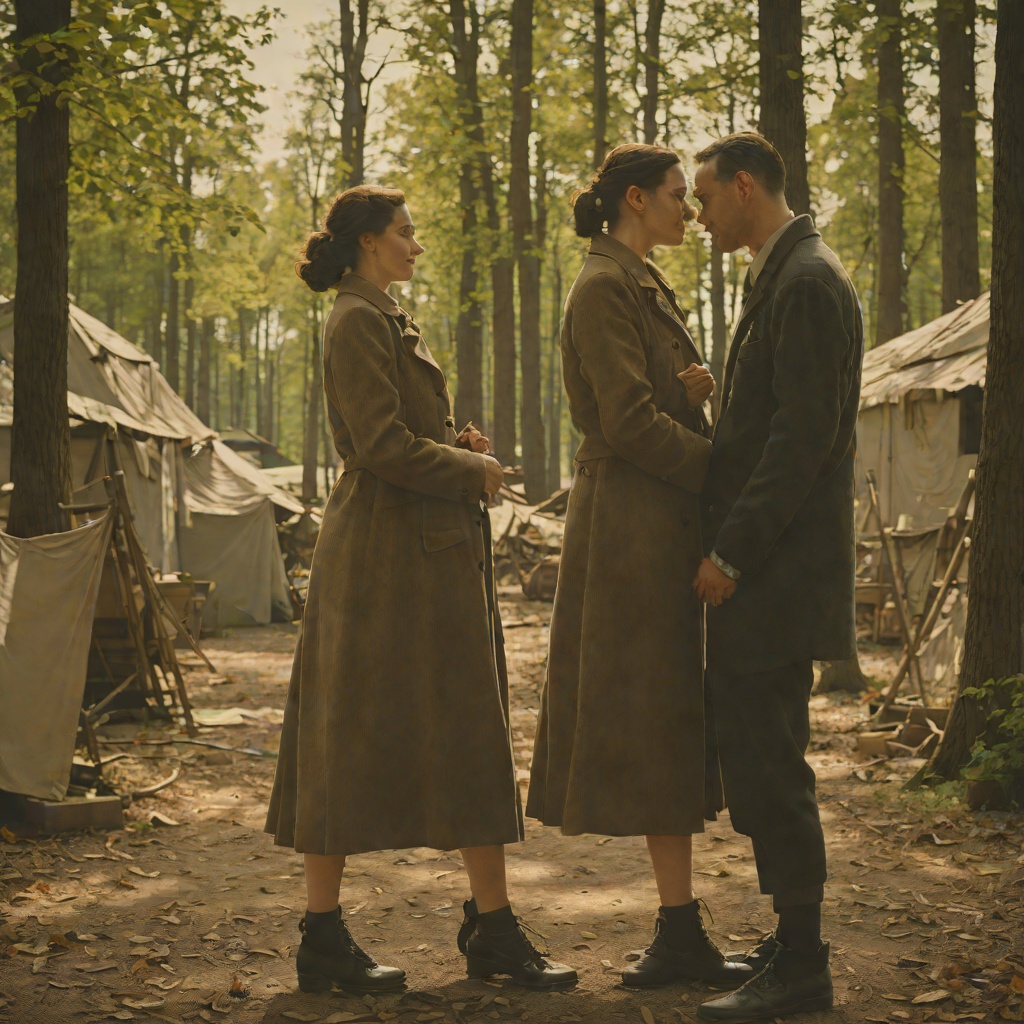
Lale writes his first letter to Gita
The Tattooist of AuschwitzThe first letter Lale Sokolov writes to Gita Furman is not merely a note passed between two prisoners; it is a quiet act of rebellion against the entire machinery of Auschwitz. It begins in the aftermath of a moment that had stopped his heart: while tattooing a terrified young woman, he had looked into her eyes and felt his heart "simultaneously to stop and to begin beating for the first time." He had forced a small smile, she had returned a smaller one, and then she was gone, leaving him with only the memory of her dancing eyes and the knowledge of her number: 34902. The letter is his attempt to reclaim her from that number, to give the digits a name and a future.
The Unlikely Messenger
The letter's journey from Lale's hand to Gita's depends on a man whose very presence in the camp is a study in contradiction: Stefan Baretski. Lale discovers that Baretski is not German but was born in Romania, in a small town near the Slovak border, only a few hundred miles from Lale's own hometown of Krompachy. He had run away to Berlin, joined the Hitler Youth, and then the SS, driven by a hatred for a father who beat him and his siblings viciously. He worries about his sisters, one younger and one older, who still live at home. This shared geography and hidden vulnerability create a strange, unspoken bond. Walking back to Birkenau one night, Lale quietly accepts Baretski's earlier offer of paper and pencil, stating simply, "Her number is 34902." The next morning, Baretski appears in Lale's single room—entering without knocking, as he always does—and delivers the crucial information: "She's in Block 29." He hands Lale a pencil and paper with a promise: "Here, write to her and I will make sure she gets it." When Lale asks if Baretski knows her name, the guard's look is answer enough. He gives Lale an hour, but Lale asks for two.
Composing the First Words
Alone in his room, Lale agonizes over the first words he will write to prisoner 34902. How to begin? How to address a woman he has only seen once, whose name he does not know? He decides to keep it simple: "Hello, my name is Lale." The page he hands to Baretski is only a few sentences long. He tells her he is from Krompachy in Slovakia, his age, and the makeup of his family, who he hopes are safe. He asks her to be near the administration building next Sunday morning, explaining that he will try to be there too, but that if he is not, it will be because of his work, which is not regulated like everyone else's. Baretski reads the letter in front of Lale, then asks with a hint of disdain, "Is this all you have to say?" The question hangs in the air, a reminder of the immense risk contained in those few careful lines. Lale immediately feels the weight of what he has done: he has placed prisoner 34902 in danger. He is protected; she is not. And still, he wants, needs, to take the risk.
The Reply and the Question
The next day, Lale works with Leon well into the evening while Baretski patrols nearby, swaggering up and down the rows of men with his insidious smirk, using his rifle as a baton when he dislikes the look of someone. Only when Lale and Leon are packing up does Baretski produce a piece of paper from his jacket pocket. "Oh, Tätowierer," he teases, "she doesn't say much. I think you should choose yourself another girlfriend." He playfully pulls the note away before handing it over, and Lale, refusing to play the game, turns and walks away, forcing Baretski to chase after him. Lale puts the note in his bag, eats a hurried meal, shoves several pieces of bread up his sleeve—cursing that his Russian uniform has been replaced by a pajama-like outfit with no pockets—and hurries back to his room. He drops onto his bed and holds the note to his chest, picturing prisoner 34902 writing the words he is so eager to read. Finally, he opens it. "Dear Lale," it begins. Like him, she has written only a few careful lines. She is also from Slovakia. She has been in Auschwitz longer than Lale, since early April. She works in one of the warehouses nicknamed "Canada," where prisoners sort through the belongings confiscated from fellow victims. She will be in the compound on Sunday and will look for him. Lale rereads the note, turns the paper over several times, then grabs his pencil and scribbles in bold on the back of her letter: "Your name, what is your name?"
A Risk That Defines a Life
The letter is the first thread in a bond that will sustain Lale through the horrors to come. It is a deliberate act of hope in a place designed to extinguish it, a refusal to let the tattooed number be the final word. The risk he takes for Gita foreshadows every subsequent act of defiance: smuggling penicillin to save her from typhus, using his position to trade and bribe, and even altering a condemned man's number to give him a chance at life, explaining that where Mendel is going, no one is numbered. The letter also establishes the pattern of their relationship, one built on stolen moments, secret messages, and the constant threat of discovery. Decades later, when Lale finally tells his story, the memory of that first letter and the woman who answered it remains the emotional core. His son Gary recalls that his mother, when very sick in the camp, had a vision of her own mother telling her, "You will get better. Move to a faraway land and have a son." The letter is the first step toward that prophecy's fulfillment. It is the moment Lale chooses to love, and in choosing to love, he chooses to live. The story he tells, three years in the untying, is not a lesson in history but a lesson in humanity, and it begins with a few careful lines written on a scrap of paper, passed through the hands of an SS guard who was himself a beaten child from a town near Lale's own.