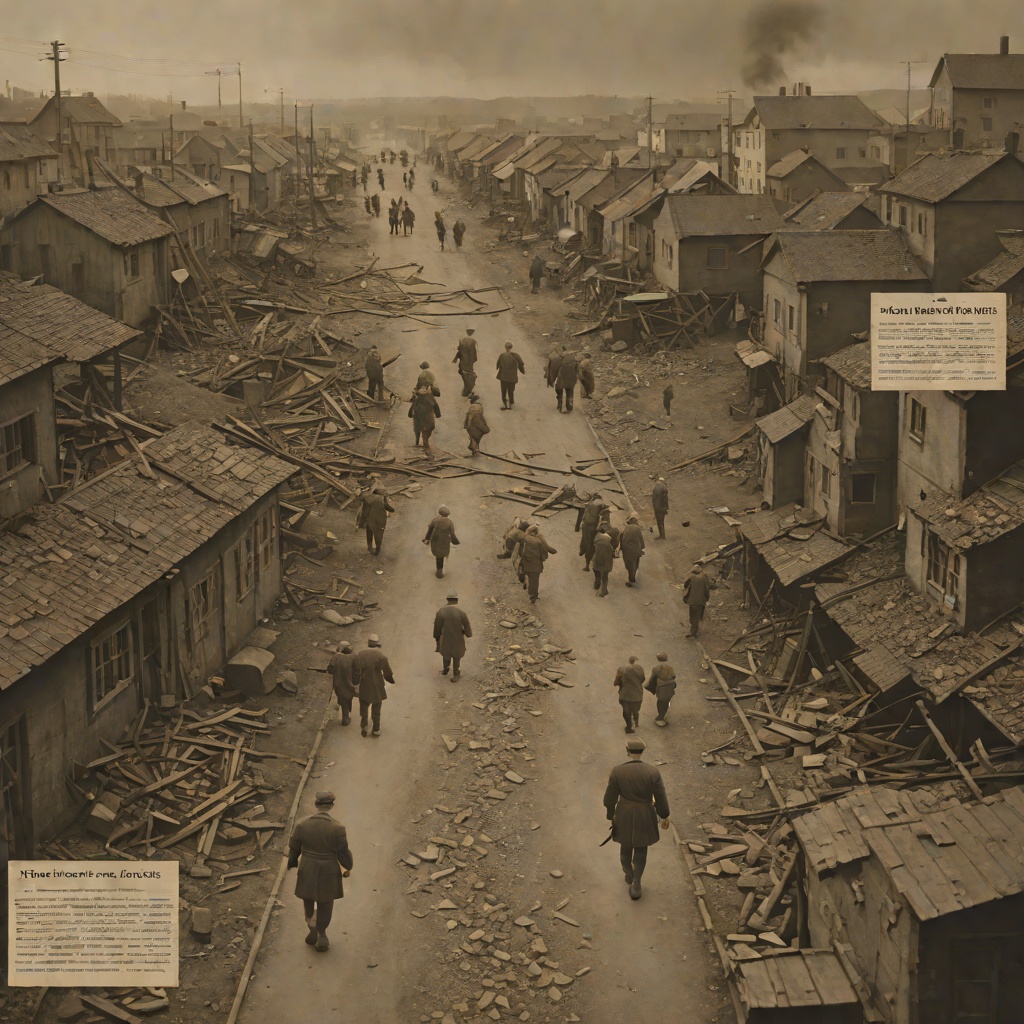
Lale's flight from the Russian headquarters
The Tattooist of AuschwitzLale's flight from the Russian headquarters marks the culmination of his long ordeal and the beginning of his return to the world. After surviving Auschwitz, the death marches, and the chaos of liberation, Lale finds himself in a strange limbo: a prisoner of the Germans for three years, he is now living in a Russian-run chalet, trusted enough to help himself to money and jewels from the vault. Yet this trust is a cage of its own. The flight is not a spontaneous dash for freedom but a meticulously planned escape, executed with the same cool nerve and improvisation that had kept him alive in the camp. It is the moment the tattooed number 32407, once a mark of dehumanization, becomes his only valid form of identification, and the moment a stranger's kindness — a stationmaster's sandwich and thermos of hot coffee — restores his faith in humanity.
The Staging of the Escape
The escape begins not at the chalet's gate but in the quiet rituals of the night before. Alone and securely locked in his room, Lale gathers the gems scattered on his bed and puts them back into a sock. From the closet he chooses the nicest-looking suit and sets it aside, laying out a shirt, several pairs of underpants and socks on the table, and slotting a pair of shoes underneath. The next morning he showers and dresses in his chosen clothes, including four pairs of underpants and three pairs of socks — a small, practical hoard against the uncertainties of the road. He places the sock containing the gems into his inside jacket pocket. It is a scene of almost domestic preparation, a man packing for a journey, except that the luggage is hidden on his body and the currency is stolen jewels.
His cover story is as carefully constructed as his wardrobe. He takes one last look around his room and makes his way to the vault, helping himself to his normal amount of money and jewels. As he is about to leave, the accountant officer stops him with an unexpected gift: "Wait. Take extra today. We have two very senior officers from Moscow arriving this afternoon. Buy them the best." Lale accepts the extra money and jewels without hesitation, then adds a second layer to his deception. He tells the officer he might be a little late coming back that morning because he is going to the library to borrow a book. When the officer points out that there is a perfectly good library on site, Lale demurs, claiming he still finds the officers there intimidating. The ruse works. "Oh, OK. As you wish," the officer replies, and Lale walks out with permission to be late and a plausible excuse for his absence.
The Road Through Austria
Lale walks into the garage and nods to the attendant, who is busy washing a car. "Lovely day, Lale. Keys are in the jeep. I hear you're going alone today," the attendant says. Lale confirms, mentioning that Friedrich has been transferred, and hopes it isn't to the front. He hops casually into the jeep and drives away from the chalet without looking back. In the village, he parks at the end of the main street, leaves the keys in the ignition, and walks away. He spots a bicycle leaning outside a shop and casually wheels it away, then hops on and cycles out of town. The casualness is deliberate — a man who belongs, who has every right to be where he is, attracts no suspicion.
A few miles away, his luck nearly runs out. He is stopped by a Russian patrol, and a young officer challenges him: "Where are you going?" Lale answers with the simple truth, stripped of any cover story: "I have been a prisoner of the Germans for three years. I am from Slovakia and I am going home." The Russian grabs hold of the handlebars, forcing Lale to dismount. He turns away from the soldier and receives a firm kick up the butt. "The walk will do you good. Now fuck off." Lale walks on, not worth arguing. The encounter is a brutal reminder that his freedom is not yet real, that he is still at the mercy of armed men who can kick him like an animal. But he is alive, and he keeps walking.
Evening arrives, and he does not stop walking. He can see the lights of a small town ahead and picks up his pace. The place is crawling with Russian soldiers, and even though they ignore him, he feels he must move on. On the outskirts of town he comes across a railway station and hurries over to it, thinking he might find a bench to lay his head down for a few hours. Walking out onto a platform, he finds a train but no signs of life. The train fills him with foreboding — a visceral memory of the cattle cars that had carried him to Auschwitz — but he represses the fear and walks up and down, peering inside. Carriages. Carriages designed for people. A light in the nearby station office catches his attention, and he walks toward it. Inside, a stationmaster rocks on a chair, his head dropping forward as he fights the need to sleep. Lale steps back from the window and fakes a coughing fit before approaching with a confidence he doesn't really feel.
The Bribe and the Kindness
The stationmaster, now awake, comes to the window, opening it just enough for a conversation. "Can I help you?" Lale asks if he can travel on the train. "Can you pay?" comes the reply. Lale pulls the sock from his jacket, extracts two diamonds, and hands them to him. As he does so, the sleeve on his left arm rides up, revealing his tattoo. The stationmaster takes the gems and tells him the end carriage — no one will bother him there — but the train is not leaving until six in the morning. Lale glances at the clock inside the station. Eight hours away. "I can wait. How long is the journey?" "About an hour and a half." He thanks the stationmaster profusely.
As Lale is heading for the end carriage, he is stopped by a call from the stationmaster, who catches up to him and hands him food and a thermos. "It's just a sandwich the wife made, but the coffee's hot and strong." Taking the food and coffee, Lale's shoulders sag and he can't hold back the tears. He looks up to see that the stationmaster also has tears in his eyes as he turns away, heading back to his office. "Thank you." He can barely get the words out. In a world where every transaction had been measured in survival, this small, unasked-for kindness — a sandwich and hot coffee from a stranger's wife — breaks something open in him. The stationmaster, who had seen the tattoo and understood exactly what it meant, had chosen to give rather than to take.
The Border and the Tattoo
Day breaks as they reach the border with Slovakia. An official approaches Lale and asks for his papers. Lale rolls up his sleeve to show his only form of identification: 32407. "I am Slovak," he says. "Welcome home," the official replies. The number that had been burned into his arm as a mark of ownership, that had reduced him to a statistic in the Nazi machinery, is now the proof of his identity. It is the only document he possesses, and it is enough. The tattoo, which had once been a sentence of death, becomes his passport to life.
Bratislava. Lale steps off the train into the city where he has lived and been happy, where his life should have been playing out for the last three years. He wanders through districts he used to know so well. Many are now barely recognizable due to bombing. There is nothing here for him. He has to find a way back to Krompachy, some two hundred and fifty miles away; it will be a long trip home. It takes him four days of walking, interspersed with occasional rides in horse-drawn carriages, a bareback ride on a horse, and a ride on a tractor-drawn cart. He pays, when he needs to, the only way he can: a diamond here, an emerald there. Finally he walks down the street he grew up on and stands across from his family home. The palings of the front fence are gone, leaving just the twisted posts. The flowers, once his mother's pride and joy, have been strangled by weeds and overgrown grass. The home he had sacrificed himself to protect is empty and decaying, and the full weight of what he has lost — and what he has survived — settles on him.
Narrative Significance
The flight from the Russian headquarters is the final proof of Lale's character: the same qualities that had made him the Tätowierer — his nerve, his charm, his ability to read people and improvise — are what carry him home. It is also the moment where the novel's central irony reaches its peak. The tattoo, which had been the instrument of his dehumanization, becomes the emblem of his humanity. The number 32407, which had marked him as property of the SS, is what the Slovak official accepts as proof that he belongs. The flight is also a study in contrasts: the cold brutality of the Russian patrol's kick versus the stationmaster's tearful kindness; the stolen diamonds that buy his passage versus the sandwich that restores his soul. It is a journey that recapitulates the entire arc of his imprisonment — the cattle train that took him to Auschwitz, the forced marches, the camps — but in reverse, moving from captivity toward home, from a number back to a name. The flight is not just an escape; it is a reclamation of identity, and the first step toward the reunion with Gita that awaits him in Bratislava.