Liberation of Auschwitz
The Tattooist of AuschwitzThe Liberation of Auschwitz is the historical and emotional climax of The Tattooist of Auschwitz, the moment when the machinery of the Nazi camp system collapses and the prisoners, who have endured years of dehumanization, are suddenly cast into a chaotic, uncertain freedom. For Lale Sokolov and Gita Furman, the event is not a single triumphant instant but a harrowing rupture that separates them, forcing each to survive alone before their eventual reunion. It is the pivot on which the entire narrative turns, transforming the prisoners' long ordeal into a desperate scramble for survival and setting the stage for their eventual reunion in Bratislava. The liberation is also the point where the book's central themes—survival, hope, and the preservation of identity—are tested most severely, as the prisoners must navigate a world where the SS are no longer in control but where danger and death remain ever-present.
The Approach of the Russians and the Warning
The liberation is preceded by a moment of tense anticipation. Lale learns from a source that the camp is being emptied, and his heart leaps when he is told, "The Russians, they're nearly here." This news, delivered in a hushed, urgent tone, sets off a frantic chain of events. Lale immediately runs from the building to the women's camp, where he finds the door to Block 29 shut and no guard standing outside. Entering, he discovers the women huddled together at the back, frightened and full of questions. Even Cilka, who has maintained a complex and often ambiguous relationship with the SS, is present. The scene is one of collective anxiety; the prisoners sense that the end is near, but they do not know whether the end will bring liberation or a final, murderous act by their captors. The news of the Russian advance is both a promise of salvation and a signal of imminent danger, as the SS are known to be capable of destroying the camp and its inhabitants rather than allowing them to be freed.
The Chaos of the Evacuation
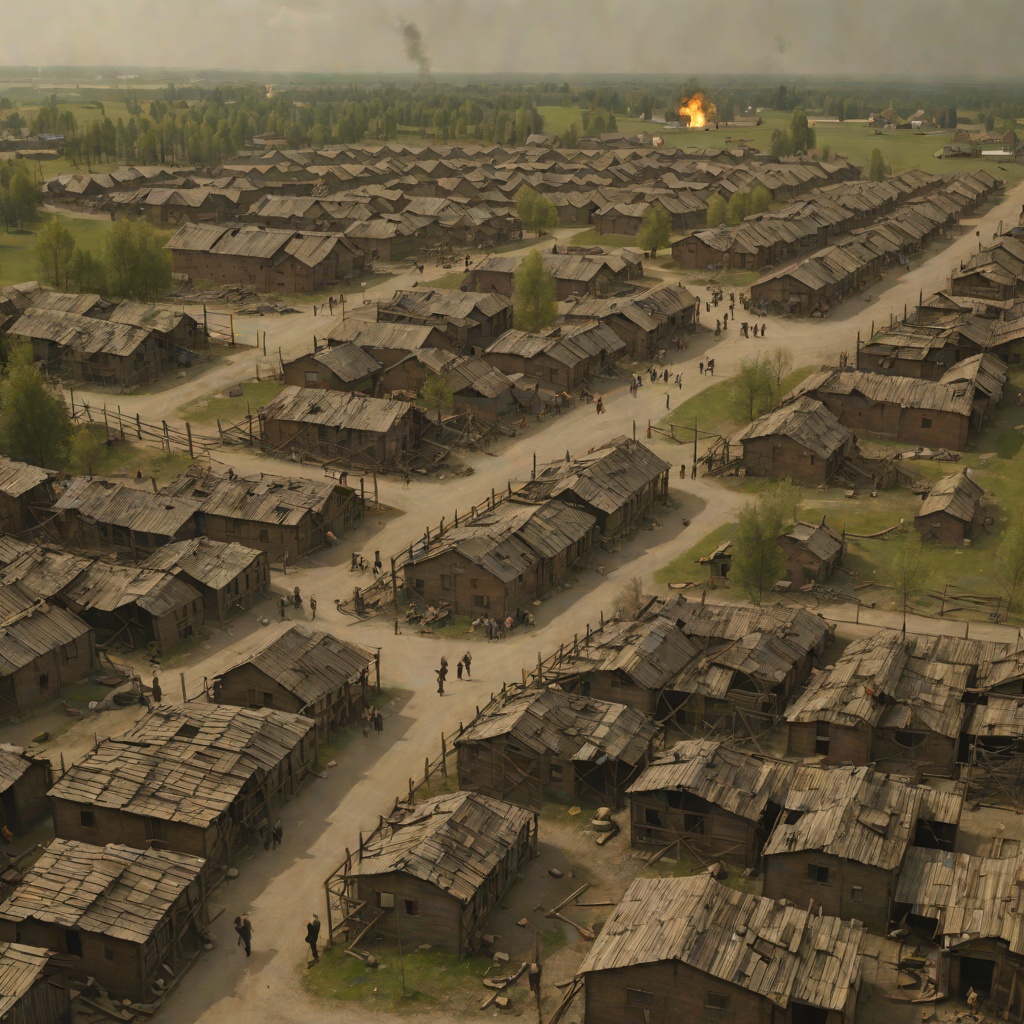
The morning after the warning, Lale is woken by cannon fire and explosions. He rushes outside with the Hungarian prisoners, only to be greeted by a scene of utter pandemonium: panicked SS officers and a chaos of prisoners and captors on the move, seemingly oblivious to each other. The main gates of the camp are wide open, and hundreds of prisoners walk through them unchallenged. These are dazed, weak men and women, malnourished and barely able to comprehend their sudden freedom. Some stumble around aimlessly and then choose to return to their blocks to escape the cold, unable to process the possibility of escape. Lale, however, walks through the gates he has passed through hundreds of times before on his way to and from Auschwitz. A train is standing nearby, belching smoke into the sky, ready to leave. Guards and dogs begin rounding up men and pushing them toward the train, and Lale is caught up in the scrum, scrambling aboard. The gates of his wagon are slammed closed behind him. As the train pulls away, he pushes his way to the side and peers out, watching as hundreds of prisoners still wander around aimlessly. Then he sees the SS open fire on those who remain. He stands, staring through the slats of the wagon, through the snow falling heavily and mercilessly, as Birkenau disappears from view. This is not a liberation in the sense of a peaceful handover; it is a violent, chaotic rupture, where the prisoners are caught between the retreating SS and the advancing Russians, and where the price of freedom is paid in the blood of those who cannot or will not move.
Gita's Flight and the Kindness of Strangers
While Lale is forced onto the train, Gita's path to freedom takes a different, more perilous route. She and four Polish friends flee the camp and find refuge in a small village, where an older woman takes them in, making a fuss over the girls and sitting them at her kitchen table. Gita cannot remember the last time she sat on a chair at a kitchen table, a small but devastating detail that underscores how completely the camp has stripped her of ordinary human comforts. The older woman ladles hot soup for them and peppers them with questions, but the owners soon decide it is not safe for them to stay, fearing that the SS officer will report the girls' presence. The woman, however, is resourceful; she returns with a neighbor and offers the five of them a place to sleep in the roof cavity of her house, which is warmer than the cellar due to the heat from the fireplace rising. They cannot stay in the house during the day, as every house can be searched at any time by the Germans, even though they seem to be retreating. Gita and her friends spend their days hiding in the nearby woods, and word of their presence sweeps through the village. The local priest has his parishioners bring food to the house's owner each day, a quiet act of communal resistance and humanity. After a few weeks, the remaining Germans are flushed out by the advancing Russian soldiers, several of whom set up house in the property directly opposite where Gita and her friends sleep. One morning, the girls are late leaving for the woods and are stopped by a Russian guard. They show him their tattoos and try to explain where they have been and how they came to be here. Sympathetic to their plight, he offers to place a guard outside the house, meaning they no longer have to spend their days in the woods. Their presence is no longer a secret, and they receive smiles and waves from the soldiers when they come and go. This period of relative safety is shattered one evening when a drunk Russian staggers into the house, waving a pistol. The girls can see their guard lying unconscious outside. The intruder singles out one of the girls and attempts to rip her clothes off, dropping his trousers at the same time. Gita and the others scream, and several Russian soldiers burst into the room. Seeing their comrade on top of one of the girls, one of them pulls out his pistol and shoots him in the head. The soldiers drag the would-be rapist from the house, apologizing profusely. The liberation, for Gita, is not a clean break but a dangerous limbo, where the threat of violence persists even from those who are ostensibly her liberators.
The Aftermath and the Long Road to Reunion
The liberation of Auschwitz does not immediately reunite Lale and Gita. Lale is shunted from camp to camp, his thoughts dominated by Gita and by how he can get to her. He finds himself in Vienna, a city that was a dream destination for him in his playboy days, but which now fails to live up to that romantic perception. The guards are indifferent to him and the other prisoners, and he is told where and when to get his meals. He observes his surroundings for several days, noting the doddering camp commandant and chatting to amenable guards to understand the dynamic among the prisoners. Once he discovers that he is probably the only Slovak prisoner there, he decides to keep to himself, isolated among Poles, Russians, and a few Italians who sit around all day talking with their countrymen. His escape from the Saurer-Werke subcamp and his flight from the Russian headquarters are separate ordeals, but they are all part of the same post-liberation struggle. Gita, meanwhile, eventually makes her way to Bratislava, where she and Lale are finally reunited. The liberation, therefore, is not the end of their story but the beginning of a new, difficult chapter, one in which they must rebuild their lives from the ashes of the camp. The event also carries a heavy historical weight that extends beyond the personal. The liberation is the moment when the full scale of the atrocities becomes undeniable, and the book's epilogue notes that Lale's parents, Jozef and Serena Eisenberg, were transported to Auschwitz on March 26, 1942, and killed immediately upon arrival, a fact Lale never knew and which was only discovered after his death. The liberation, for Lale, is thus a bittersweet victory, shadowed by the losses he cannot yet comprehend.
Memory, History, and the Meaning of Liberation
The liberation of Auschwitz is not only a historical event within the narrative but also a subject of deep reflection in the book's framing. The author, who spent three years untangling Lale's story, notes that Lale's memories were remarkably clear and precise, matching her research into people, dates, and places. There was no parting of memory and history for Lale; they "waltzed perfectly in step." This observation is crucial to understanding how the liberation is presented. It is not a mythologized moment of triumph but a lived reality, remembered with the same clarity as the horrors that preceded it. The author also reflects on the burden of guilt Lale carried for more than fifty years, the fear that he and Gita might be seen as Nazi collaborators. The liberation, in this context, is also a liberation from that guilt, as Lale sheds the burden of his past through the act of telling his story. The book's motto, "If you wake up in the morning, it is a good day," takes on a profound resonance in the aftermath of the liberation. For Lale, every day after Auschwitz is a gift, a testament to his survival and his determination to live. The liberation of Auschwitz, then, is not merely the end of a nightmare but the beginning of a life lived in defiance of death, a life that Lale would go on to share with Gita until her death on October 3, 2003, and his own on October 31, 2006. The event is the fulcrum on which the entire narrative balances, the point where the prisoners' suffering is finally acknowledged by the outside world, and where the survivors must begin the long, painful work of living again.