Mendel Bauer
The Tattooist of AuschwitzMendel Bauer is a young Jewish prisoner at Auschwitz-Birkenau whose brief appearance in the narrative marks one of its most concentrated acts of mercy. He is introduced not through his own story but through the urgency of another man's intervention: Lale Sokolov, the camp's Tätowierer, discovers that Mendel is destined for the hangman and takes it upon himself to erase the evidence that would seal Mendel's fate. In a single night, Mendel is transformed from a condemned man into a fugitive of the camp's own record-keeping, sent away on a transport with nothing but a chance at life. His rescue, though fleeting in the telling, carries the weight of the novel's central ethical claim — that to save one person is to save the world.
Identity and Introduction
Mendel Bauer appears in the narrative at a moment of extreme peril. He is first encountered when Lale, furious with himself for some oversight, demands to know his name. The exchange is terse and revealing: Lale asks, "Your name—what's your name?" and Mendel replies simply, "Mendel." Pressed for more, he adds, "Sorry, Mendel Bauer." The apology — reflexive, almost automatic — speaks to the condition of a prisoner who has learned to treat his own identity as an inconvenience. Mendel is young, though his exact age is never stated; he is old enough to be slated for a transport, yet young enough that Lale addresses him with a protective urgency. He has two friends who look on during his rescue, boys who share his block and who will carry the secret of what Lale does for him.
The circumstances that bring Mendel to Lale's room are grim. He is marked for execution, and the reason is written on his arm: his prisoner number. In the logic of the camp, the number is both identity and death sentence. Lale understands this immediately. When one of the boys watching asks why Lale is bothering to help, Lale explains: "Where Mendel is going, no one is numbered. It wouldn't take long for his number to be seen, and then he would be right back here, to keep his appointment with the hangman." The number that marks Mendel as a prisoner of Auschwitz would mark him as a fugitive anywhere else — a man who has escaped and been recaptured, or who has no business being alive at all.
The Rescue
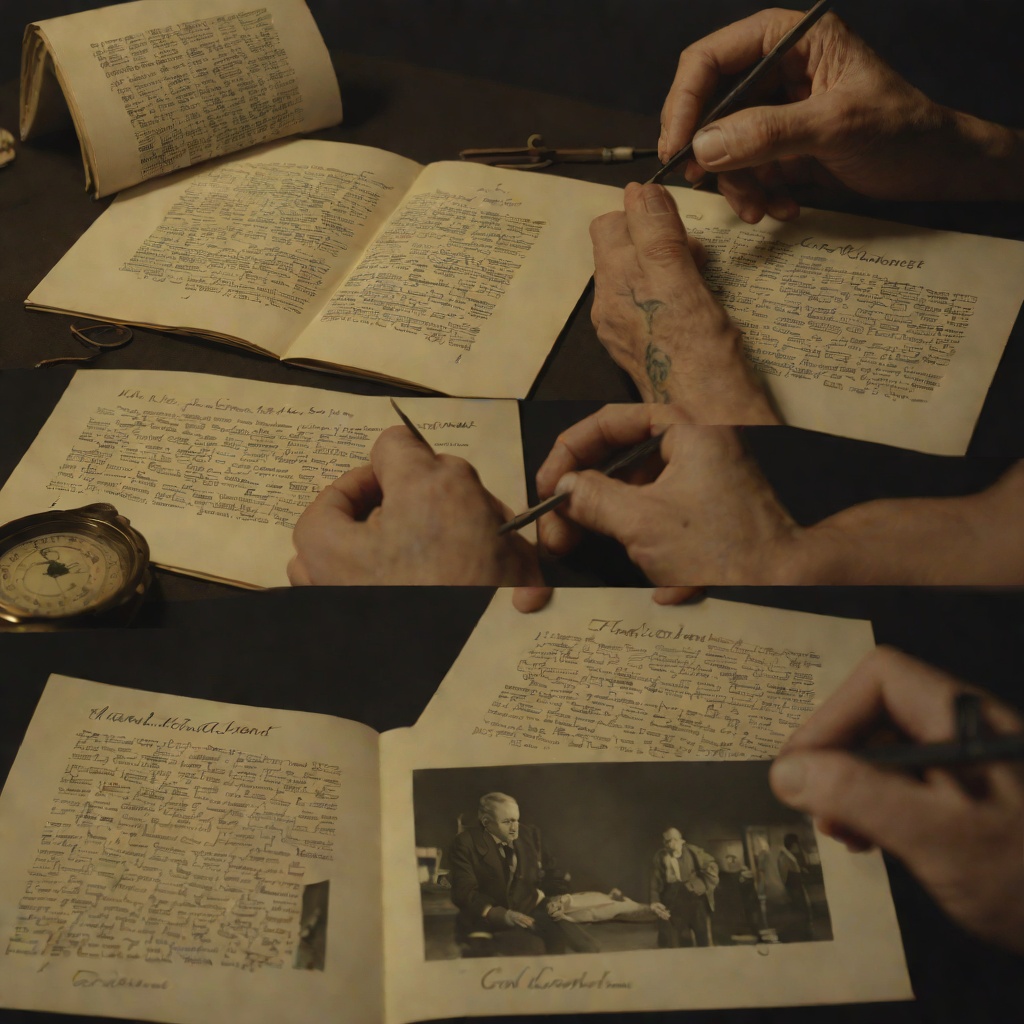
Lale's intervention is swift and practical. Back in his room, he sweeps Mendel's two friends off the bed, takes out his bag, and sits down beside the condemned young man. "Give me your arm," he says, and sets about changing the number into a snake. The job is not perfect, but it is good enough to conceal the numbers. The transformation is both literal and symbolic: the digits that would identify Mendel as a numbered prisoner of Auschwitz are reworked into a living creature, a coil of ink that hides rather than reveals. The snake is an apt image — a creature of survival, of shedding skin, of moving silently through hostile territory.
As the boys look on, one of them asks the obvious question: "Why are you doing this?" Lale's answer is less about Mendel than about the system that would kill him. The number, once seen, would send Mendel straight back to the hangman. By erasing it, Lale gives him a chance to disappear into the anonymity of a transport, to become just another face among thousands. When the job is finished, Lale turns to the two boys and delivers a warning that is also a lesson in the camp's brutal arithmetic: "You two get back to your block now, and go carefully. I'm only good for one rescue per night." The line is wry, but it carries a real limit — Lale's power to save is finite, measured in nights and in the risk he can absorb.
He tells the boys that Mendel will not be there tomorrow. "He's going out on a transport at midnight. I don't know where he's going, but wherever it is, he will have at least a chance of staying alive." The phrase "at least a chance" is the crux of it. Lale cannot promise Mendel survival, only the possibility of it — a possibility that would have been foreclosed entirely by the hangman's rope. The rescue is not a triumph but a reprieve, a redirection of fate from certain death to uncertain life.
Context and Consequence
Mendel's rescue takes place against the backdrop of a camp where numbers govern everything. Lale has learned this lesson through his own body: when he first arrived at Auschwitz, he was processed like all the others, stripped of his jacket, his shirtsleeve ripped, his left forearm pushed flat on a table while the numbers 32407 were stabbed into his skin with a piece of wood and a needle. The shock of that moment stayed with him — the realization that he might be defined for the rest of his life, short or long, by that irregular number. The tattooing took only seconds, but its meaning was permanent. Mendel's number, had it been left intact, would have carried the same weight: a mark of ownership, a claim by the camp on his body and his fate.
The camp's dehumanization extended beyond the needle. Lale arrived in a cattle wagon, dressed in a pressed suit, clean white shirt, and tie — "Always dress to impress" — only to be stripped, shaved, and issued old Russian army uniforms and wooden shoes. He sat through the barber's chair with his back straight and his head held high while SS officers assaulted the naked prisoners with the ends of their weapons. In the dormitory, the men found a bitter humor in their condition, joking about eating the hay in their mattresses until a hesitant "Mooooooo" rose from the darkness, drawing quiet, real laughter. This was the world Mendel inhabited: a place where men were treated as livestock, where a number on the arm determined respect, where the higher the number, the less the person mattered. Lale had worked out this hierarchy himself, watching as thousands of Hungarian Jews arrived each week and turf wars broke out between nationalities over the small perks of survival.
Mendel's fate after the rescue is unknown. He is sent out on the midnight transport, and the narrative does not follow him. What remains is the act itself — Lale's willingness to risk his own position, his own life, for a young man he barely knows. The rescue of Mendel Bauer is one of the novel's clearest expressions of its central creed, the belief that saving one person is saving the world. It is a small act, measured against the scale of the Holocaust, but it is precisely the smallness that makes it meaningful. In a place designed to reduce every person to a number, Lale's snake is a refusal of that reduction — a claim that Mendel Bauer is more than the digits on his arm, and that his life, however uncertain its continuation, is worth the risk of another man's.