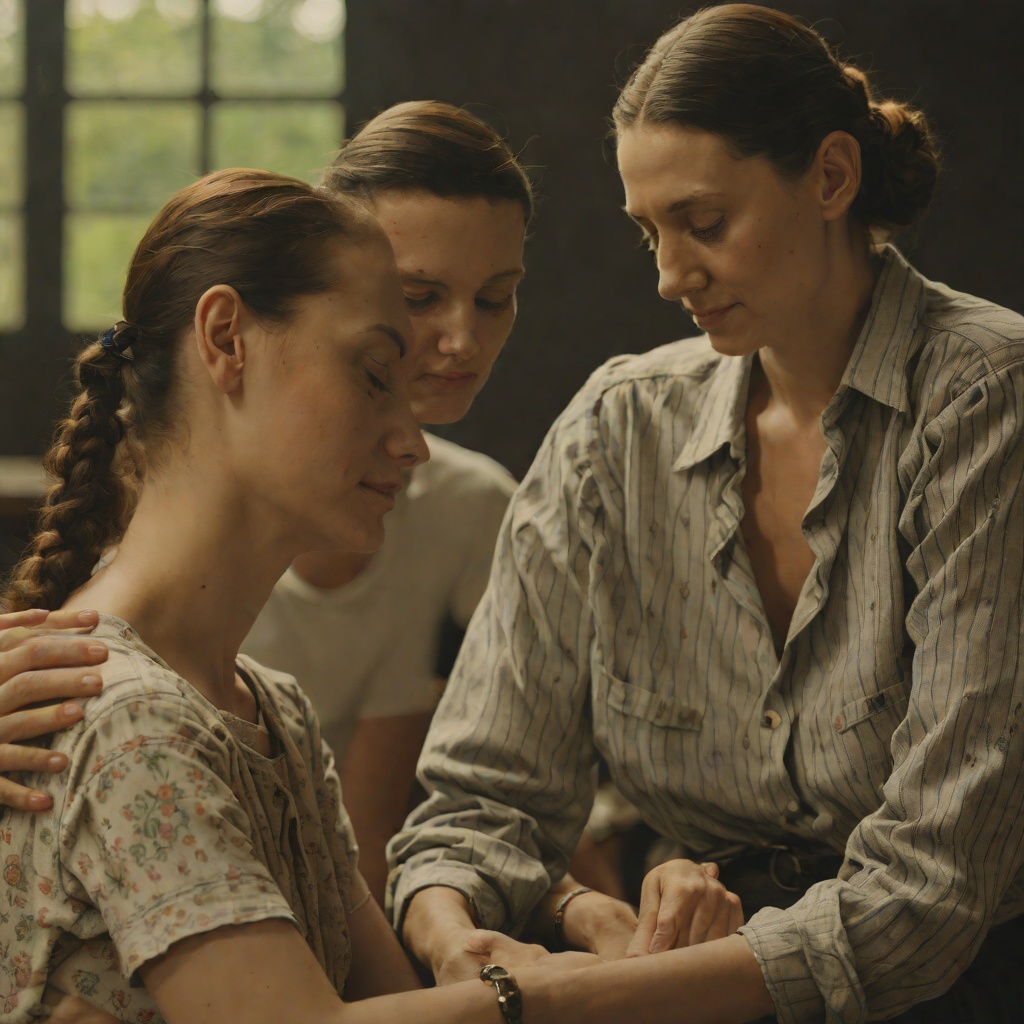
Nadya
The Tattooist of AuschwitzNadya is a Slovak Jewish prisoner in Birkenau whom Lale Sokolov encounters during his time in the camp. She is forty-one years old, a children's nurse by vocation, and utterly alone: her husband and six-year-old son both died of typhus, the son three years before his father, leaving her the sole survivor of her family. Her name, as she tells Lale, means "hope." In a place engineered to strip prisoners of identity, Nadya's name and her quiet endurance mark her as a figure of fragile, almost unbearable meaning.
Identity and Introduction
Lale first meets Nadya when he sits beside her on a pile of bricks where she has stopped to rest. She gives him a thin smile and remarks that she has been putting children to bed since she was a baby herself, that she could do it with her eyes closed. When Lale asks whether she has family in the camp, she shakes her head sadly and explains that her husband and son died of typhus. "It's only me now," she says, introducing herself as Nadya. Lale, moved by her loss, tells her his name and expresses a wish to hear about her family.
That evening the two converse long into the night, with Lale doing most of the talking and Nadya preferring to listen. He tells her about his family back in Slovakia and about his love for Gita Furman. In return he learns the precise contours of her grief: her son had been six when he died, two days before his father. When Lale asks for her opinions, he finds her answers similar to those his own mother would give. The resemblance unsettles him. He wonders whether it is this that draws him to her, that makes him want to protect her the way he wants to protect Gita. He finds himself sinking into an acute homesickness, and dark thoughts he has kept at bay about his family's safety consume him. If he cannot help them, he resolves, he will do what he can for this woman in front of him.
Appearance and Manner
Studying Nadya's face in profile one night, Lale finds her quite beautiful. Her unshaven brown hair cascades down her shoulders and blows in the slight breeze around her face, so that she spends a good deal of time tucking it back behind her ears. The gesture is achingly familiar to him: it is a gesture his mother made all day, every day, as wayward strands escaped from her tight bun or from under the scarf that hid it. Nadya speaks with the quietest natural voice Lale has ever heard. She is not whispering; this is simply her voice. Lale eventually works out what it is about her voice that saddens him: it is emotionless. Whether she is relaying stories of happy times with her family or talking about the tragedy of being here, there is no change in her tone. The flatness is not coldness but the residue of overwhelming loss, a voice that has been drained of variation by grief.
Relationship with Lale
Lale's bond with Nadya deepens into something like filial devotion. He lingers after the other men retreat indoors one evening, not tired enough to sleep, and senses her presence in the doorway. "Join me," he says, and she sits beside him, staring off into the night. Their conversation turns to the meaning of her name, and she answers, "Hope. It means hope," before standing and bidding him good night. The exchange is brief but resonant: in a camp where hope is systematically extinguished, Nadya carries it as her very name.
Lale's protective impulse toward her mirrors his feelings for Gita. He finds himself wanting to shield her, to do for her what he cannot do for his own family back in Slovakia. The parallel between Nadya and his mother is explicit in his mind, and it fuels his homesickness even as it gives him a concrete object for his care. Nadya, for her part, accepts his attention with quiet grace, preferring to listen rather than speak, offering the kind of steady, unjudging presence that Lale needs.
Deportation and Farewell
Nadya's fate arrives with the liquidation of the Gypsy camp. As prisoners are loaded onto trucks, Lale sees her in the crowd and runs to her, pleading, "Nadya, don't go." She forces a brave smile and tells him she has no choice. "I go where my people go," she says. "Goodbye, my friend, it's been..." An officer pushes her along before she can finish the sentence. Lale stands paralyzed, watching until the last person has been loaded onto the trucks. The trucks drive off, and slowly he walks back into the eerily silent block. He goes back to bed, but sleep will not come.
The unfinished sentence is the last thing she ever says to him. Her departure strips the camp of one of its few sources of warmth for Lale, and the silence of the block afterward mirrors the emptiness her absence leaves. Nadya's fate is never resolved in the narrative; she is simply taken, one of countless prisoners swept into the machinery of destruction.
Thematic Significance
Nadya embodies several of the novel's central tensions. Her name, meaning "hope," is bitterly ironic given her deportation, yet it also captures the stubborn persistence of hope that defines Lale's own survival philosophy. Her emotionless voice, which so saddens Lale, is a testament to the psychological toll of the camp, a voice that has been flattened by the accumulation of losses. Her resemblance to Lale's mother makes her a stand-in for the family he cannot protect, and his devotion to her becomes a displaced act of care for those he has left behind in Slovakia.
Her fate also underscores the arbitrariness of survival in Birkenau. Nadya has survived typhus, the disease that killed her husband and son, only to be deported in the liquidation of the Gypsy camp. Her quiet endurance, her willingness to listen, her brave smile in the face of the trucks — none of it is enough to save her. She goes where her people go, and Lale is left to carry the memory of her unfinished goodbye.