Nazi human experimentation
The Tattooist of AuschwitzNazi human experimentation at Auschwitz-Birkenau, as rendered in The Tattooist of Auschwitz, is embodied above all in the figure of Josef Mengele, the camp doctor whose clinical curiosity and casual cruelty permeated the daily life of the camp. Mengele is introduced to the reader through the warnings of Stefan Baretski, who tells Lale Sokolov, the camp tattooist, that Mengele is "one doctor you don't want to be introduced to," a man even the SS are afraid of, a "creep." Baretski instructs Lale to remember the name, signaling that Mengele is not a peripheral figure but a central, looming presence whose power extends into every corner of the camp's operations. The narrative establishes that Mengele has made it known he will attend many of the selections, as he is "looking for particular patients," a phrase that chillingly frames human beings as specimens to be collected rather than people to be saved.
Mengele's Presence at the Selections and the Tattooist's Work
Mengele's shadow falls directly on Lale's work as the Tätowierer. During a selection, Lale is tattooing a young woman when he hears the doctor's whistling start up behind him; the sound shoots such a shock of fear through his body that he slips and stabs the woman, drawing blood. Mengele steps closer and addresses him directly: "Something wrong, Tätowierer? You are the Tätowierer, are you not?" Lale stammers a reply, his voice betraying his terror, and the encounter leaves him shaken, the doctor's voice sending chills down his spine. This moment reveals the hierarchy of fear within the camp: even a prisoner with the relative privilege of the tattooist's role is utterly vulnerable to Mengele's whim. The doctor's ability to appear at any moment, to observe and judge, turns the act of tattooing itself into a performance under the gaze of death.
The fear Mengele inspires is not abstract but visceral, and it is rooted in the knowledge of what he does. The narrative shows Mengele conducting selections with a detached, clinical brutality. In one scene, Lale is brought to a room where about fifty young women stand in a line, silent, the air sour with fear. At the front of the line, Mengele is examining one of the girls, roughly opening her mouth, grasping her hips, then her breasts, as tears fall silently down her face. Finishing his examination, he waves her off to the right—rejected—and another girl is pushed into her vacated place. The scene is a stark depiction of the reduction of the human body to an object of inspection, its worth determined by the doctor's arbitrary judgment. Mengele's smirk as he tells Lale, "You are late," and his indication of a small group of girls he is keeping, "Do their numbers," underscores his absolute power over life and death, and his casual enjoyment of the discomfort he causes.
The Physical and Psychological Toll on Prisoners
The consequences of Mengele's experiments are most poignantly revealed through the character of Leon, a fellow prisoner and friend of Lale. When Lale offers Leon food, Leon declines, and Lale presses him on why he has lost his appetite. Leon stares directly into Lale's eyes and delivers the horrifying truth: "He cut my fucking balls off, Lale. Somehow you lose your appetite when they cut your balls off." The statement is delivered with a strong and steady voice, but its content is devastating. Lale reels back in horror, turning away so Leon will not see his shock, while Leon fights back a sob and struggles to find his voice, searching the ground for something to focus on. Leon apologizes for his bluntness but expresses gratitude for Lale's offer. This exchange reveals the permanent, mutilating violence of Mengele's experiments, which stripped men of their manhood and left them to live with the physical and psychological aftermath. Leon's ordeal is a testament to the fact that the experiments were not abstract research but concrete, irreversible acts of destruction.
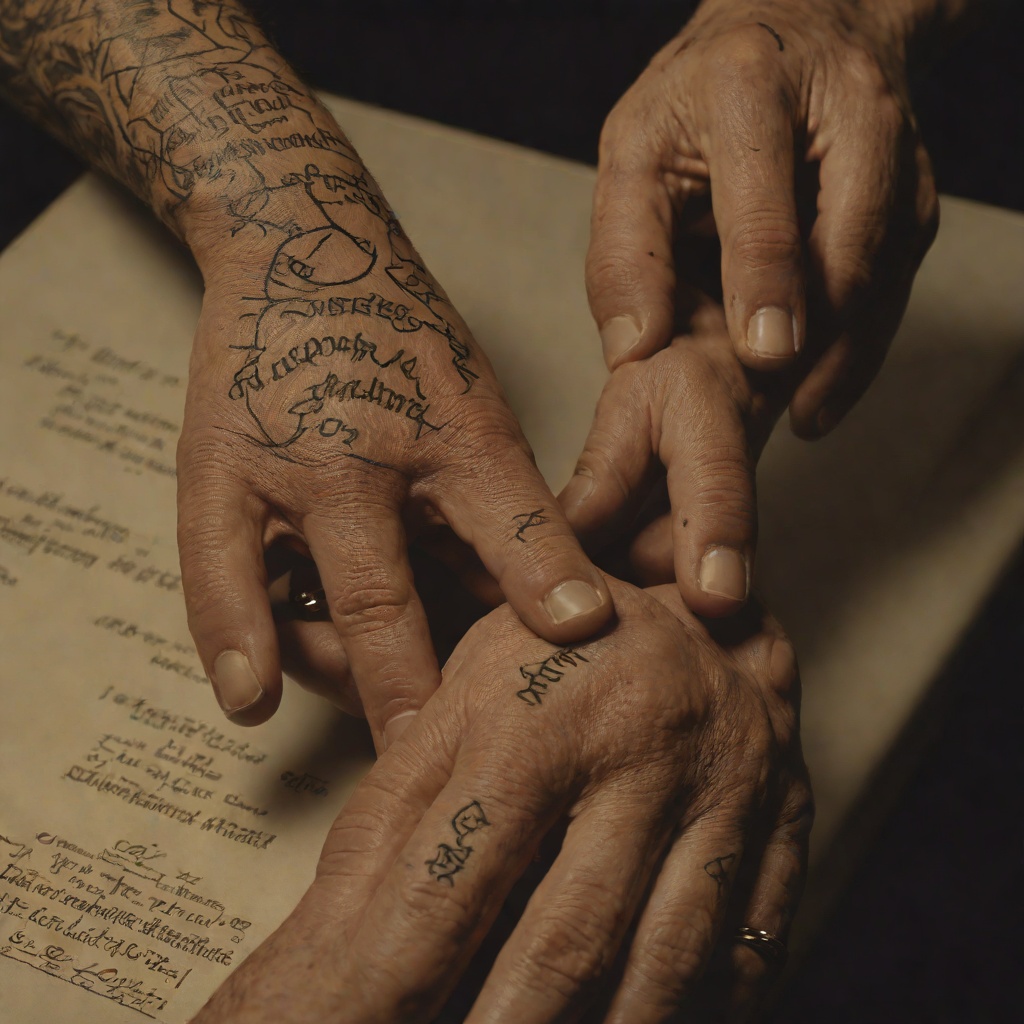
The dehumanizing logic of the camp system, of which Mengele's experiments were the most extreme expression, is also evident in the treatment of prisoners' bodies from the moment of arrival. Lale's own tattooing, the stabbing of the numbers 32407 into his skin with a piece of wood with a needle embedded in it, and the rough rubbing of green ink into the wound, is an act of bodily violation that defines him. He wonders if for the rest of his life he will be defined by this moment, this irregular number. Similarly, the forced shaving of heads, the cold showers, and the exchange of clothes for old Russian army uniforms strip prisoners of their individuality. The body becomes a site of power, marked, shaved, and dressed to erase identity. Mengele's experiments are the logical endpoint of this system, where the body is not only marked but also dissected, altered, and destroyed in the name of a perverted science.
The Body as a Site of Resistance and Memory
Despite the overwhelming violence, the narrative also shows the body as a site of resistance and a repository of memory. Lale's own body bears the marks of torture, and these marks become a means of connection and intimacy. After Lale is tortured in Block 11, he shows Gita the welts on his back. She says nothing but runs her fingers ever so softly over the welts, and her lips follow. Their lovemaking is slow and gentle, and Lale feels tears well up and fights them back, recognizing this as the deepest love he has ever felt. In this moment, the scars of Nazi violence are transformed into a site of tenderness and human connection, a defiant assertion of love in the face of brutality. The body, so brutally violated, becomes the ground for a profound and healing intimacy.
Lale's own experience of torture, at the hands of Jakub in the Strafkompanie, further illustrates the body's role as a site of both suffering and survival. Jakub drags Lale to a small, windowless room, punches him in the face, kicks him in the ribs, and handcuffs him to a chain. He tears the shirt from Lale's back and lashes him five times with a birch rod, then pulls down his trousers and whips him across the buttocks five more times. Lale's yelps are not feigned. Yet even in this moment of utter vulnerability, Lale's body becomes a tool of resistance. He anticipates Jakub's kick and backs away, exaggerating the impact by rolling and heaving and clutching his chest, a performance of pain that is also a strategy for survival. The body, subjected to the worst of Nazi violence, is also the instrument through which Lale navigates and endures that violence.
The narrative's treatment of Nazi human experimentation is ultimately a meditation on the relationship between memory and history. The author, reflecting on Lale's story, notes that Lale's memories were remarkably clear and precise, matching research into people, dates, and places. There was no parting of memory and history for this beautiful old man—they waltzed perfectly in step. The experiments of Mengele, the torture, the tattooing, and the shaving are not just historical facts but lived realities that left permanent marks on the bodies and minds of survivors. The story of Lale and Gita, and of Leon and countless others, is a testament to the resilience of the human spirit in the face of a system designed to destroy it. The body, marked and broken, becomes a living record of the horrors of the Holocaust, and the act of telling the story becomes a way of ensuring that the memory of what happened is not lost.