Poland
The Tattooist of AuschwitzPoland forms the geographical and moral heart of the narrative, the country into which Lale Sokolov is carried as a prisoner and where the central drama of his life unfolds. It is the land of his captivity, the site of his transformation into the camp tattooist, the stage for his love affair with Gita Furman, and the ground from which both must ultimately escape to find freedom. The country is defined not by its own identity but by the machinery of death that the Nazis have built upon its soil, making it the fixed point against which all of Lale's suffering, resistance, and hope are measured.
The Journey into Poland
Lale's entry into Poland begins not with a destination but with a disappearance of all familiar landmarks. In April 1942, he rattles across the countryside in a cattle wagon, one among countless young men stuffed into vehicles designed to transport livestock. He has been given no idea where they are headed, and he dresses in his usual attire—a pressed suit, clean white shirt, and tie—following his lifelong motto to always dress to impress. The wagon is less than ten feet wide, and he cannot see the end to gauge its length. He attempts to count the men on the journey with him, but with so many heads bobbing up and down, he eventually gives up. His back and legs ache, his face itches, and the stubble reminds him that he has not bathed or shaved since boarding two days earlier. He is feeling less and less himself.
As the train makes many stops, some lasting minutes and some hours, always outside a town or village, Lale occasionally catches glimpses of the station names as they speed through: Ostrava, a town he knows is close to the border of Czechoslovakia and Poland, and then Pszczyna, confirming that they are indeed now in Poland. The unknown question remains: where will they stop? He spends most of the journey lost in thoughts about his life in Bratislava—his job, his apartment, his friends, and especially his female friends. The confirmation that he is in Poland marks the moment when his old life in Slovakia becomes unreachable, and the country ahead of him becomes the only reality he will know.
Arrival at Auschwitz
When the train finally stops, Lale steps out into a landscape that will define his entire experience of Poland. He places his suitcase on the ground, realizing with a shiver that it is unlikely he will see the case or its contents again. He touches his hand to his heart, to the money hidden in his jacket pocket, and looks to the heavens, breathing in the fresh, cool air and reminding himself that at least he is outdoors. A gunshot rings out and he jumps; before him stands an SS officer, weapon pointed skyward, shouting "Move!" He glances back at the emptied train, where clothing blows away and books flap open. Several trucks arrive, and small boys clamber out, snatching up the abandoned belongings and throwing them into the trucks. A heaviness settles between Lale's shoulder blades as he thinks, "Sorry, Mama, they have your books."
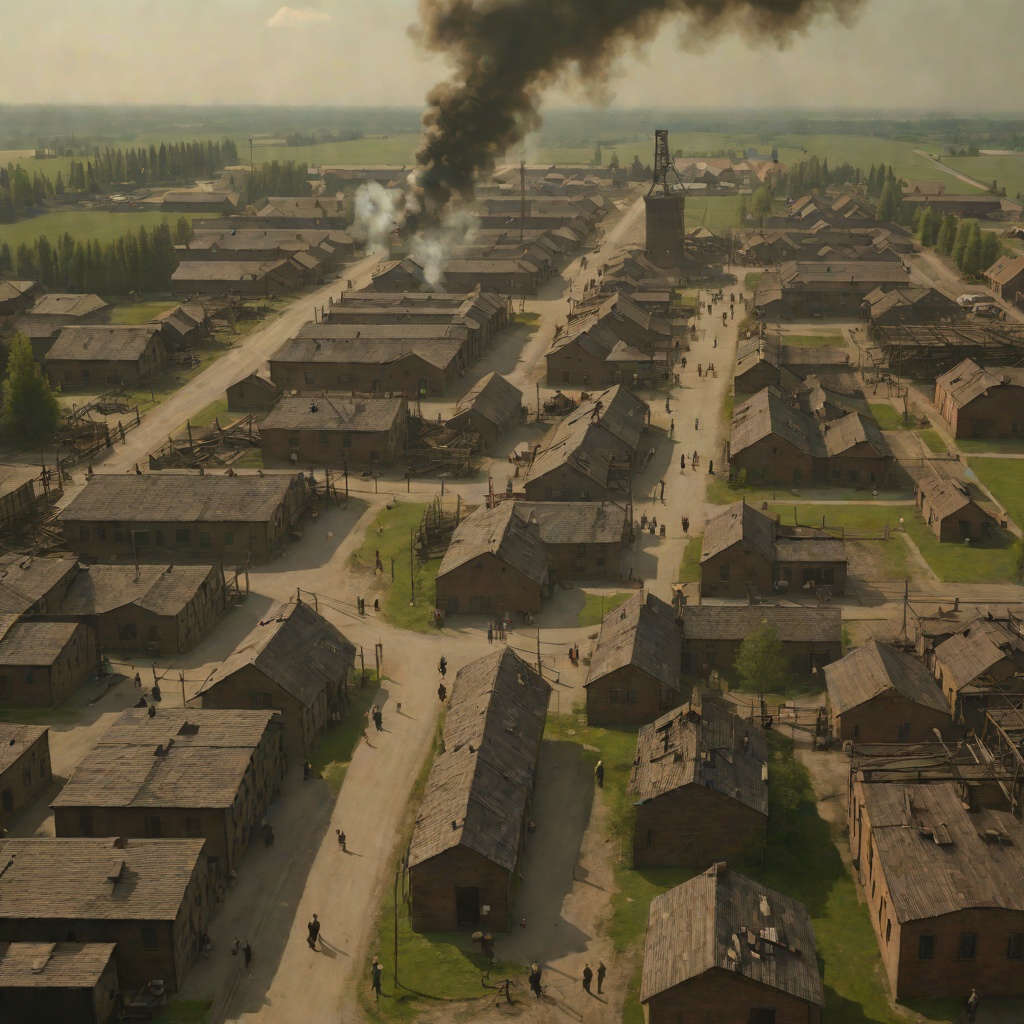
The men trudge toward the looming, dirty pink-brick buildings with picture windows, trees lining the entrances flush with new spring growth. As Lale walks through the open iron gates, he looks up at the German words wrought from the metal: ARBEIT MACHT FREI. He does not know where he is or what work he will be expected to do, but the idea that it will set him free has the feeling of a sick joke. The combination of SS, rifles, dogs, and his belongings taken—this he had been unable to imagine. Poland, for Lale, is thus introduced through the gates of Auschwitz, a place whose promise of freedom through work is immediately revealed as a cruel deception.
The Landscape of Horror
Poland's soil becomes the stage for the most harrowing scenes of the narrative. On a beautiful spring day, not too hot, Lale watches as a large, enclosed truck continues past the usual point for unloading building supplies and drives around the back of the administration building. He knows that the boundary fence lies not far beyond, and he has never dared venture to this area, but curiosity gets the better of him now. He walks after it with an air of "I belong here, I can go where I want." Peering around the corner at the back of the building, he sees the truck pull up beside an odd bus that has been adapted into a bunker of sorts, with steel plates nailed across the window frames. Dozens of naked men are herded out of the truck and led toward the bus. Some enter willingly; those who resist are hit with a rifle butt, and fellow prisoners drag the semiconscious objectors to their fate. The bus is so full that the last men to board cling to the steps with their tiptoes, their naked bottoms hanging out the door. Officers shove their weight against the bodies, then the doors are slammed shut. One officer walks around the bus, rapping on the metal sheets, checking that everything is secure. A nimble officer clambers onto the roof with a canister in his hand. Unable to move, Lale watches as he opens a small hatch on the roof of the bus and upends the canister, then slams the lid down and latches it. As the guard scurries down, the bus shakes violently and muffled screams can be heard. Lale drops to his knees, retching, and remains there, sick in the dirt, as the screams fade. This is the gas van, and Poland is the country where such atrocities are committed in broad daylight, witnessed by a man who will carry the memory for the rest of his life.
The Camp as a Polish Territory
The camp itself becomes a distinct territory within Poland, with its own geography and hierarchies. When Lale is appointed as the Tätowierer, the camp tattooist, he is led to an area of the camp that is still under construction. Many of the buildings are unfinished, and the eerie quiet makes him shiver. One of these new blocks is complete, and Baretski shows Lale to a single room located immediately inside the door. "You will sleep here," Baretski says. Lale puts his bag of tools on the hard floor and takes in the small, isolated room, already missing his friends in Block 7. He learns that he will now take his meals in an area near the administration building, and that in his role as Tätowierer he will receive extra rations. "We want our workers to have their strength," Baretski explains, motioning for Lale to take a spot in the dinner line. "Make the most of it." This single room and the extra rations mark Lale's privileged position within the Polish camp, a position that both protects him and isolates him from the other prisoners.
It is within this Polish territory that Lale meets Gita Furman. When he asks her about herself, she meets his stare defiantly and says, "I am prisoner 34902 in Birkenau, Poland." Her answer identifies her not by her name or her origins but by her prisoner number and the Polish location of her captivity. Poland, for Gita, has become synonymous with her dehumanization, and her defiant declaration of her prisoner identity is both an act of resistance and an acknowledgment of the reality imposed upon her. Lale, in contrast, introduces himself by his name, Ludwig Eisenberg, his nickname Lale, his hometown of Krompachy, Slovakia, and his family—a mother, a father, a brother, and a sister. The contrast between their self-presentations captures the different ways they have internalized their captivity in Poland.
The March and the Escape from Poland
Poland remains the setting for the final ordeal of the narrative. As the war draws to a close, Gita and her friends are on the march with thousands of other women from Birkenau and Auschwitz, trudging along a narrow track through ankle-deep snow. They search the rows for Cilka and Ivana, asking a hundred times, "Have you seen Cilka? Have you seen Ivana?" The answer is always the same. The women try to support each other by linking arms, and at seemingly random times they are halted and told to take a rest. Despite the cold they sit in the snow, anything to give their feet some relief. Many remain there when the order to move on comes: dead or dying, unable to take another step. Day becomes night, and still they march. Their numbers dwindle, which only makes it harder to escape the watchful eye of the SS. During the night, Dana drops to her knees, unable to go on. Gita stops with her, and for a while they are unseen, screened by other women. Dana keeps telling Gita to go on, to leave her, but Gita protests—she would rather die here with her friend, in a field somewhere in Poland. Four young girls offer to help carry Dana, but Dana will not hear of it. She tells them to take Gita and go. As an SS officer advances on them, the four girls pull Gita to her feet and drag her with them. Gita looks back at the officer, who has stopped beside Dana but moves on without drawing his pistol. No shot rings out; clearly he thinks she is already dead. The girls continue to drag Gita, refusing to let her go as she attempts to break free and get back to Dana. Through the dark, the women stumble on, the sound of random shots barely even registering now. As day breaks, they are brought to a halt in a field by a train track, where an engine and several cattle wagons stand waiting. "They brought me here. Now they will take me away," thinks Gita. Poland, which received her as a prisoner, is now the place from which she must flee.
Poland as Memory and Return
After the war, Poland recedes from the narrative as a physical location but remains as a haunting memory. When Lale eventually arrives back in Bratislava, he goes immediately to the train station and asks, "Is it true that survivors from the concentration camps have been coming home?" He is told it is, and is given the train schedule. With no idea where Gita might have ended up—not even which country—he decides the only thing to do is meet every train. For two weeks, he loiters at the train station as each arrival pulls in, walking up and down the platform and approaching every disembarking woman with the question, "Were you in Birkenau?" On the few occasions he gets a yes, he asks, "Did you know Gita Furman? She was in Block 29." No one knows her. Poland, and specifically Birkenau, becomes the shared reference point by which survivors identify each other, the country that binds them together in their common suffering. The country that once held Lale and Gita captive now serves as the password for their reunion, the place name that carries the weight of everything they endured and everything they hope to recover.