Big Thicket camp shootout
The ThicketThe Big Thicket camp shootout is the climactic rescue assault against Cut Throat Bill’s gang, staged at a remote logging camp where Lula Parker is being held and Spot is being tortured. Jack Parker, Eustace Cox, and Shorty exploit the gang’s chained black bear as a distraction, then force their way into a confused firefight. The encounter frees Lula Parker, kills Nigger Pete and several gang members, wounds Eustace Cox, and demonstrates how the camp’s culture of captivity and animal cruelty collapses into self-inflicted violence.
Causes and Setting
The assault grows out of Jack Parker’s continuing effort to rescue Lula Parker after the Sabine River ferry disaster. The gang led by Cut Throat Bill has carried her into the Big Thicket, while Spot, the group’s Black laborer and former gravedigger, has been captured and brought to the camp. Earlier knowledge has already connected the gang to repeated bank robberies and to the long criminal career of Cut Throat Bill, who was said to have ridden with Frank and Jesse James as a young man. The camp is therefore not merely a hideout but the temporary center of a mobile criminal economy built on stolen property, forced movement, and violence.
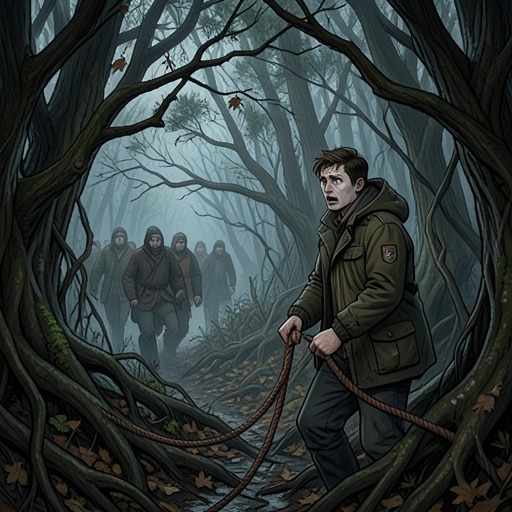
The location itself reveals the gang’s physical reach. From a hillside, Jack Parker sees a clearing containing a crude flat-roofed cabin, a greasy stovepipe, a fresh logging road, and a rough corral holding twelve horses. The road has recently been widened from a mere animal trail, suggesting that the forest is being rapidly reorganized for human extraction and movement. A black bear is tied to a tree by a heavy logging rope, with roughly twenty feet of range. The scene joins the gang’s violence to the transformation of the land: the camp occupies a newly cut space, and the animal has been converted into both captive spectacle and potential weapon.
The Opening Distraction
Shorty creates the assault’s crucial opening by crawling down the hill and reaching the tree without being seen. He cuts the rope binding the black bear, but the bear does not immediately understand that it is free. The delay allows the distraction to become more dangerous. Skinny, one of the gang members, grows increasingly bold, teasing the animal with a stick and imitating chicken wings while the others laugh. His performance recalls the earlier chicken fight in which men fastened metal claws to roosters and made them fight for money; in both scenes, spectators turn animal suffering into entertainment.
The reversal comes when the bear lunges after the rope no longer restrains it. Skinny discovers too late that the animal can move faster than he can escape. The bear rises, growls, and strikes him across the head, sending him reeling into the fire. His hair and head catch fire while Cut Throat Bill, Nigger Pete, Fatty Worth, and the other gang members laugh at his death before recognizing that the bear is now running toward them. Their guns come out, but their shooting fails to stop it. The gang’s treatment of the bear has produced the very force that breaks the camp’s order, turning cruelty into an instrument of reprisal without making the violence itself morally clean.
The Firefight and Rescue
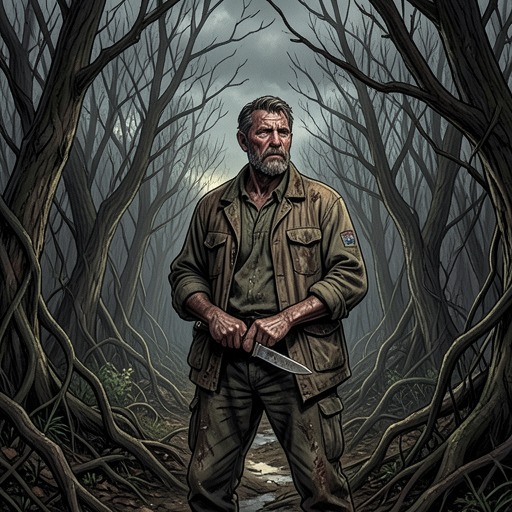
The bear’s charge gives Jack Parker and his companions the approach they need. Jack Parker orders Eustace Cox downhill with the four-gauge shotgun, and Eustace rises without attempting to hide, carrying the massive weapon like a decisive emblem of force. The commotion draws everyone from the cabin, including two previously unseen, heavily built men who appear to be twins. Their arrival enlarges the danger just as the rescuers become visible, making the attack a rapidly multiplying confrontation rather than a controlled rescue.
Lula Parker appears through the cabin door as the shooting begins. Her clothing has become ragged, her hair is pinned with a pointed stick, and she looks thin, haggard, and older than Jack Parker remembers. She does not recognize him at first; seeing only an armed man, she darts back inside, with Fatty Worth rushing after her. Her appearance makes the rescue’s human stakes immediate. The objective is not simply to defeat Cut Throat Bill’s gang but to reach a sister whose captivity has altered her body and appearance and has disrupted recognition itself.
The gunfire spreads across the clearing. The twins exchange shots with Jack Parker; after six shots from them and four from him, neither side is hit, although bullets pass close enough to create an involuntary bond between opponents. Eustace Cox fires his pistol at Cut Throat Bill while retaining the shotgun, and Jack Parker is knocked down when a stray bullet clips the heel from his right boot. The accident saves him from a subsequent shot by Nigger Pete that would otherwise have struck his head. The battle’s survival logic is therefore repeatedly governed by chance, damaged equipment, and sudden shifts in position rather than by clean heroic control.
Shorty’s marksmanship changes the balance. After Nigger Pete is wounded and fires unsuccessfully at him, Shorty reloads the Sharps and hits Nigger Pete in the chest with a shot powerful enough to kill a buffalo. Nigger Pete remains standing and rushes Shorty, forcing Shorty to abandon the long rifle and fire three pistol shots at close range. Even then Nigger Pete continues around the cabin, and Shorty pursues him. At the rear of the cabin, Nigger Pete realizes that he has been shot by a man he contemptuously identifies as a midget. Shorty finally uses the small pistol concealed in his boot to shoot Nigger Pete in the head, ending the pursuit.
The assault also exposes Eustace Cox’s unstable relationship with violence and alcohol. He has previously been described as an excellent tracker whose confidence can lead him toward drinking, after which he becomes dangerous and difficult to control; Shorty therefore keeps Eustace’s four-gauge shotgun and limits his access to money. During the shootout, Eustace is shot in the shoulder and is struck twice more, while the liquor eventually catches up with him and he collapses as he tries to reload. His courage is undeniable, but so is the physical and psychological cost of turning him loose in the middle of a battle. The weapon that makes him formidable also makes his loss of control consequential.
Consequences and Aftermath
The bear’s escape and the rescuers’ attack dismantle the gang’s concentration of power. The animal races through the camp and down the logging road, dragging the severed rope behind it, while the gang fires without effect. Behind that moving catastrophe, Shorty kills Nigger Pete, Eustace Cox engages the men near the cabin, and Jack Parker struggles to keep his empty or poorly suited weapons from becoming liabilities. The camp’s apparent security dissolves into separated pockets of combat, with combatants unable to distinguish one threat from another and even members of the gang firing across one another.
Jack Parker’s four-gauge creates a final moral and tactical danger. As he moves along the cabin wall, he realizes that firing the weapon through the building might kill not only the gang members inside but Lula Parker as well. The rescue cannot be completed by indiscriminate force; Lula Parker’s presence turns every shot into a possible act of kinship transformed into accidental murder. Before Jack Parker must decide whether to risk the blast, a previously unseen hopping man emerges from the doorway, and Jimmie Sue shoots him in the side of the head with a Winchester from behind a dead horse. She then calls out triumphantly and disappears back into cover, adding another intervention to the battle’s chain of reversals.
The shootout’s immediate result is the opening of the cabin and the collapse of the gang’s control over its prisoners, but its deeper consequence is a redefinition of rescue. The rescuers win not through a single superior plan but through coordinated improvisation: Shorty frees the bear and supplies long-range fire, Eustace Cox advances with the four-gauge, Jack Parker presses toward Lula Parker despite limited shooting skill, and Jimmie Sue intervenes at the moment a new attacker appears. The gang’s own methods—captivity, spectacle, torture, and contempt for vulnerable bodies—return as the conditions of its defeat.
Narrative Significance
The episode brings together several recurring structures of the story: the rescue quest, the pursuit of outlaw violence, the precarious dignity of marginalized people, and the unstable boundary between human and animal life. Spot’s torture beside the fire and the bear’s confinement establish a hierarchy in which bodies are made available for another group’s amusement or profit. Yet the same animal that has been reduced to camp property becomes an active agent in the gang’s destruction. The event does not sentimentalize the bear; its agency is dangerous, unpredictable, and inseparable from the violence imposed upon it.
The battle also complicates the language of heroism. Earlier, the colored man who becomes Eustace Cox rejects the romantic legends surrounding Cut Throat Bill and insists that there are no heroes. The shootout supports that judgment. Cut Throat Bill’s men laugh at Skinny’s death, fire wildly at the bear, and turn on one another amid the confusion. The rescuers are braver but not untouched by brutality: Shorty kills Nigger Pete at close range, Eustace Cox advances while intoxicated and wounded, and Jack Parker must contemplate a blast that could kill his sister. The scene’s decisive value shift is from captivity to escape, but the route to freedom passes through injury, death, and moral contamination rather than clean triumph.
Finally, Lula Parker’s damaged appearance and failure to recognize Jack Parker make the rescue a crisis of identity as well as a military action. Family cannot be restored simply by locating the captive; captivity has changed what recognition requires. The camp shootout ends the gang’s immediate domination, but it cannot erase what the gang has done to Lula Parker, Spot, Eustace Cox, or the rescuers themselves. Its significance lies in that double movement: a violent victory that makes reunion possible, and an exposure of the frontier world in which liberation is achieved only by entering the same economy of force that produced the captivity.