Bobby O'Dell lynching
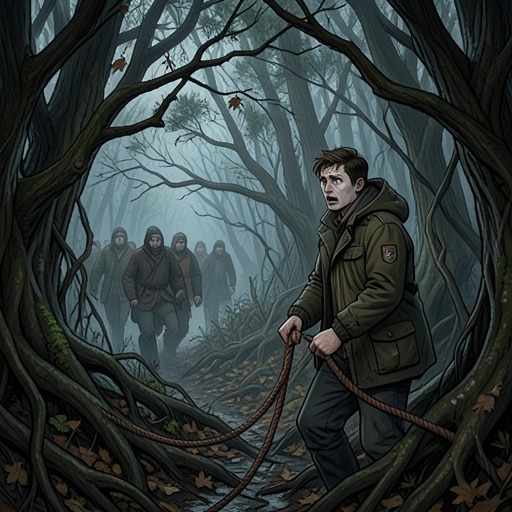
The ThicketBobby O'Dell lynching is the book’s starkest demonstration of justice becoming mob power. After a prisoner is held in a damaged sheriff’s office, a crowd takes control of the jail, carries Bobby O'Dell into the street, and strangles him from an electric-light pole before continuing to assault his body. The episode exposes how quickly legal authority can be displaced by public cruelty, and how a community can convert a human death into entertainment, participation, and moral evasion.
Collapse of Legal Authority
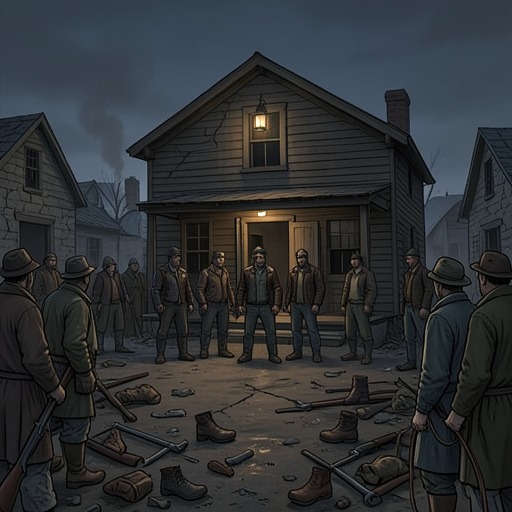
The lynching occurs in the wake of wider disorder. The sheriff’s office is already compromised: the door stands open, Sheriff Winton is not present, a fellow is emptying a desk drawer, and Bobby O'Dell sits in the rear cell with a blood-soaked rag around his head, a splinted leg, and a face blackened by beating. The setting makes the jail look less like a functioning institution than a room awaiting occupation. When a group of men fills the doorway, its leader announces that stopping them is pointless because their minds are made up. Deke, who says he has removed himself from law enforcement, picks up the hat containing the office’s small belongings and walks away, leaving the crowd to decide what happens next.
That withdrawal is the event’s first decisive turn. The men do not merely evade the law; they appropriate its visible instruments. One takes the cell key from the desk, opens Bobby O'Dell’s cell, and leads him out while the crowd watches. The key, the jail, and the sheriff’s office remain physically present, but their authority has become empty. The scene therefore belongs to a broader pattern in which formal jurisdiction is repeatedly treated as negotiable: later, Shorty warns Sheriff Winton that Winton has no jurisdiction where the group is going, while other armed figures openly threaten violence behind a curtain. In this world, law survives as language and props, whereas force determines who may act.
The Public Killing
Bobby O'Dell is terrified and physically impaired, yet the crowd pulls him into the street on his one splinted leg. He prays loudly for Jesus to save him and admits regret, but no rescue comes. He also asks that people understand his mother was not responsible for his wrongdoing. His words briefly preserve a distinction between individual guilt and inherited blame, but the crowd has no interest in hearing it. The men treat his fear and confession as obstacles to the procedure rather than reasons to halt it.
The execution is improvised around an electric-light pole at the edge of the street. Small metal bars make a ladder up its side, and a little man carrying a coiled rope climbs the pole like a squirrel. He throws the rope over a bar, drops it down, and watches the men below fasten a loop around Bobby O'Dell’s neck. When someone complains that the rope is too long, the climber adjusts it until the crowd is satisfied. The practical correction gives the killing a grotesque air of communal workmanship: the only person excluded from the group’s satisfaction is the man whose neck is in the noose.
Bobby O'Dell recognizes that the crowd is not preparing a proper hanging. When the rope-holder announces the next stage, Bobby objects that they are going to strangle him rather than hang him. The large man holding the rope accepts the correction with the words, “Now you got it,” and several men pull together. Bobby rises only about a foot before the rope is wrapped around the pole and tied. It slips, lowering him until his toes nearly touch the ground, but the arrangement is not corrected to spare him. Instead, he kicks desperately for leverage; one boot flies into the crowd and strikes a young boy in the chest.
The boy interprets the accidental impact as an attack, rushes forward, and hits Bobby O'Dell weakly in the chest before retreating. Bobby attempts to kick him again, and the narrator finds himself wishing that the kick had connected. This fleeting response does not cleanse the scene, but it establishes a moral contrast between the condemned man’s ferocious struggle for survival and the crowd’s casual participation. Even a child is drawn into the violence, first through accident and then through imitation.
Violence After Death
The killing does not end when Bobby O'Dell becomes still. As he spins around the pole like a piñata, men approach almost in turn to hit him. Others throw dirt clods, and insults continue without pause. His tongue protrudes grotesquely, his body performs a final shimmy, and then he goes still; nevertheless, the men keep striking him. The repeated blows transform execution into degradation. Death is not treated as the boundary of punishment but as permission to continue without resistance.
The crowd’s cruelty is also organized as a social ritual. One man manages the rope, another climbs, another ties Bobby’s hands, others pull, throw dirt, or strike him, and spectators comment on the process. The division of labor disperses responsibility across many bodies. No single participant has to represent the whole act, because the whole crowd continually confirms it. The result is a collective performance in which violence claims legitimacy from its number of witnesses rather than from a judgment, evidence, or lawful procedure.
When the narrator protests that Bobby has been hanged enough, the man in church clothes replies, “It wasn’t your money, I figure.” The remark reduces the moral question to ownership and cost. It is an answer designed to make brutality sound like someone else’s business, even as the speaker and the crowd have made Bobby’s death public. Immediately afterward, someone strikes the narrator from behind. He falls, tastes dirt, sees boots approaching, and loses consciousness. The crowd thus suppresses not only the condemned man but also the witness who tries to name the excess.
Narrative and Historical Significance
The scene’s force comes partly from its position within a landscape already shaped by emergency and abandonment. During the Hinge Gate epidemic, Sheriff Gaston had placed signs on the roads to stop movement in both directions, while bodies were piled outside houses, hurriedly buried, or burned when identities were unknown. That earlier crisis shows a community suspending ordinary movement for collective survival; the lynching shows a different suspension of rules, one in which the crowd claims the right to decide who may live and how a prisoner must die. Both episodes reveal institutions acting under pressure, but the lynching turns exceptional conditions into personal vengeance.
The event also gives historical depth to the book’s racial order. Eustace Cox explains that his family history joins white and Black ancestry through sexual violence during the era of slavery, and that his colored and Comanche mother was compelled by a Cox man. Elsewhere, a family memory recounts an enslaved child being sold away from his parents as cheaply as a piglet separated from its mother. These memories do not identify Bobby O'Dell’s offense or excuse the crowd’s action, but they establish a society in which bodies have long been bought, separated, disciplined, and treated as property. The lynching repeats that logic in a public form: Bobby is handled, displayed, and physically controlled as though his body belongs to those who have seized it.
The episode’s violence is sharpened by the contrast between its improvised authority and the characters who understand the dangers of force. Shorty keeps Eustace Cox’s four-gauge shotgun because Eustace’s anger, racial humiliation, and alcohol dependence can make a firearm catastrophic; Shorty describes both his own dwarfism and Eustace’s race as burdens imposed by other people. That guarded use of weapons differs from the mob’s conduct. The crowd does not restrain its power to prevent harm. It gathers power precisely to make harm unquestionable.
For the narrator, Bobby O'Dell’s death becomes inseparable from other memories of violence, including the shooting of his grandfather and the storm that follows him through memory. He begins as a curious observer who follows the prisoner into the street, but he ends the episode as a battered witness, pushed to the ground for objecting. The event therefore changes the value of public order from assumed protection to exposed danger. Its lasting significance is not only that Bobby O'Dell dies, but that everyone around him—including the men who claim to punish him, the child who joins in, and the witness who is silenced—must reveal what happens when law is replaced by the crowd’s appetite for punishment.