Quarantine
The ThicketQuarantine is the emergency condition imposed on Hinge Gate during the smallpox epidemic, and it is one of the novel’s decisive forces rather than a mere background detail. It begins as a public-health response to mass death, but its boundaries also isolate survivors, obstruct legal protection, redirect property and money, and expose how quickly authority becomes improvised, coercive, or absent. The condition turns geography into law: roads become barriers, guarded entrances replace ordinary civic circulation, and the difference between being inside and outside the town can determine whether a person receives help, punishment, or neither.
Definition and Imposition
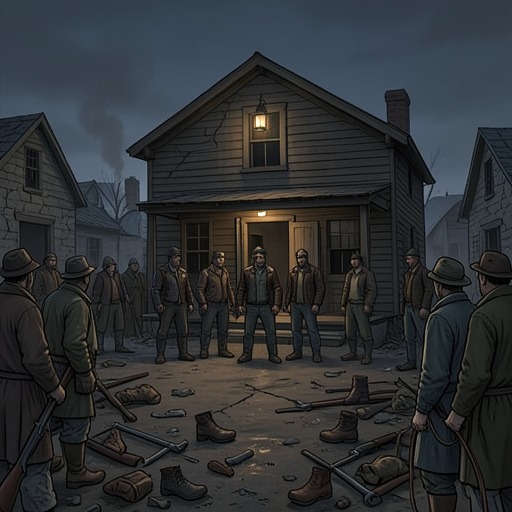
Quarantine arises after smallpox spreads through Hinge Gate with such force that the outbreak is called an epidemic. Dead people are piled outside houses, carried away in wagons, buried hastily, or burned when their identities and destinations are unknown. In response, Sheriff Gaston places signs on the roads entering town that prohibit residents from leaving and outsiders from coming in. The signs therefore announce two related rules: movement outward is treated as a danger to other communities, while movement inward is treated as a danger to Hinge Gate’s remaining inhabitants.
The quarantine is accompanied by armed enforcement. Guards stand at both ends of Hinge Gate, making the town physically difficult to enter or leave even for someone seeking the law. The system is presented as necessary because the disease moves through ordinary contact and travel, but the narrative also emphasizes its disorderly circumstances. Smoke pots burned around houses do not stop the disease; they merely fill the air with smoke and make breathing harder for those already infected. The community responds to catastrophe with visible measures, yet those measures cannot restore control over death or uncertainty.
Effects on the Parker Family
The epidemic destroys Jack Parker’s immediate family. His mother and father die despite having never previously been sick, while Jack and Lula Parker, both exposed within the household, survive. Their survival does not return them to ordinary life. They have to watch their parents die without being able to touch them for fear of infection, so quarantine transforms familial care into enforced distance at the moment when care matters most.
The disease also reshapes the family’s economic future. Old Caleb Parker anticipates the confusion caused by the outbreak and moves the land contracts away from the local bank to the bank at Sylvester, a town not under the same quarantine. He arranges for the lawyer Cowton Little to sell the family properties for a fair price, subtracting his commission and sending the proceeds to the siblings. This plan treats quarantine not only as a medical emergency but as a disruption of property, banking, legal communication, and inheritance. Jack and Lula’s future depends on transactions conducted beyond the sealed town and, potentially, by mail.
Old Caleb Parker’s plan to send the siblings to Tessle’s household is likewise shaped by the emergency. He intends to arrive later so that his presence will not overwhelm the arrangement, but the proposed surprise reflects the limited choices available to survivors. Quarantine has removed their parents, disrupted their home, and made family relocation part of the disease’s aftermath. It produces displacement even for those whom smallpox has not physically infected.
Barriers to Justice and Movement
For Jack Parker, quarantine immediately becomes a barrier to justice. After reaching the region, he recognizes that there is no use going into Hinge Gate to seek the law because the armed guards at both ends of the town prevent ordinary access. He therefore asks a passing man to take him to Sylvester, even though Sylvester is farther away, because it is not quarantined. The journey is not chosen for convenience; it is forced by the unequal distribution of legal access created by the epidemic.
That detour brings Jack into a damaged and unstable civic world. At the sheriff’s office, the door stands open, Sheriff Winton is absent, a young man is emptying a desk drawer, and a badly beaten prisoner occupies the jail cell with a blood-soaked head bandage, a splinted leg, and a face covered in bruises. The quarantine does not itself cause every act of violence in this scene, but it helps explain why the ordinary machinery of law appears so exposed and unreliable. The office remains a symbol of authority while its records, personnel, and prisoners are already caught in disorder.
The same exceptional atmosphere permits punishment outside regular legal procedure. Bobby O’Dell is dragged into the street and lynched before a crowd, with a rope fastened to an electric-light pole by a small man who climbs it like a squirrel. The public execution demonstrates that the town’s boundaries have not preserved a stable rule of law; instead, fear and collective judgment can occupy the space where legal process should be. Quarantine suspends normal movement, but the wider crisis also allows authority to fragment among guards, crowds, bounty hunters, and armed individuals.
Expansion into a Wider State of Exception
The quarantine’s logic echoes later scenes in which formal jurisdiction is openly contested. Shorty objects that Sheriff Winton has no jurisdiction where the group is going, while Winton dismisses the objection as practically irrelevant. The exchange shows a frontier order in which legal authority can travel with a badge or a gun even when its recognized territory ends. Quarantine is an early and literal example of this unstable sovereignty: the town declares exceptional boundaries for public safety, and other characters later exploit similarly uncertain boundaries for pursuit, detention, or violence.
The epidemic also belongs to a larger history of communities being defined through exclusion. In Sheriff Winton’s remembered account of the Comanche attack on his North Texas homestead, settlers continue moving into land the Comanche regard as their own, while the Comanche push back through raids, livestock slaughter, abduction, and torture. The story-within-the-story complicates any simple opposition between lawful settlement and lawless wilderness. North Texas is described as one of the Comanche’s haunts, and the settlement itself is an intrusion into a contested space. Like quarantine, the frontier boundary claims to organize danger, but it also reveals who is permitted to remain, who is driven out, and whose violence is later classified as legitimate.
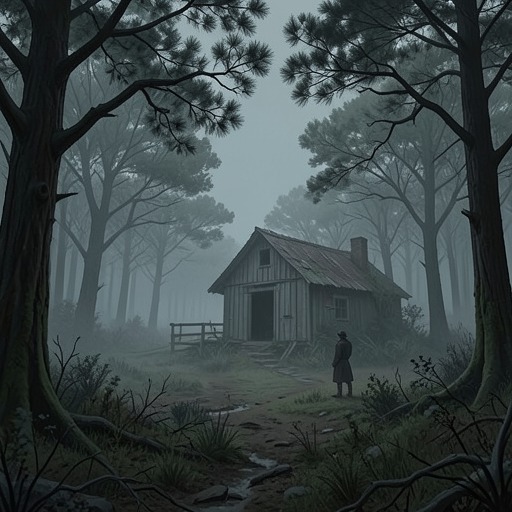
The same pattern continues through the Big Thicket. Jack Parker and his companions search for Fatty Worth with little reliable information: directions are guesses, the possible camp lies beyond a sawmill, and the woods contain many sawmills. The landscape is not empty or ungoverned in any simple sense. Colored workers cut timber under a white sawmill operator, roads carry overlapping traces, and industrial machinery breaks into the forest. Later, oil is discovered on land divided between Eustace Cox and Shorty, altering the value of their property while they choose to preserve most of it as trees and farmland. These developments show emergency boundaries giving way to commercial and territorial reorganization rather than to a return to an untouched normality.
Aftermath and Reversal
Quarantine eventually ends in practical terms. Hinge Gate is later described as far beyond smallpox, and the town can again host ordinary civic acts such as the courthouse marriage of Shorty and Lula Parker. The end of the epidemic therefore permits movement, legal administration, and renewed social connection. Yet the condition leaves permanent marks: Jack associates smallpox with the place where his parents are buried and rebuilds away from the old house, fearing that the disease might somehow rise from the ground and find him.
The final reversal is that the land protected and reorganized during the crisis becomes valuable through oil. The property Eustace Cox and Shorty divide produces a well directly on their boundary, bringing substantial money even though they allow only that one well because they prefer to retain the land’s trees and farmland. Quarantine begins as a regime of restricted circulation and ends in a transformed economic landscape. Its most lasting effect is not simply that it once closed Hinge Gate, but that it changes where the survivors live, how they handle property, whom they trust, and what kind of future can be built after catastrophe.